Camarilla
 By LuxAlgoMar 21, 2026
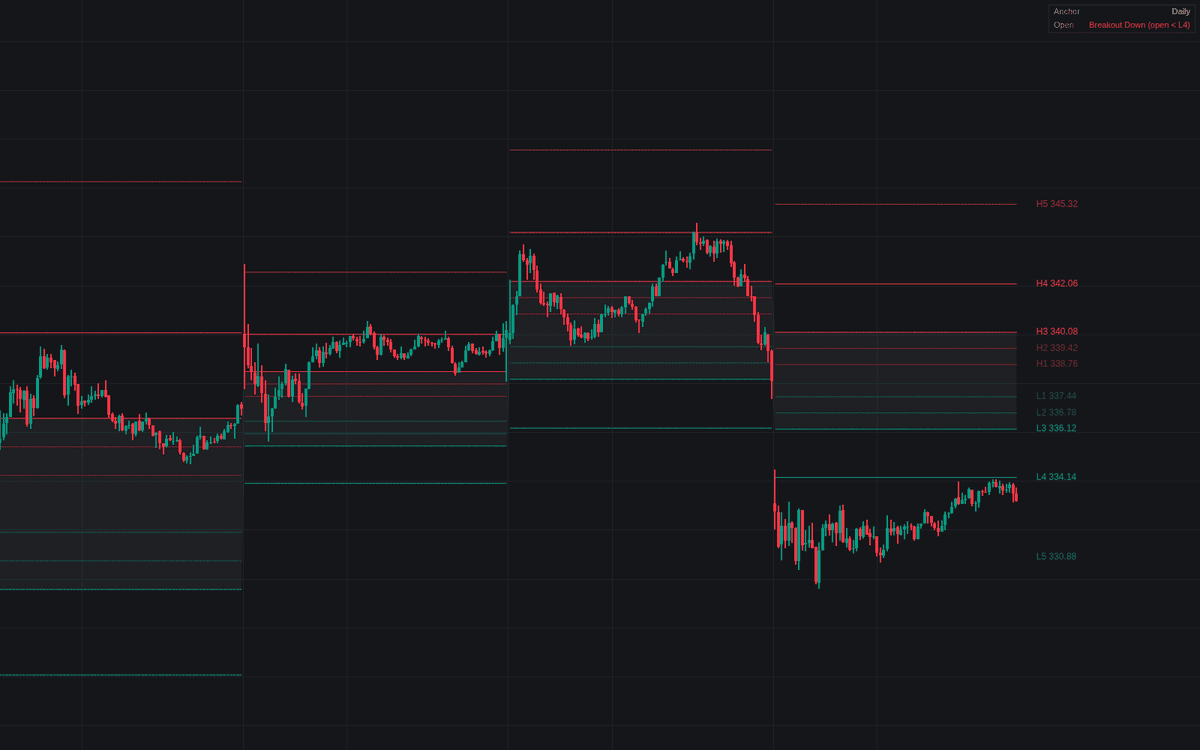

Camarilla converts the prior period's high, low, and close into a ladder of session levels arranged around that close: four resistance rungs (H1-H4) above, four supports (L1-L4) below, each spaced from it by a set fraction of the prior range times the 1.1 factor, plus the H5/L5 extensions. Built as the definitive clean implementation of the Camarilla equation, it shades the rotation band between L3 and H3, labels every rung, and classifies each session by where it opened inside the ladder.
How to Trade the Camarilla?
- H3 / L3 tests: the reversion rungs. The classic play fades a push into H3 or L3 while the session keeps trading inside the band between them.
- H4 / L4 breaks: the breakout rungs. A close beyond level 4 marks a potential trend day, with H5 or L5 as the running target.
- False-break warnings: price re-entering the ladder after breaking a level 4 is the standard trap tell, and both sides carry dedicated alerts.
- Open location: the day-type panel reads the open (inside the L3-H3 band it leans rotation, beyond a level 4 rung continuation) so the playbook is chosen before the first trade.
Camarilla Settings
- Anchor Period (default Daily): the prior period supplying the high, low, and close; Weekly and Monthly run the identical construction on larger bars. Keep the chart timeframe below the anchor.
- H1 / L1, H2 / L2, H3 / L3, H4 / L4, H5 / L5 (all default on): visibility per rung pair. H5 uses the common variant (H / L) x C; L5 mirrors that offset beneath the close.
- Rotation Band Fill (default on): shading between L3 and H3.
- Line Width (default 1) and Level Labels (default on): rung name and price shown at the right of the current ladder.
- Day-Type Panel (default on) with position and text-size options, plus the resistance and support colors.
Frequently Asked Questions

Original indicatorBuilt in-house by LuxAlgo
The Library is free. Quant makes it yours.
Pull any concept or indicator into Quant: rebuild it, retune it, or turn it into a backtested strategy of your own.