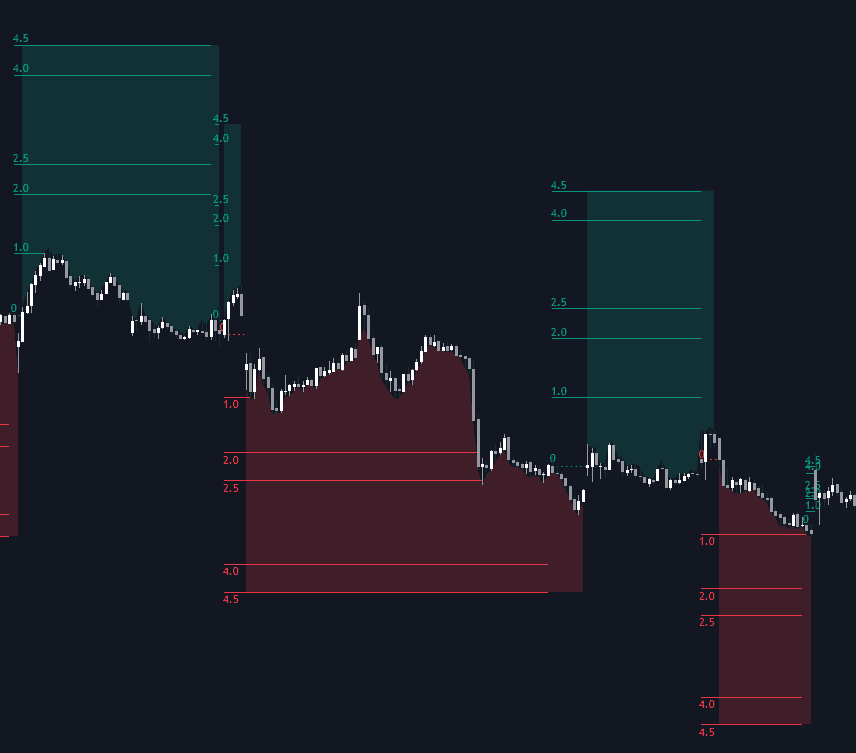
CISD Projections
Jan 7, 2026

The CISD Projections trading indicator is a mechanical, rules-based tool designed to plot objective price targets after a confirmed market reversal. Built around fractal market structure and manipulation leg analysis, this trading indicator helps traders anticipate where price is statistically most likely to expand next. Instead of relying on subjective take-profit levels, CISD Projections delivers clear, repeatable targets that adapt to volatility, leg size, and current market conditions, making it a powerful addition to any trading strategy.
By combining Change in State of Delivery (CISD) logic with extended Fibonacci projections, this indicator translates market structure into actionable price objectives. It is suitable for discretionary traders seeking confirmation and for systematic traders looking for consistent, mechanical target generation across any market or timeframe.
How to Trade the CISD Projections Trading Indicator
CISD Projections derive their targets from the manipulation leg that precedes a confirmed CISD. Once a reversal is validated, the indicator measures the swing responsible for the shift in delivery and applies predefined Fibonacci expansion levels to project realistic continuation targets.
These projections are not predictive guesses. They are calculated levels based on how price historically expands following manipulation and reversal, making them especially useful for defining take-profit zones, scaling out positions, or setting realistic expectations for trade continuation.
The trading indicator follows a simple and transparent process:
- 1. Detect the CISD reversal bar that confirms a shift in market delivery.
- 2. Identify the manipulation leg, defined as the swing that caused the reversal.
- 3. Project mechanical targets by anchoring extended Fibonacci levels (1, 2, 2.5, 4, 4.5) to the manipulation leg.
Each projection level represents a different expansion scenario based on swing magnitude and market participation.
How to Interpret CISD Projection Targets
Correct interpretation of CISD Projections depends on contextual analysis rather than blindly targeting the furthest level. The size of the manipulation leg and current volatility regime play a critical role in determining which projections are most realistic.
General guidelines include:
- Average-sized manipulation legs often reach the 2 to 2.5 projection levels.
- Expanding or momentum-driven legs can extend toward 4 to 4.5.
- Exceptionally large manipulation legs may justify conservative targets, often focusing on the 1 projection level.
Traders should continuously evaluate market conditions by asking key questions:
Is volatility expanding or contracting? Is the current manipulation leg larger or smaller than previous ones? Is price reacting efficiently to projected levels?
By doing so, CISD Projections become a contextual trading strategy component rather than a rigid take-profit tool.
Ultimately, this trading indicator provides objective price targets grounded in measured swing behavior. It can be used as a standalone targeting tool or combined with liquidity zones, CISD levels, and higher-timeframe structure to refine trade management and expectations.
Filtering CISD Projection Setups
CISD Projections include multiple filtering options to help traders control signal quality and focus on higher-probability setups. These filters allow the indicator to adapt to different trading styles, from aggressive intraday execution to conservative swing trading.
Available filters include:
- Bars Threshold: Displays only setups where the manipulation leg meets a minimum number of bars, filtering out weak or insignificant swings.
- CISD Filter: Restricts projections to CISDs forming near the top or bottom of the price range over the last X bars.
- Invalidate CISDs on CHoCH: Stops projection expansion after the first close beyond the manipulation leg, preventing invalid targets after a structural break.
Higher filter values typically produce fewer but more meaningful setups, while disabling filters allows traders to study micro-structure and internal market behavior.
CISD Projections Trading Indicator Settings
The settings panel gives full control over how setups, projections, and visuals are displayed, allowing the trading indicator to align with any trading strategy or market environment.
- Bars Threshold: Defines the minimum number of bars required for a valid manipulation leg.
- CISD Filter: Enables range-based filtering and sets the lookback length.
- Invalidate CISDs on CHoCH: Stops projection extension after a structural break against the CISD direction.
Projections
- Enable or disable individual projection levels.
- Select which Fibonacci expansion ratios to display.
- Customize line style for each projection.
Style
- CISD Level: Toggle the CISD price level and adjust its style.
- Label Size: Control the visibility and readability of projection labels.
- Bullish Color: Set colors for bullish projection setups.
- Bearish Color: Set colors for bearish projection setups.
- Background Fill: Enable or disable the fill between price and the furthest projection level.
FAQ
What is the CISD Projections trading indicator used for?
CISD Projections are used to define mechanical, statistically informed price targets after a confirmed reversal, helping traders manage exits and expectations more objectively.
Can CISD Projections be used as a trading strategy?
Yes. While often used for trade management and targeting, CISD Projections can also serve as a standalone trading strategy component when combined with CISD confirmation and structure-based entries.
How do I access the CISD Projections indicator?
You can get access on the LuxAlgo Library for charting platforms like TradingView, MetaTrader (MT4/MT5), and NinjaTrader for free.
Trading & investing are risky and many will lose money in connection with trading and investing activities. All content on this site is not intended to, and should not be, construed as financial advice. Decisions to buy, sell, hold or trade in securities, commodities and other investments involve risk and are best made based on the advice of qualified financial professionals. Past performance does not guarantee future results.
Hypothetical or Simulated performance results have certain limitations. Unlike an actual performance record, simulated results do not represent actual trading. Also, since the trades have not been executed, the results may have under-or-over compensated for the impact, if any, of certain market factors, including, but not limited to, lack of liquidity. Simulated trading programs in general are designed with the benefit of hindsight, and are based on historical information. No representation is being made that any account will or is likely to achieve profit or losses similar to those shown.
Testimonials appearing on this website may not be representative of other clients or customers and is not a guarantee of future performance or success.
As a provider of technical analysis tools and strategies, we do not have access to the personal trading accounts or brokerage statements of our customers. As a result, we have no reason to believe our customers perform better or worse than traders as a whole based on any content, tool, or platform feature we provide.
Charts used on this site are by TradingView in which the majority of our technical indicators are built on. TradingView® is a registered trademark of TradingView, Inc. www.TradingView.comTradingView® has no affiliation with the owner, developer, or provider of the Services described herein.
Market data is provided by CBOE, CME Group, BarChart, CoinAPI. CBOE BZX real-time US equities data is licensed from CBOE and provided through BarChart. Real-time futures data is licensed from CME Group and provided through BarChart. Select cryptocurrency data, including major coins, is provided through CoinAPI. All data is provided “as is” and should be verified independently for trading purposes.
This does not represent our full Disclaimer. Please read our full disclaimer.
© 2026 LuxAlgo Global, LLC.