Concept
Change in State of Delivery
Change in State of Delivery, also known as CISD, is a Smart Money Concepts / ICT concept. The Library holds 3 implementations, each one a working definition you can pull into Quant.
Top Change in State of Delivery indicators
The top custom implementations, built on the original standard Change in State of Delivery formula.
3 total
From studying Change in State of Delivery to trading it: take any implementation below into Quant and backtest it instantly.
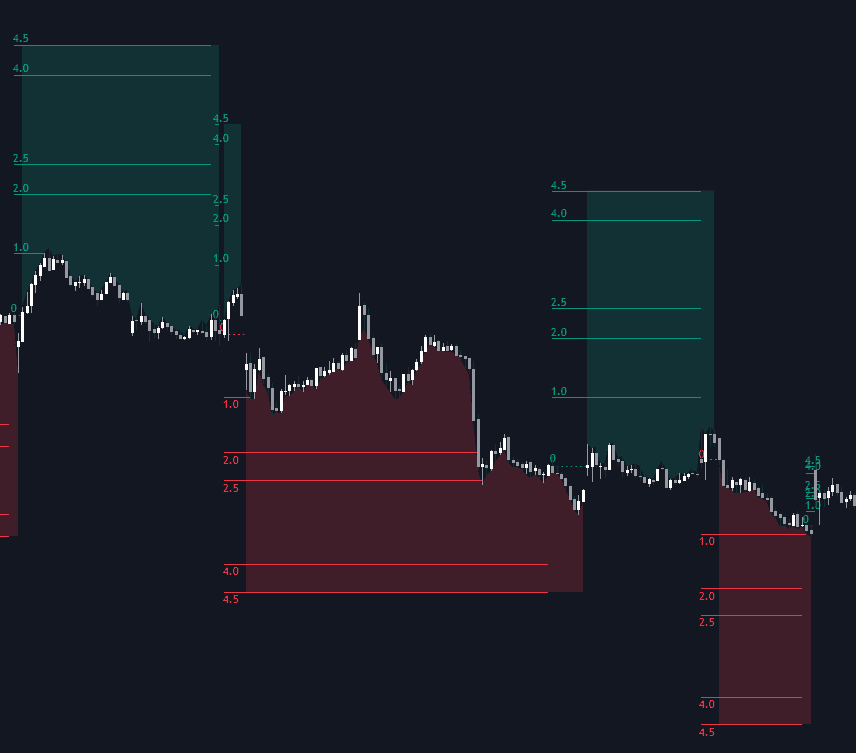
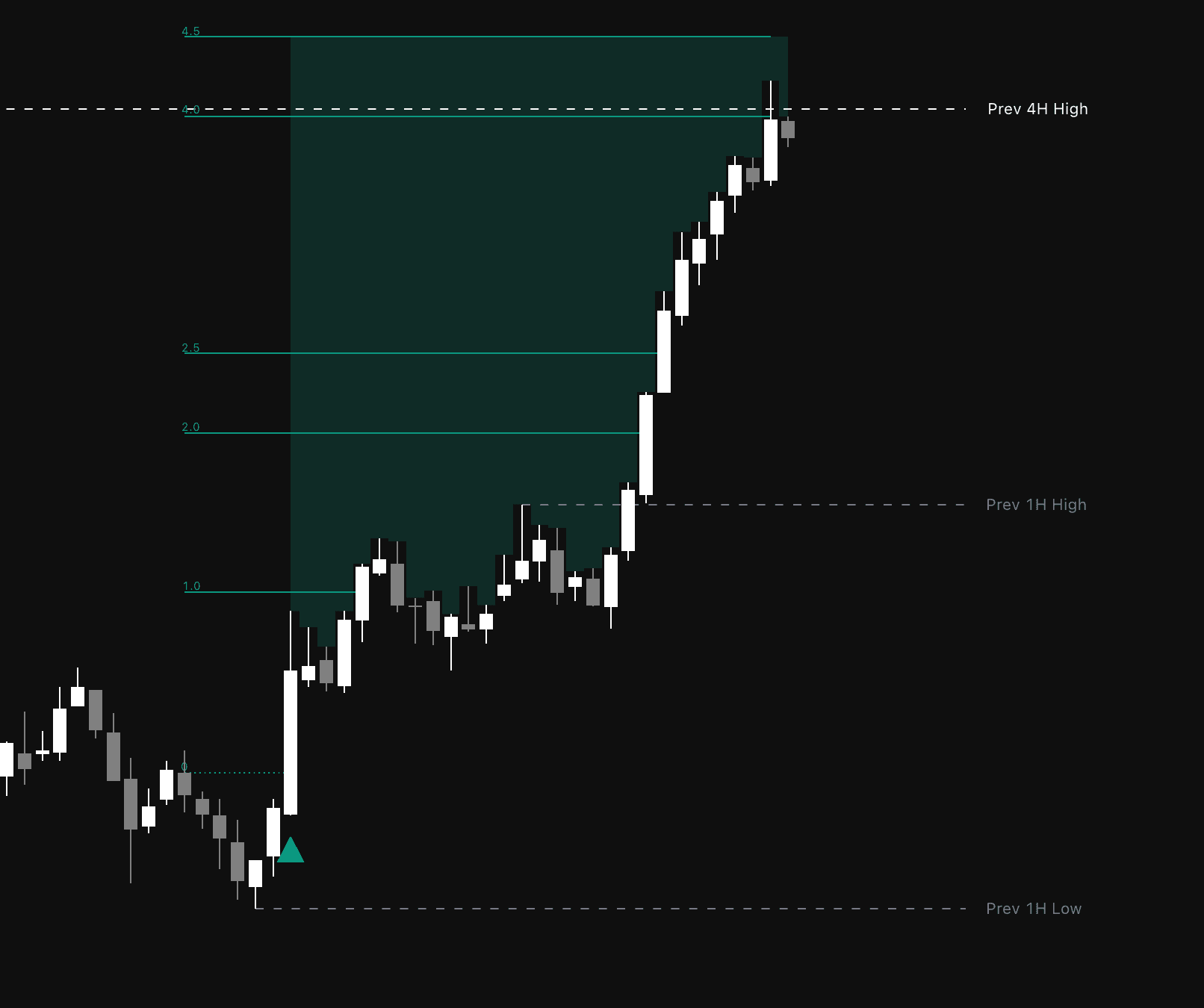
What is a Change in State of Delivery?
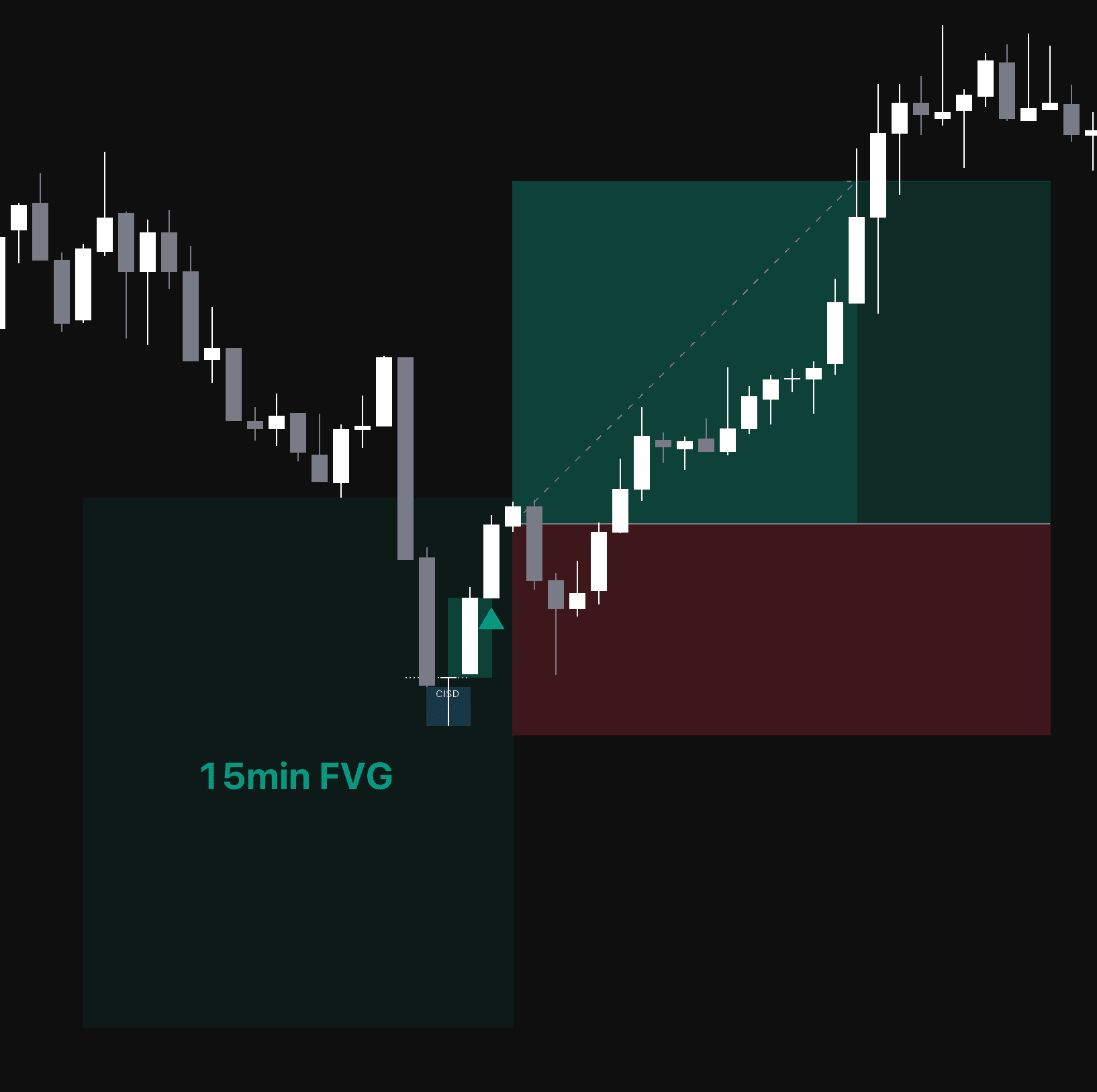
A change in the state of delivery (CISD) is ICT's body-close test for the moment price flips from being delivered in one direction to the other. While a leg sells off, down-closing candles are doing the delivering; when (typically after a liquidity sweep of a low) a candle body closes back above the opening price of the final consecutive series of those down-closing candles, the state of delivery is said to have changed from sell-side to buy-side. The mirror applies at highs. The defining detail is bodies and opens: a wick through the level does not count, only a close through it.
The term belongs to the ICT (Inner Circle Trader) lexicon and rose to prominence in the community's later teaching cycles, where it increasingly serves as the entry trigger inside sweep-and-reverse models. In that role it sits at a specific point in the sequence: engineered liquidity is taken first, often at a session extreme inside a favored time window, and the CISD close is the first objective evidence that the taking is finished and delivery has turned.
Usage is not perfectly standardized across the community. The common operational reading marks the CISD level at the opening price of the first candle in the last unbroken run of down-closing (or up-closing) candles into the extreme, with confirmation on a full body close through that level. Because the trigger lives in candle anatomy rather than at a prior swing point, a CISD usually confirms earlier than a structure break: earlier, but less filtered, which is why most models also demand convincing displacement and higher-timeframe context rather than trading every flip.
What makes the concept useful beyond its speed is that it timestamps the reversal leg itself. The candles that deliver the CISD close often leave a fair value gap behind, giving the model a defined retracement entry, and the leg's origin gives an anchor for projections. Within the broader accumulation-manipulation-distribution frame, the CISD is the hinge between the manipulation phase and the distribution phase: the moment the engineered move gives way to the intended one.
How to identify a Change in State of Delivery
The bullish case after a swept low is described; mirror every step for the bearish case at highs.
- 1Start with context: an engineered move into liquidity, such as a sweep of an obvious low or a liquidity pool, ideally during a favored window like the London or New York killzones.
- 2Find the last unbroken series of down-closing candles running into the extreme; ignore any up-closing candles earlier in the leg.
- 3Mark the opening price of the first candle in that series; that open is the CISD level.
- 4Wait for a candle body to close fully above the level. Wicks through it do not qualify, and a body close is what separates the signal from a stop-run.
- 5Grade the quality: a close delivered with displacement that leaves a fair value gap carries more weight than a drift through the level.
- 6Plan the entry on the retracement, commonly at the CISD level itself, the gap left behind, or an optimal trade entry pullback of the reversal leg.
How traders use it
- As the confirmation step in sweep-and-reverse models: liquidity is run first, the CISD close prints second, and the entry is usually taken on the retracement back to the CISD level or into a gap left by the reversal leg.
- As an anchor for targets: the leg that produced the CISD can be projected in standard-deviation multiples to frame how far the new delivery direction might carry.
- As a wick filter: because the rule demands body closes, CISD-based triggers ignore the sweep wicks and momentary pokes through the level that would trip a simple level-break alert.
- As a time-gated trigger: many models only honor CISDs that print inside specific windows, using ICT time anchors and killzones to separate engineered turns from random noise.
- As a phase marker: within an accumulation-manipulation-distribution read of a session, the CISD is taken as the transition out of manipulation, telling the trader which side of the day's session ranges to trade from.
CISD vs. structure breaks
Change of Character: A change of character keys off a prior swing point breaking against the prevailing structure; whether a wick through the swing counts or a body close is required is itself contested. A CISD needs no swing break: it closes through the opening price of the final delivery candles, so it typically fires earlier and closer to the extreme, at the cost of less confirmation.
Break of Structure: A break of structure is a with-trend event: the previous swing taken out in the direction already travelling. A CISD is counter-trend evidence that the current delivery has failed, and it is measured on candle bodies and opens rather than swing extremes.
Breaker Block: A breaker is a location: the failed order block that price reclaims after a sweep, later traded as support or resistance. The CISD is an event, the body close that confirms the reclaim, so the two often describe the same turn from different angles.
Concept family
Smart Money Concepts / ICT
54 concepts mapped · 54 in the Library
Change in State of Delivery FAQ
Turn Change in State of Delivery into a trading strategy.
Take any implementation from this page into Quant, then build on it, backtest it on real data, and keep refining it in conversation.