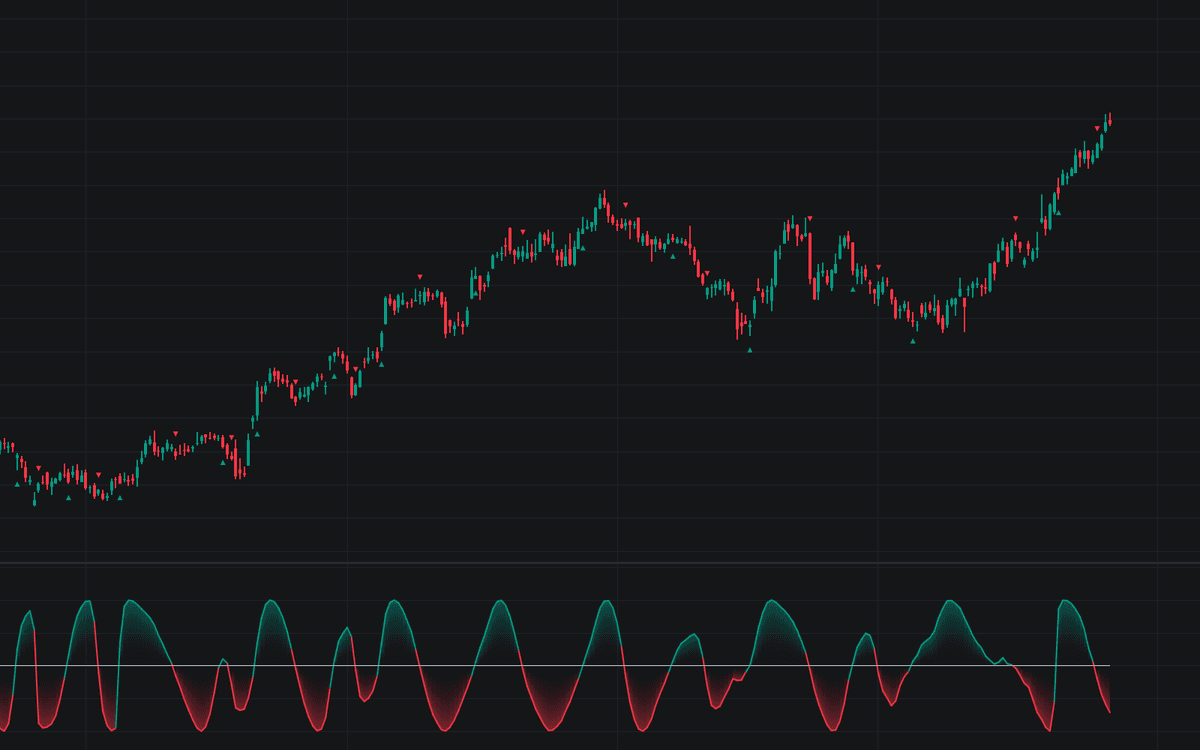
Correlated Sine Oscillator

Feb 17, 2026

Static chart image
Oscillators
Correlation
Cycle
Works on the following platforms:
tradingviewSymbolTradingView
For free use on the TradingView platform
ninjatraderNinjaTrader
For free use on the NinjaTrader platform
metatrader4MetaTrader 4/5
For free use on the MetaTrader 4/5 platform
thinkorswimThinkorswim
For free use on the Thinkorswim platform

The Correlated Sine Oscillator is an advanced trading indicator built to extract and visualize the dominant market cycle hidden within price action. By projecting price onto a dynamically phase-aligned sine wave, this oscillator delivers a clean, normalized output between -1 and 1—making it easier for traders to identify trend shifts, cyclical turning points, and momentum transitions in any market.

Unlike traditional oscillators that rely purely on momentum or overbought/oversold logic, the Correlated Sine Oscillator uses signal processing techniques to stay synchronized with price swings. The result is a responsive yet stable cycle-based trading tool that helps traders align entries and exits with the natural rhythm of the market.

How to Trade the Correlated Sine Oscillator?

The Correlated Sine Oscillator is designed to help traders visualize cyclical market structure. By mapping price action to a mathematically correlated sine wave, it reveals when the market is entering a rising phase, a falling phase, or approaching a potential turning point.

Because the oscillator is normalized between -1 and 1, traders can quickly interpret signals across any asset class—whether trading crypto, forex, indices, or equities.

Identifying Cycle Direction and Trading Signals

The oscillator fluctuates around a central zero line, which represents the midpoint of the detected market cycle.

  • Bullish Signals: When the oscillator crosses above the zero line, a bullish triangle (▲) appears below the price bar. This signals the beginning of an upward cycle phase and can be used as a long entry trigger within a broader trading strategy.
  • Bearish Signals: When the oscillator crosses below the zero line, a bearish triangle (▼) appears above the price bar. This signals the start of a downward cycle phase and can be used for short entries or exit signals.
  • Cycle Extremes: Values approaching +1 indicate the peak of the cycle, while values approaching -1 represent trough conditions. These extremes can be used to anticipate potential reversals or profit-taking zones.

Because signals are based on midline crossings rather than fixed overbought/oversold levels, the oscillator adapts better to trending environments compared to traditional RSI-style indicators.

Using Cycle Extremes for Timing Entries

Advanced traders can combine zero-line crosses with extreme readings:

  • Enter on zero-line cross and scale out near +1 or -1.
  • Fade extremes when the broader trend shows divergence.
  • Combine with price structure, volume analysis, or trend filters for higher-probability setups.

This flexibility makes the Correlated Sine Oscillator suitable for both swing trading and intraday trading strategies.

The Phase Multiplier Explained

The Phase Multiplier is a key optimization setting that directly impacts the responsiveness of the oscillator.

Because the indicator derives phase using averaged real and imaginary components, the multiplier adjusts the smoothing of these internal calculations:

  • Higher Phase Multiplier: Produces a smoother and more stable oscillator. This reduces noise and false signals but introduces slightly more lag. Ideal for swing traders or higher timeframes.
  • Lower Phase Multiplier: Increases sensitivity and allows the oscillator to respond more quickly to price shifts. This is useful for scalping or fast-moving markets but may generate more frequent signals.

Balancing responsiveness and stability is crucial when integrating this indicator into a broader trading strategy.

Indicator Construction and Signal Processing Logic

The Correlated Sine Oscillator is built using advanced digital signal processing concepts adapted for financial markets. Its structured workflow ensures the final sine wave output remains correlated with price cycles.

  • Detrending: The script removes trend bias by subtracting a Simple Moving Average (SMA) from closing price. This isolates cyclical fluctuations around zero, eliminating slow-moving trend distortion.
  • Quadrature Projection: The detrended price is projected onto both Sine and Cosine waves (real and imaginary components) using the selected Cycle Period.
  • Dynamic Phase Estimation: The arctangent of these components calculates the current phase angle. This determines exactly where price sits within its cycle—peak, trough, rising phase, or falling phase.
  • Correlation Alignment: A synthetic sine wave is generated and shifted according to the calculated phase. This ensures the oscillator remains phase-aligned with the dominant frequency of the price action.

This mathematical structure makes the oscillator more adaptive than fixed-parameter oscillators and better suited for markets with evolving cyclical behavior.

Optimizing Settings for Your Trading Strategy

Customizing inputs allows traders to tailor the indicator to different markets and timeframes.

  • Cycle Period: Defines the dominant wavelength (in bars) that the oscillator targets. For example, a value of 20 tunes the indicator to detect cycles repeating every 20 bars. Shorter values increase responsiveness; longer values focus on broader market structure.
  • Phase Multiplier: Controls smoothing of phase components. Higher values create cleaner signals, while lower values increase responsiveness.
  • Bullish Color: Sets the oscillator and gradient fill color when above zero.
  • Bearish Color: Sets the oscillator and gradient fill color when below zero.

For crypto markets with higher volatility, slightly shorter cycle periods may be effective. For equities or indices, longer cycle tuning may provide more stable results.

Integrating the Correlated Sine Oscillator into a Complete Trading System

While powerful on its own, this trading indicator performs best when integrated into a structured trading system:

  • Combine with trend filters (e.g., moving averages) to trade only in the direction of the dominant trend.
  • Use support and resistance zones to confirm entries.
  • Pair with volume indicators to validate breakout phases.
  • Apply risk management rules with predefined stop-loss and take-profit levels.

Because it identifies cyclical phase transitions rather than simple momentum thresholds, it can provide earlier context for potential reversals and continuation setups.

FAQ

What is the Correlated Sine Oscillator used for?

It is a cycle-based trading indicator designed to identify and visualize the dominant market rhythm. Traders use it to detect bullish and bearish phase transitions, time entries and exits, and improve cycle-based trading strategies.

Is this indicator suitable for all markets?

Yes. The normalized -1 to 1 range makes it adaptable across crypto, forex, stocks, indices, and commodities. Proper Cycle Period tuning is recommended for each asset.

How do I access the Correlated Sine Oscillator?

You can get access on the LuxAlgo Library for charting platforms like TradingView, MetaTrader (MT4/MT5), and NinjaTrader for free.

Does it repaint?

The oscillator operates using closed-bar data for its calculations. However, traders should always confirm behavior on their selected timeframe and settings.

Trading & investing are risky and many will lose money in connection with trading and investing activities. All content on this site is not intended to, and should not be, construed as financial advice. Decisions to buy, sell, hold or trade in securities, commodities and other investments involve risk and are best made based on the advice of qualified financial professionals. Past performance does not guarantee future results.

Hypothetical or Simulated performance results have certain limitations. Unlike an actual performance record, simulated results do not represent actual trading. Also, since the trades have not been executed, the results may have under-or-over compensated for the impact, if any, of certain market factors, including, but not limited to, lack of liquidity. Simulated trading programs in general are designed with the benefit of hindsight, and are based on historical information. No representation is being made that any account will or is likely to achieve profit or losses similar to those shown.

Testimonials appearing on this website may not be representative of other clients or customers and is not a guarantee of future performance or success.

As a provider of technical analysis tools and strategies, we do not have access to the personal trading accounts or brokerage statements of our customers. As a result, we have no reason to believe our customers perform better or worse than traders as a whole based on any content, tool, or platform feature we provide.

Charts used on this site are by TradingView in which the majority of our technical indicators are built on. TradingView® is a registered trademark of TradingView, Inc. www.TradingView.comTradingView® has no affiliation with the owner, developer, or provider of the Services described herein.

Market data is provided by CBOE, CME Group, BarChart, CoinAPI. CBOE BZX real-time US equities data is licensed from CBOE and provided through BarChart. Real-time futures data is licensed from CME Group and provided through BarChart. Select cryptocurrency data, including major coins, is provided through CoinAPI. All data is provided “as is” and should be verified independently for trading purposes.

This does not represent our full Disclaimer. Please read our full disclaimer.

© 2026 LuxAlgo Global, LLC.