Donchian MA Bands
 By LuxAlgoOct 5, 2023
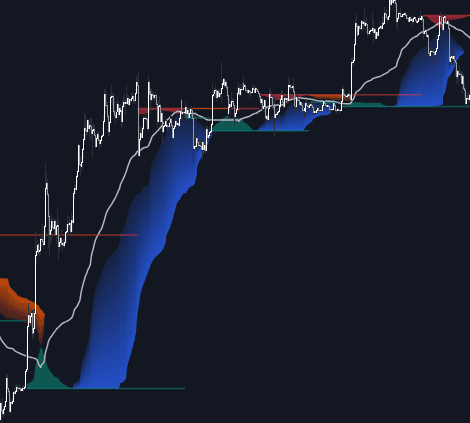
Donchian MA Bands applies Donchian channel logic to moving average values instead of raw price: it takes the highest and lowest MA readings over a lookback, then iterates that calculation to build layered dynamic zones. The result is a pair of clouds that hug price during trends (a dominant lower zone in uptrends, a dominant upper zone in downtrends), with each zone doubling as potential support or resistance.
How to Trade the Donchian MA Bands?
- Price holding above the lower zone: uptrend conditions, with the zone acting like trailing support.
- Price holding below the upper zone: downtrend conditions, the zone serving as dynamic resistance.
- Breakout dots: in Bands mode, dots print when price closes beyond the extremities, boundary breaches to combine with your own entry, exit, or stop logic rather than standalone buy/sell calls.
- S/R zones: with Clouds, Upper Band, or Lower Band active, filled areas mark gaps between successive extremes; repeated tests set up bounce trades, clean breaks suit breakout plans.
By default the script also plots the midpoint of the highest and lowest values, a simple trend reference. Breakout signals behave best in trending markets; in ranges they more often flag tops and bottoms, worth remembering when pairing this with other trend tools.
Donchian MA Bands Settings
- Style (default Clouds): Clouds, Upper Band, Lower Band, or Bands. Bands adds one more Donchian iteration and enables the breakout dots.
- Type MA (default VWMA): SMA, EMA, RMA, HullMA, WMA, VWMA, DEMA, TEMA, or NONE.
- Length (default 20): lookback for both the moving average and the Donchian pass; longer settings smooth the zones but respond later.
- A second Type MA and Length pair (defaults VWMA, 20) under S/R drives the support/resistance zones.
Frequently Asked Questions
Free indicator
Get free access to this indicator on the platforms below.

The Library is free. Quant makes it yours.
Pull any concept or indicator into Quant: rebuild it, retune it, or turn it into a backtested strategy of your own.