Double Bollinger Zones
 By LuxAlgoJun 23, 2026
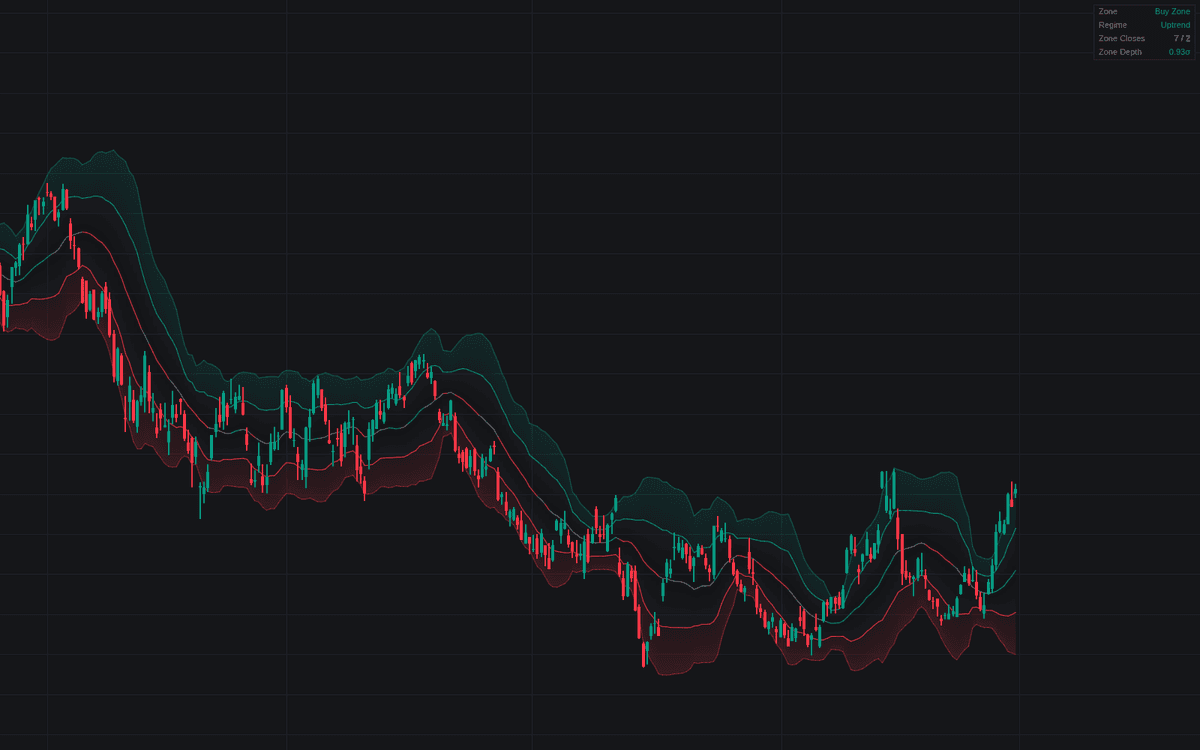

Double Bollinger Zones runs two band pairs off one shared 20-period basis (inner bands at one standard deviation, outer at two), turning the chart into a regime map of buy, sell, and neutral zones. Faithful to the Double Bollinger Zones method, it claims a trend only after consecutive closes hold a zone, drops back to neutral when the zone is lost, and reports zone, regime, close count, and depth in a dashboard.
How to Trade the Double Bollinger Zones?
- Uptrend qualified: the required run of closes (2 by default) holds the buy zone between the upper bands. Territory to follow, not stretch to fade.
- Zone lost: a close back inside the inner band drops the regime to neutral, the first warning the method gives.
- Pullback holds the floor: an intrabar tag of the one-deviation line that closes back inside keeps the regime: the continuation entry, invalidation just beyond the boundary.
- Full traverse: a regime qualified in one outer zone after the opposite one, the map's completed regime change.
Double Bollinger Zones Settings
- Length (default 20): lookback of the shared basis and standard deviation.
- Source (default close): series for the basis and deviation; zone residence is always judged on closes.
- Basis Type (default SMA): the single shared average both pairs run off.
- Inner Multiplier (default 1) and Outer Multiplier (default 2): the regime boundaries and far zone edges, the method's defining pair.
- Confirmation Closes (default 2): consecutive closes required to qualify a regime; raise it in choppy tape.
- Zone Boundary Buffer (default 0): extra deviations a close must clear, the second whipsaw guard.
- Show Dashboard (default enabled); Regime-Colored Basis and Zone Gradient Fills enabled, Regime Markers disabled. Alerts cover those events.
Frequently Asked Questions

Original indicatorBuilt in-house by LuxAlgo
The Library is free. Quant makes it yours.
Pull any concept or indicator into Quant: rebuild it, retune it, or turn it into a backtested strategy of your own.