Double-bottom Base
 By LuxAlgoMar 29, 2026
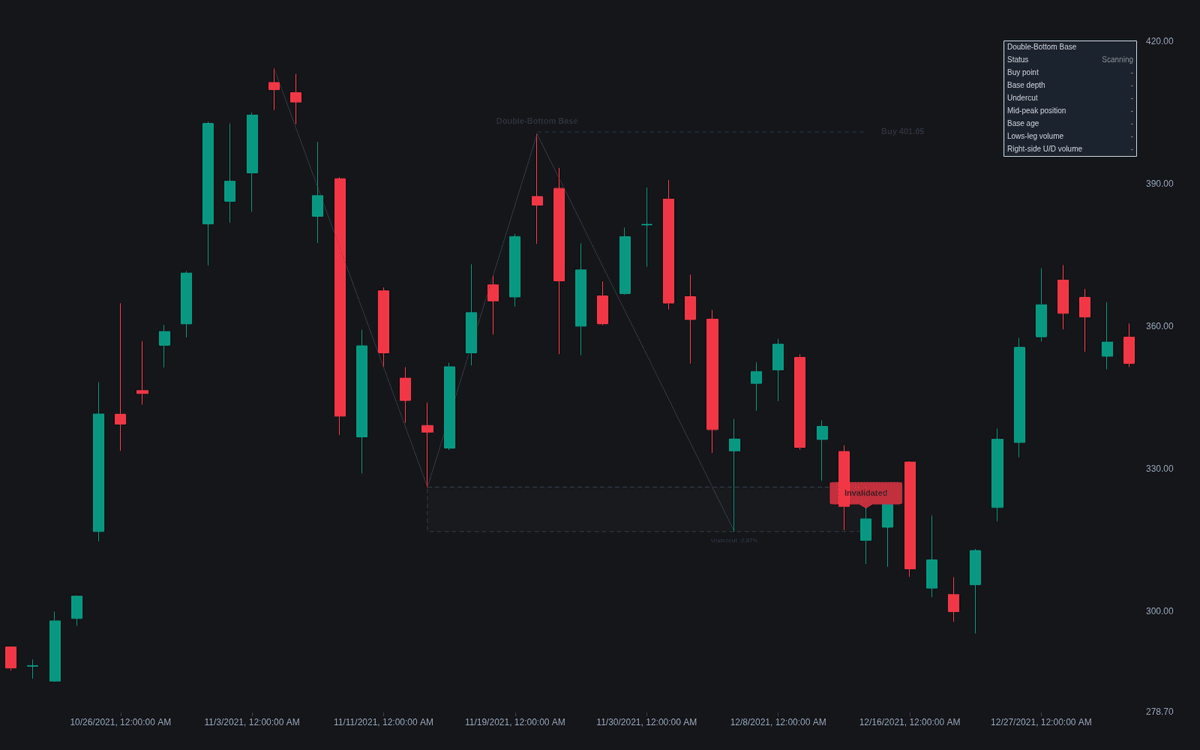

Double-bottom Base detects the W-shaped double-bottom base by explicit rules: two sell-offs whose second low undercuts the first without collapsing, a middle peak high in the range after a qualifying advance, and a buy point just above that peak. The Library's first build draws the W, shakeout zone and buy level while the base pends; a dashboard grades proportions and volume character.
How to Trade the Double-bottom Base?
- Reclaim: a close back above the first low is the earliest sign the shakeout is working.
- Handle set: a right-side swing high in the upper half lifts the buy level to the handle high.
- Breakout: a qualifying-volume close above the buy point confirms the base and starts buy-zone and stop tracking; without volume only a caution fires.
- Invalidation / stop: a broken undercut low, a third test of the lows, a stale base or a stop hit end it.
Double-bottom Base Settings
- Swing Detection Length (default 5): pivot span tracing the W.
- Base Length (bars) (defaults 35 to 250) and Base Depth (%) (defaults 10 to 40): allowed age and correction depth.
- Minimum Mid-Peak Position (%) (default 50) and Maximum Undercut (%) (default 8): mid-peak floor and undercut cap.
- Prior Uptrend Filter (default enabled), Uptrend Window (bars) (default 100), Minimum Prior Advance (%) (default 25), Left High Tolerance (%) (default 2): the prior-advance test.
- Pivot Margin (%) (default 0.1): the margin forming the buy point.
- Breakout Volume Confirmation (default enabled), Volume Average Length (default 50), Breakout Volume Multiplier (default 1.4): the volume test.
- Detect Handle Variant (default enabled), Buy Zone (%) (default 5), Fixed Stop After Breakout (default enabled, 7%), Post-Breakout Watch (bars) (default 125): post-detection trade management.
- Dashboard and style toggles: summary panel, W structure, shakeout zone, buy levels and invalidated-base history.
Frequently Asked Questions

Original indicatorBuilt in-house by LuxAlgo
The Library is free. Quant makes it yours.
Pull any concept or indicator into Quant: rebuild it, retune it, or turn it into a backtested strategy of your own.