Fibonacci Bollinger Bands
 By LuxAlgoJun 5, 2026
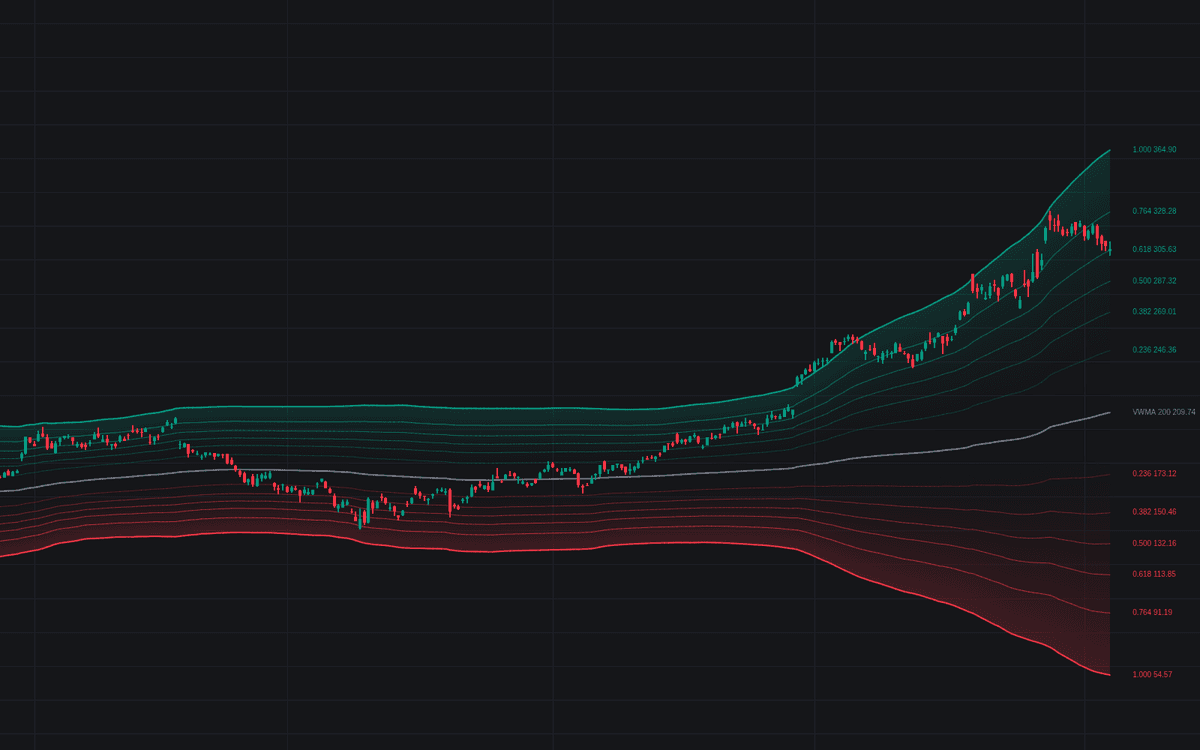

Fibonacci Bollinger Bands is the definitive clean build of Fibonacci Bollinger Bands: a volatility ladder whose outer rail sits a full deviation multiple from the basis while interior rungs subdivide that span at 0.236, 0.382, 0.500, 0.618 and 0.764. One deviation measure feeds the whole geometry, so the ladder breathes together with volatility. Rung lines fade toward the basis, fills strengthen toward the rails, and right-edge labels print each rung's ratio and current price.
How to Trade the Fibonacci Bollinger Bands?
- Basis as regime axis: closes above the 200-bar basis put the upper rungs in play; closes below hand control to the lower set. Crosses fire alerts both ways.
- Interior rungs: the day-to-day support and resistance. Grade a move by the rungs it takes and holds, with close-based crossing alerts in both directions.
- Outer rail tags: a push into the 1.000 rail keeps the classic band-tag meaning: faded in balanced tape, respected as strength in trends.
Fibonacci Bollinger Bands Settings
- Source (default close): price series the basis and standard deviation are computed on.
- Basis Type (default VWMA): the ladder's center. The volume-weighted default needs volume data; SMA, EMA, WMA and SMMA (RMA) are structurally identical alternatives.
- Basis Length (default 200): lookback of both the basis and the deviation. 200 turns the basis into a regime axis; a classic 20 behaves like standard band timing.
- Outer Deviation Multiplier (default 3.0): standard deviations from basis to outermost rail, the span the ratios subdivide.
- Ladder Gradient Fill (default on), Rung Labels (default on) and Outer Tag Markers (default off) control presentation only. Levels are unaffected.
Frequently Asked Questions

Original indicatorBuilt in-house by LuxAlgo
The Library is free. Quant makes it yours.
Pull any concept or indicator into Quant: rebuild it, retune it, or turn it into a backtested strategy of your own.