Fibonacci Ranges (Real-Time)
 By LuxAlgoSep 19, 2023
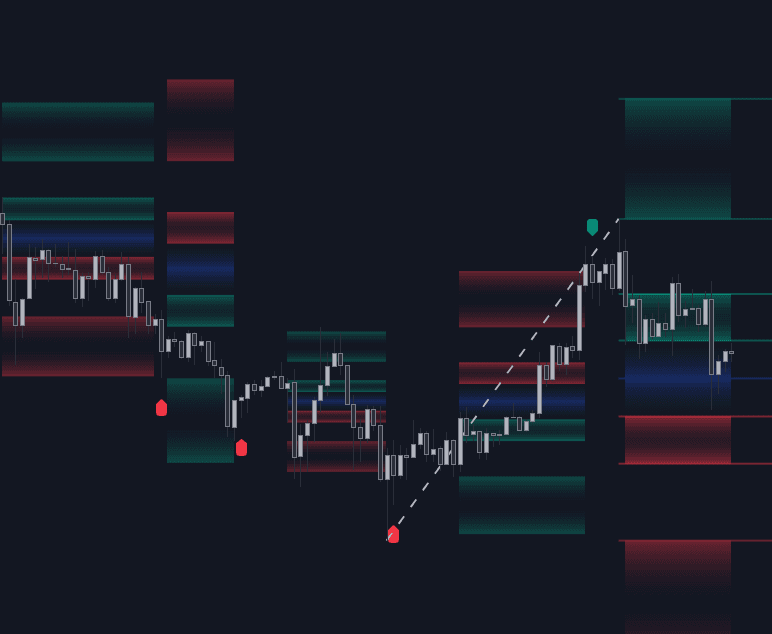
Fibonacci Ranges (Real-Time) wraps the latest swing high and low in Fibonacci retracements and keeps the resulting channel live while the market negotiates it. A channel is born when a fresh swing forms and price closes inside the chosen break levels; it survives until a set number of consecutive bars close beyond them. Every visible range is therefore one price still respects — a rolling map of the active trading range.
How to Trade the Fibonacci Ranges (Real-Time)?
- Range extremities: the outer areas of each channel serve as support and resistance for trades within the range.
- Breakout labels: when price escapes a channel, the indicator flags a possible reversal — the point where ranging logic hands over to directional logic.
- Failed escapes: if price closes back inside the break levels before the count completes, the breakout count resets to zero — often a sign the range still holds.
- Shadows: prior channels drawn with a one-bar delay; where large shadow blocks stack, durable support and resistance regions tend to sit.
- Latest Fibonacci: an independent set of levels spanning the newest swing high and low, useful for reading the current directional context.
Fibonacci Ranges (Real-Time) Settings
- L / R: bars required to the left and right to confirm a swing point.
- Channel: choose Channel, Channels + Shadows, or None.
- Break level: the level pair that defines escape — 0.382-1.382, 0.000-1.000, 0.236-0.764, or 0.382-0.618. Narrower pairs retire channels sooner; broader pairs create larger, more frequent ones.
- Break count: consecutive closes outside the break levels needed to end a channel.
- Show breaks: marks each break instance; alerts are available for Break Up and Break Down events.
Frequently Asked Questions
What officially ends a channel?
A channel ends once the Break count is met — that many consecutive bars closing outside the break levels. Any close back inside beforehand resets the count to zero, so brief pokes through a level do not kill the range.
How is this better than drawing retracements by hand?
Manual retracements stay where you anchored them. This tool re-anchors on every qualifying swing, applies consistent birth and expiry rules, and archives old channels as shadows. If you prefer levels derived from pivot calculations instead of live swings, Fibonacci Pivots takes that route.
How do I access Fibonacci Ranges (Real-Time)?
Free through the LuxAlgo Library — and from this page it also runs in Quant, LuxAlgo's AI, if you want to watch channels form and retire in a backtest.
Free indicator
Get free access to this indicator on the platforms below.

The Library is free. Quant makes it yours.
Pull any concept or indicator into Quant: rebuild it, retune it, or turn it into a backtested strategy of your own.