JMA
 By LuxAlgoMar 27, 2026
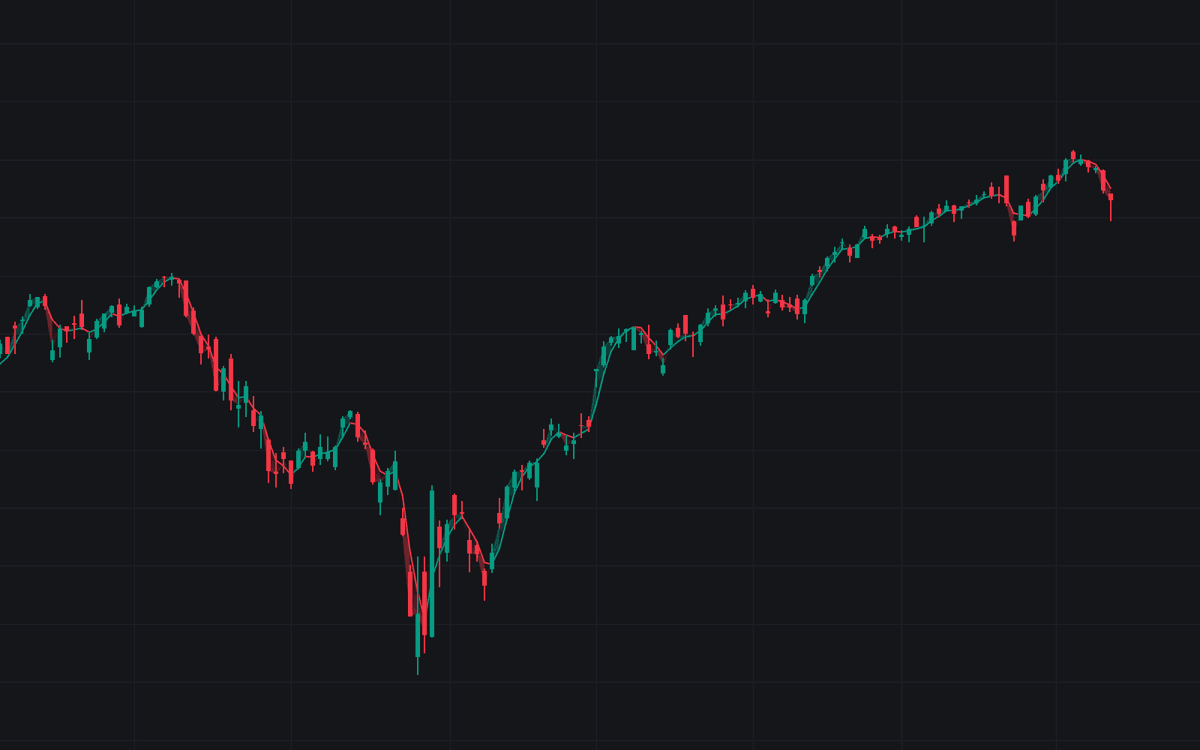

JMA plots the Jurik Moving Average, the adaptive smoother that pursues maximum smoothness for minimum lag. Because the original JMA algorithm was licensed commercially and never published, this build implements the standard published three-stage approximation with the documented length, phase, and power mapping, and says so. The line colors itself by slope, and an optional SMA or EMA of the same length overlays for calibration.
How to Trade the JMA?
- Slope color: rising reads bullish, falling bearish. The slope turning is the event most systems key on, and both turns fire alerts.
- Flat stretch: the line holds nearly level through congestion, so a horizontal JMA is a usable no-trend flag.
- Price crossings: standard crossover grammar with a smoother, lower-lag line; markers are off by default but the alerts fire regardless.
- Gradient fill width: the fill visualizes extension. Price sprinting away from a flat line signals stretch rather than confirmed trend.
Against a comparison average of the same length, the JMA should catch genuine swings sooner while shrugging off more of the noise in between.
JMA Settings
- Source (default close): the smoothed series; feeding an oscillator or volume series here covers the smoothing-core use.
- Length (default 7): the customary JMA default. Longer is smoother and slower.
- Phase (default 0): repositions the lag-overshoot trade-off across −100 to +100; no setting removes the trade-off.
- Power (default 2): how aggressively the filter adapts. Higher hugs price through fast moves, lower holds flatter in congestion.
- Comparison Average (default None): the optional SMA or EMA of the same length and source.
- Slope Trend Coloring (default enabled), Price / JMA Gradient Fill (default enabled), and Price Crossing Markers (default disabled) round out the style group.
Frequently Asked Questions

Original indicatorBuilt in-house by LuxAlgo
The Library is free. Quant makes it yours.
Pull any concept or indicator into Quant: rebuild it, retune it, or turn it into a backtested strategy of your own.