Laguerre Filter
 By LuxAlgoJun 18, 2026
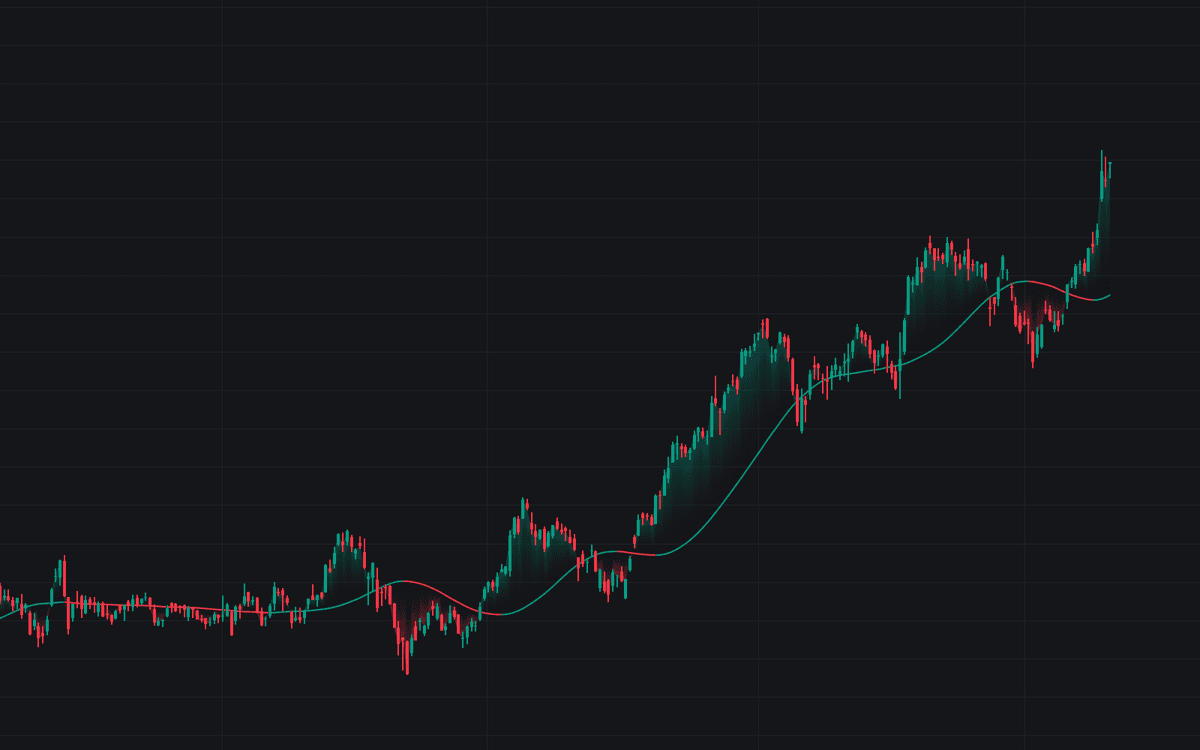

Laguerre Filter is the clean single-line build of the Laguerre filter: four of John Ehlers' one-pole filter stages chained in series and blended with fixed 1-2-2-1 weights into one smoothed line on price. A lone damping factor stands in for the usual bar-count length, the line colors by its slope, and every stage is seeded with the source itself so the cascade opens on real data instead of ramping up from zero.
How to Trade the Laguerre Filter?
- Price crossing the filter: traded the way EMA crosses are - optional triangle markers, with crossing alerts armed either way.
- Slope color: a rising line under price sets the bullish bias; when the line flattens and price saws back and forth across it, trend entries are at their most failure-prone.
- Gradient fill: highlights how pullbacks within a trend repeatedly test the line as dynamic support or resistance.
Slope-turn alerts complement the crossings, flagging the moments the smoothed line itself changes direction rather than waiting for price to cross it.
Laguerre Filter Settings
- Source (default close): the series being smoothed. Ehlers' published example feeds the bar midpoint; the close is the common charting default.
- Gamma (default 0.8): the filter's only knob, shared by all four stages. At 0 only the last four bars contribute, in a fixed weighting; raising it stretches the warped memory so smoothness and lag build together. Its effect compounds through the stages, so adjust gradually.
- Slope Trend Coloring (default on): direction-colored line; disable for the neutral color.
- Price / Filter Gradient Fill (default on) and Price Crossing Markers (default off): display toggles.
Frequently Asked Questions

Original indicatorBuilt in-house by LuxAlgo
The Library is free. Quant makes it yours.
Pull any concept or indicator into Quant: rebuild it, retune it, or turn it into a backtested strategy of your own.