Kagi
 By LuxAlgoJun 15, 2026
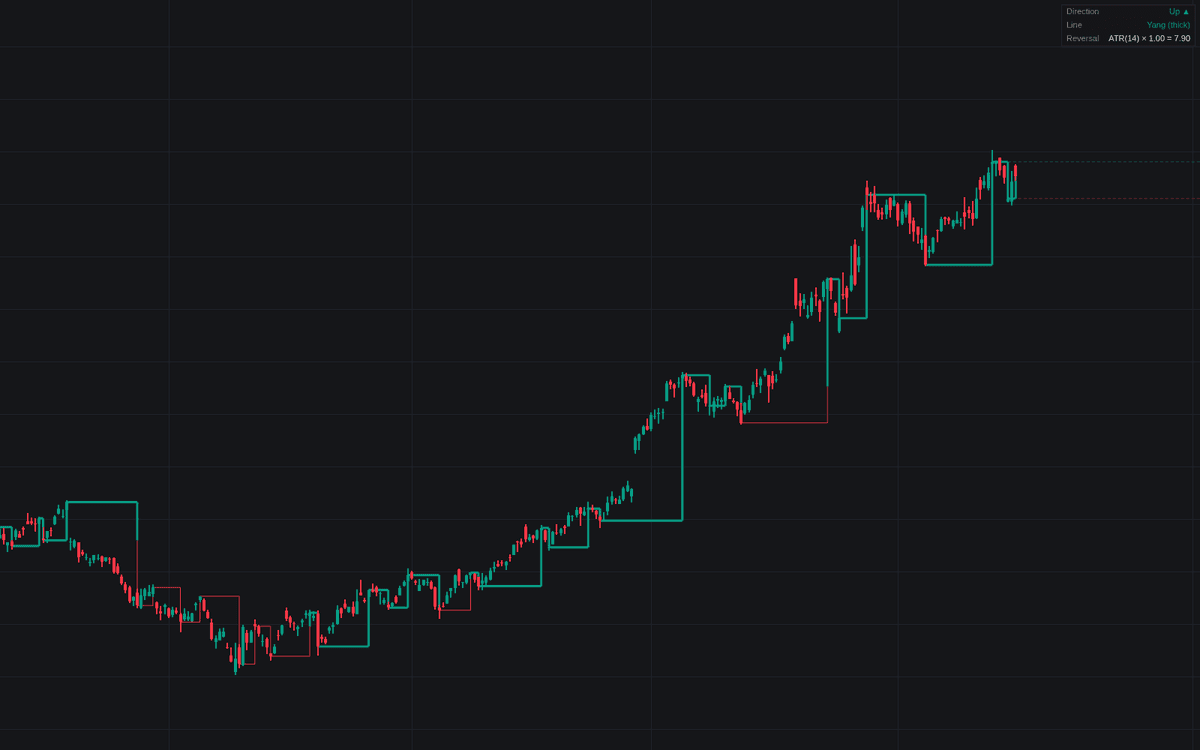

Kagi redraws price as a single time-free line that only turns when the move earns it - the first faithful build of the Kagi chart in the library. The line extends while price pushes with it and reverses only after a full reversal amount, ATR-scaled by default so sensitivity holds across regimes. Thickness carries the signal: the line turns thick (yang) when the prior shoulder gives way and thin (yin) when the prior waist breaks, with dashed levels extending from both so the flip prices are visible before they trade.
How to Trade the Kagi?
- Yang flip: price exceeding the prior Kagi high - the shoulder - turns the line thick, the traditional buy indication, covered by the Yang Flip (Bullish) alert.
- Yin flip: a break of the prior Kagi low - the waist - turns the line thin, the traditional sell indication.
- Reversal up / down: each turn marks a full reversal-sized retracement off the latest extreme; the Kagi Reversal alerts date these turns without waiting for a thickness change.
The dashboard keeps the filter explicit: line direction, yang or yin state, and the effective reversal amount in price units.
Kagi Settings
- Source (default close): series the line is built from; classic Kagi uses closing prices.
- Reversal Method (default ATR): ATR adapts the filter to volatility, Percentage scales it with price, Fixed Amount uses constant price units.
- ATR Length (default 14) and ATR Multiplier (default 1): the adaptive reversal amount.
- Percentage (default 1) and Fixed Amount (default 1): the alternative reversal definitions.
- Show Dashboard (on) with Location (Top Right) and Size (Small).
- Style: yang and yin colors with widths 3 and 1, Prior Kagi High/Low Levels (on), Yin/Yang Flip Markers (off).
Frequently Asked Questions

The Library is free. Quant makes it yours.
Pull any concept or indicator into Quant: rebuild it, retune it, or turn it into a backtested strategy of your own.