





kNN Market Architecture
Mar 16, 2026
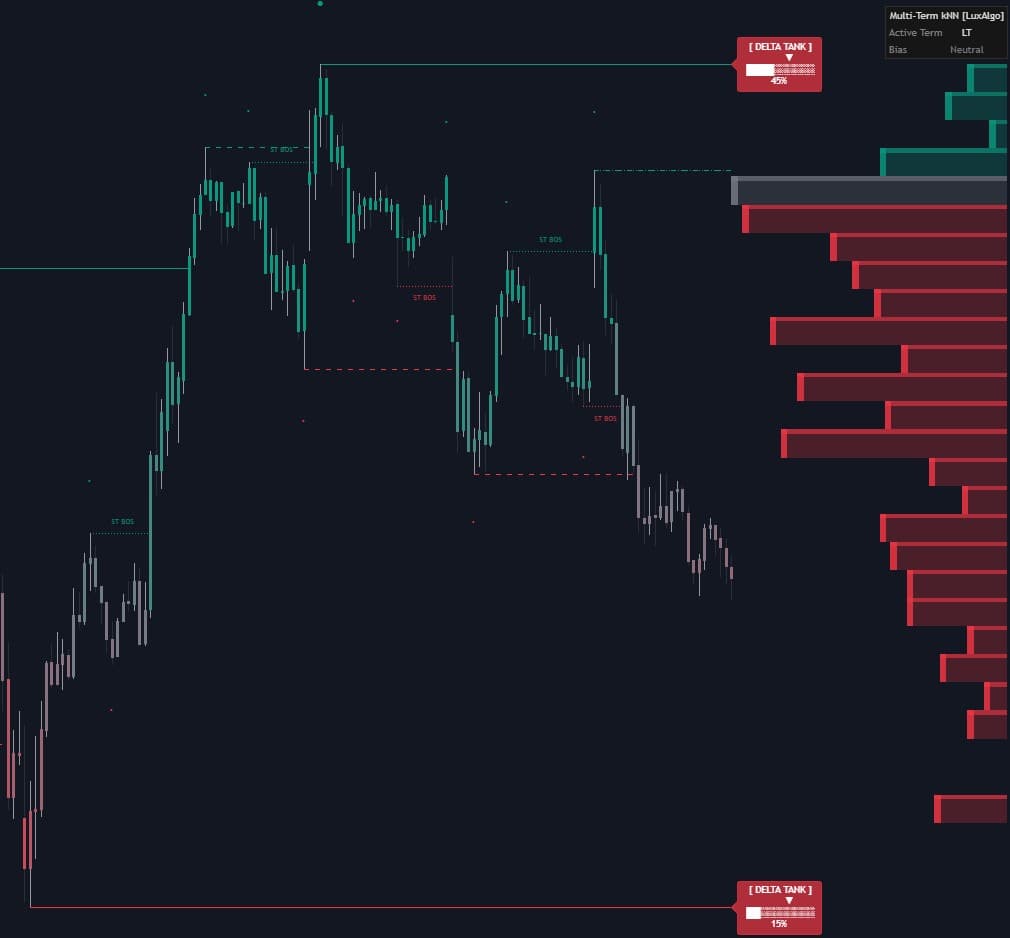
The kNN Market Architecture [LuxAlgo] trading indicator is an advanced market structure and price action analysis tool that combines machine learning, volume analysis, and dynamic pivot detection to help traders identify high-probability breakout and reversal zones. By using a k-nearest neighbors (kNN) classifier to validate pivots based on historical volatility and volume patterns, the indicator filters out weak market noise and reveals the most meaningful structural levels across multiple time horizons.
Designed for modern traders who want more than basic support and resistance lines, this trading indicator integrates structural analysis with cumulative volume delta and an anchored volume profile. The result is a multi-layered framework that allows traders to analyze trend direction, liquidity zones, and institutional activity within a single chart.
How to Trade with the kNN Market Architecture Trading Indicator
The indicator organizes market structure into three hierarchical layers:
- Short-Term (ST)
- Medium-Term (MT)
- Long-Term (LT)
Each structural pivot must pass a machine learning validation process before being plotted on the chart. Unlike traditional pivot indicators that simply mark highs and lows based on fixed lookback windows, this system evaluates whether the pivot resembles historically significant turning points using volume and volatility features.
This approach produces a cleaner and more reliable structural map, allowing traders to focus on the most meaningful levels where market reactions are likely.
Traders commonly use the indicator to:
- Identify break of structure (BOS) events signaling trend continuation.
- Detect potential reversal zones where price structure shifts.
- Track institutional accumulation or distribution using volume delta.
- Analyze market bias across multiple timeframes without switching charts.
Multi-Scale Bias Analysis
One of the core strengths of the kNN Market Architecture trading strategy framework is its multi-scale bias system.
Users can choose which structural layer determines the overall market bias:
- Short-Term Bias (ST) – useful for scalping and intraday trading.
- Medium-Term Bias (MT) – ideal for swing trading setups.
- Long-Term Bias (LT) – better suited for macro trend analysis.
When price trades above the most recently validated high of the selected structure layer, the indicator marks the market as bullish. When price falls below the most recent validated low, the bias shifts to bearish.
This allows traders to perform top-down analysis directly on one chart, aligning lower timeframe trades with higher timeframe structure.
The Delta Tank
The Delta Tank is a unique feature that tracks buying and selling pressure around active structural levels.
Whenever a structural level has formed but has not yet been broken, a Delta Tank label appears at that level. This label continuously tracks cumulative order flow metrics such as:
- Total traded volume
- Volume delta (buy volume vs sell volume)
- Delta-to-volume ratio
The Delta Tank visualization helps traders understand whether a level is strengthening or weakening.
- Green icon with high fill percentage: Strong buying pressure defending support or attacking resistance.
- Red icon: Increasing selling pressure, suggesting a possible upcoming Break of Structure (BOS).
- Percentage value: Indicates the ratio of delta to total volume, helping measure exhaustion or strength.
This feature provides context behind price movement, revealing whether a level is likely to hold or break.
Anchor Volume Profile
The indicator includes a dynamic anchored volume profile that automatically aligns with the current structural trading range.
Instead of displaying volume across the entire chart, this profile focuses specifically on the active range between the most recent validated structural high and low.
This allows traders to quickly identify:
- High Volume Nodes (HVNs) where price found equilibrium
- Low Volume Nodes (LVNs) where price may move quickly
- Areas where the market established fair value
By combining structure with volume distribution, traders gain insight into where the most meaningful trading activity occurred inside the current range.
Advantages Over Traditional Market Structure Indicators
The kNN Market Architecture indicator introduces several major improvements compared to standard market structure tools.
-
Machine Learning Noise Filtering
Traditional pivot indicators mark every high or low within a window. The kNN model compares each pivot’s volatility and volume signature with historical pivots to determine whether it is statistically meaningful. This results in significantly cleaner structural levels. -
Volatility-Adaptive Detection
Instead of relying on fixed lookback periods, the detection engine expands or contracts depending on current market volatility. This ensures the indicator remains responsive during quiet markets and resistant to noise during fast-moving conditions. -
Integrated Volume Context
Most support and resistance indicators only display price levels. This tool layers volume delta analysis and anchored volume profiles directly onto the structure, revealing the market forces behind price movements.
These features make the indicator particularly powerful for traders who combine market structure trading strategies with volume analysis.
Indicator Mechanics
Auto-Adjust Sensitivity
The detection engine dynamically adapts to changing market conditions using volatility measurements.
When Auto-Adjust Sensitivity is enabled, the script calculates a volatility ratio by comparing the current Average True Range (ATR) to its long-term average.
- During high volatility, the detection window expands, requiring larger price moves to confirm a pivot.
- During low volatility, the window contracts, allowing the indicator to detect smaller structural shifts.
This ensures the trading indicator remains relevant regardless of whether the market is trending aggressively or consolidating.
kNN Validation Engine
At the heart of the indicator is a k-nearest neighbors machine learning classifier.
For every potential pivot point, the engine analyzes multiple features, including:
- Relative ATR
- Relative trading volume
- Local price movement characteristics
These features are compared against a historical database of previous pivots.
If the similarity score of the pivot’s nearest neighbors falls below the defined Confidence Threshold, the pivot is rejected. Only pivots with sufficient historical similarity are plotted on the chart.
This validation process greatly reduces false signals and improves the reliability of structural analysis.
SETTINGS
Dynamic Engine
- Structure Sensitivity: Controls the base lookback used for pivot detection.
- Auto-Adjust Sensitivity: Enables volatility-based scaling of the detection window.
kNN Classifier
- k-Nearest Neighbors: Determines how many historical pivots the classifier compares to the current pivot.
- Confidence Threshold: Defines the minimum similarity score required for a pivot to be validated.
Visual Hierarchy
- ST / MT / LT Toggles: Enable or disable visibility of Short-Term, Medium-Term, or Long-Term structures.
- Bias Source: Select which structural layer determines the overall market bias.
- Color Candles by Bias: Applies gradient candle coloring based on the position within the current structural range.
Volume Profile
- Show Volume Profile: Toggles the anchored structural volume profile.
- Profile Rows: Adjusts the number of price bins used to calculate the profile.
- Profile Width (%): Controls the horizontal display size of the profile.
FAQ
What is the kNN Market Architecture indicator?
The kNN Market Architecture is a machine learning-powered trading indicator that analyzes market structure using a k-nearest neighbors classifier. It filters weak pivots and highlights high-probability structural levels using volume, volatility, and price features.
How is this different from traditional pivot indicators?
Traditional pivot indicators use fixed lookback windows and mark every mathematical high or low. The kNN Market Architecture validates pivots using historical similarity patterns, resulting in cleaner charts and more reliable structure points.
Can this indicator be used for breakout trading strategies?
Yes. Traders often use the indicator to identify Break of Structure (BOS) levels and potential breakout zones. The Delta Tank and anchored volume profile provide additional context about whether a level is likely to hold or break.
Is the kNN Market Architecture suitable for all timeframes?
Yes. Because it supports Short-Term, Medium-Term, and Long-Term structural layers, traders can use it for scalping, intraday trading, swing trading, or macro trend analysis.
How can I access the kNN Market Architecture indicator?
You can get access on the LuxAlgo Library for charting platforms like TradingView, MetaTrader (MT4/MT5), and NinjaTrader for free.
Trading & investing are risky and many will lose money in connection with trading and investing activities. All content on this site is not intended to, and should not be, construed as financial advice. Decisions to buy, sell, hold or trade in securities, commodities and other investments involve risk and are best made based on the advice of qualified financial professionals. Past performance does not guarantee future results.
Hypothetical or Simulated performance results have certain limitations. Unlike an actual performance record, simulated results do not represent actual trading. Also, since the trades have not been executed, the results may have under-or-over compensated for the impact, if any, of certain market factors, including, but not limited to, lack of liquidity. Simulated trading programs in general are designed with the benefit of hindsight, and are based on historical information. No representation is being made that any account will or is likely to achieve profit or losses similar to those shown.
Testimonials appearing on this website may not be representative of other clients or customers and is not a guarantee of future performance or success.
As a provider of technical analysis tools and strategies, we do not have access to the personal trading accounts or brokerage statements of our customers. As a result, we have no reason to believe our customers perform better or worse than traders as a whole based on any content, tool, or platform feature we provide.
Charts used on this site are by TradingView in which the majority of our technical indicators are built on. TradingView® is a registered trademark of TradingView, Inc. www.TradingView.com TradingView® has no affiliation with the owner, developer, or provider of the Services described herein.
Market data is provided by CBOE, CME Group, BarChart, Massive, CoinAPI. Select U.S. equities data is provided through Massive. CBOE BZX real-time U.S. equities data is licensed from CBOE and provided through BarChart. Real-time futures data is licensed from CME Group and provided through BarChart. Select cryptocurrency data, including major coins, is provided through CoinAPI. All data is provided “as is” and should be verified independently for trading purposes.
This does not represent our full Disclaimer. Please read our full disclaimer.
© 2026 LuxAlgo Global, LLC.