Concept
Laguerre Filter
Laguerre Filter is a Trend concept. The Library holds 1 implementation, a working definition you can pull into Quant.
Top Laguerre Filter indicator
The top custom implementation, built on the original standard Laguerre Filter formula.
1 total
Want to trade Laguerre Filter? The implementation below is one prompt away from a backtested strategy in Quant.
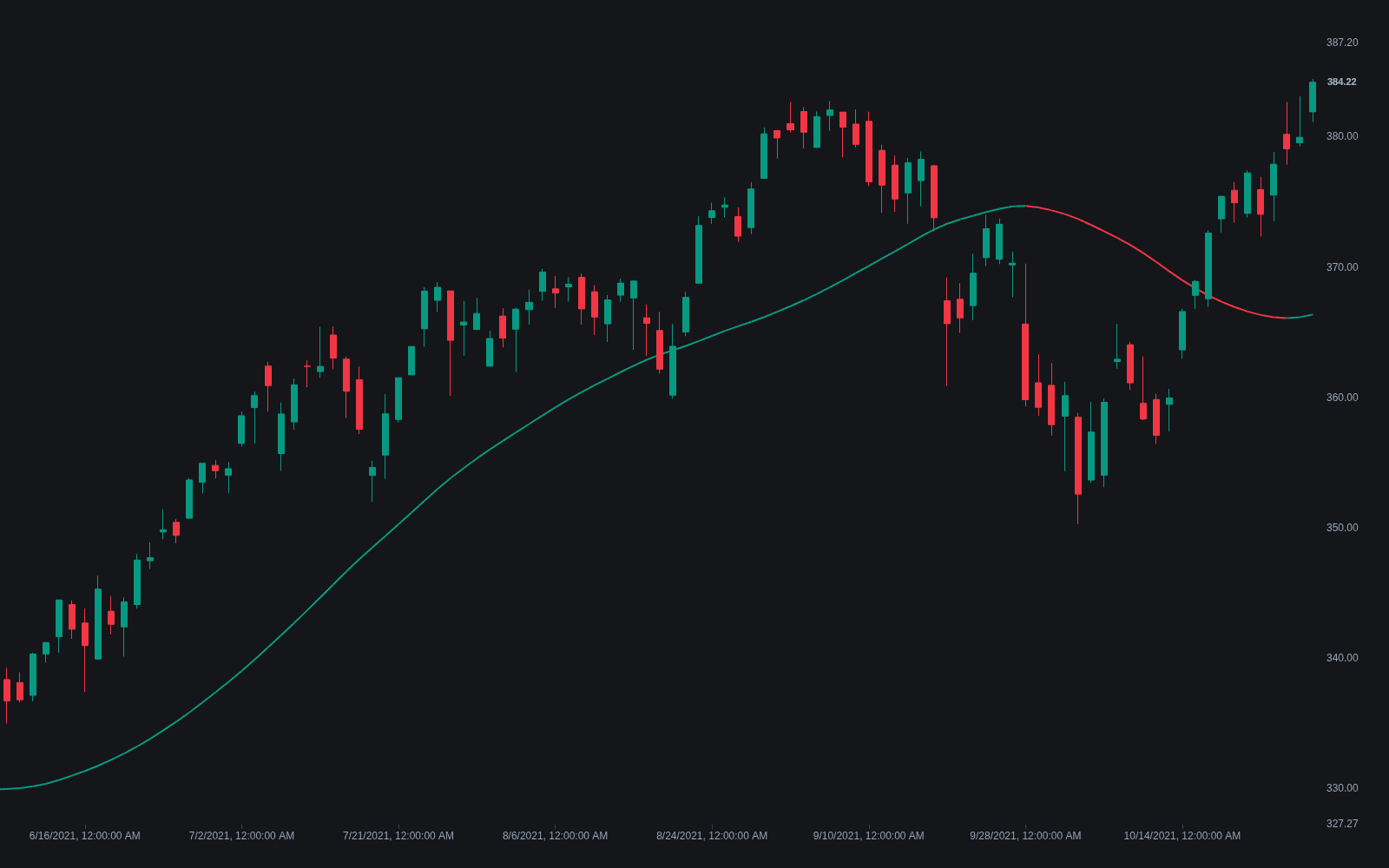
What is a Laguerre Filter?
The Laguerre filter is a smoother John Ehlers built from the Laguerre transform, a mathematical basis that lets a filter spend its memory unevenly across time. Structurally it is a cascade of four one-pole stages sharing a single damping factor, gamma, between 0 and 1; the plotted line is a fixed 1-2-2-1 weighted blend of the four stage outputs. The warped time base samples recent bars finely and compresses older ones, so the design targets heavy smoothing from only four internal elements, aiming for less lag than a conventional average of similar smoothness.
Gamma is the only knob. At 0 the cascade collapses to a fixed weighted smoother of the last four bars; raising it stretches the effective lookback, adding smoothness and lag without adding stages. The same four-stage skeleton powers Laguerre RSI, which builds an RSI-style ratio from the differences between adjacent stages instead of plotting the blend.
Ehlers published the design in the early 2000s, in a paper and book chapter memorably titled Time Warp, Without Space Travel, and the name honors Edmond Laguerre, the nineteenth-century French mathematician whose orthogonal polynomials underlie the transform. The mechanics are compact: the first stage is an ordinary one-pole smoother of price, and each later stage is an all-pass section that receives the previous stage's output and delays it in the warped time base. Low-numbered stages carry the recent past in fine detail while high-numbered stages hold a compressed summary of older history, which is exactly the memory allocation a plain moving average cannot make.
On the Library the lineage is visible in TheLark's Laguerre Moving Average and Laguerre RSI ports and in ChrisMoody's Laguerre PPO PercentileRank study, which subtracts a slow Laguerre line from a fast one, then ranks the spread by percentile to flag potential tops and bottoms. The honest framing for all of them: the filter is a well-engineered smoother, not a forecaster. It still lags genuine turns, gamma still trades speed against stability, and the warped memory that makes it elegant also makes its effective lookback harder to reason about than a simple length.
How to identify a Laguerre filter on a chart
The line looks like a smooth moving average; the giveaways are the parameter it exposes and how it behaves relative to averages of similar smoothness.
- 1Look at the input: a single gamma between 0 and 1 instead of a bar-count length is the Laguerre signature.
- 2Check the construction if source is available: four cascaded stages sharing gamma, blended with 1-2-2-1 weights and divided by 6.
- 3Compare against an EMA tuned to similar smoothness: the Laguerre line should track turns with visibly less delay, which is the design's whole claim.
- 4Sweep gamma: near 0 the line hugs price and reduces to a four-bar weighted smoother, near 1 it flattens dramatically; the compounding sensitivity of one shared parameter is characteristic.
- 5Note the derivatives: an oscillator built from differences between the stages is the Laguerre RSI, and a fast-minus-slow pair of these filters is the Laguerre PPO.
How it's calculated
A recursive four-stage smoothing filter by John Ehlers that delivers heavy smoothing with comparatively little lag.
Published by John Ehlers in Time Warp Without Space Travel, with gamma = 0.8 in his filter example.
Higher gamma means heavier smoothing and more lag; gamma = 0 collapses the filter to a 4-bar weighted average with weights 1, 2, 2, 1.
The Laguerre RSI is built from the up and down differences between these same four stages, commonly with gamma = 0.5.
How traders use it
- As a low-lag trend line: price above a rising filter reads as bullish bias, with crossovers traded the way EMA crosses are, accepting that the line still lags genuine turns.
- As the smoothing stage inside other studies, where its short internal length keeps derived oscillators responsive while stripping bar-to-bar noise.
- As a regime gate: a flat filter with price whipping across it marks chop where trend entries tend to fail, used much like an MA slope filter.
- As a crossover pair: two gammas give a fast and slow line for moving average crossover systems, or their spread becomes a Laguerre PPO ranked by percentile for top and bottom flags.
- As dynamic support and resistance: a mid-gamma filter serves the same role as dynamic S/R via MA, a moving reference that pullbacks in a trend repeatedly test.
Laguerre filter vs other smoothers
EMA: An EMA is a single one-pole stage; the Laguerre filter cascades four and blends them, spending memory unevenly so it can smooth harder per unit of lag. The price is interpretability: an EMA length maps to intuition, gamma does not.
Ehlers SuperSmoother: Both are Ehlers designs with different goals. The SuperSmoother is a two-pole filter engineered to reject high-frequency noise near the bar-sampling limit; the Laguerre filter is about warped memory allocation. They are frequently combined, SuperSmoother first, Laguerre logic after.
Adaptive-lookback MA: Adaptive averages change their effective length as conditions change; the classic Laguerre filter keeps gamma fixed. Adaptive Laguerre variants exist that drive gamma from measured volatility or efficiency, merging the two ideas at the cost of another estimation layer.
Concept family
Trend
100 concepts mapped · 100 in the Library
Laguerre Filter FAQ
Turn Laguerre Filter into a trading strategy.
Take the implementation from this page into Quant, then build on it, backtest it on real data, and keep refining it in conversation.