Monotonicity Index
 By LuxAlgoFeb 17, 2026
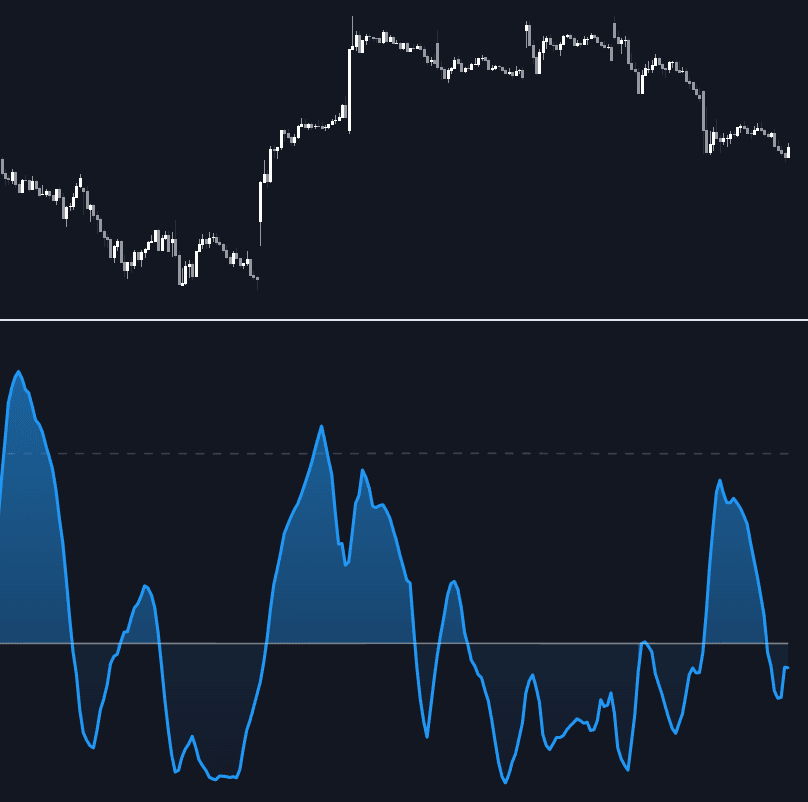
The Monotonicity Index is an advanced trading indicator designed to quantify how structurally consistent price action is over a selected lookback period. By comparing real market movement to an optimal monotonic (strictly increasing or decreasing) fit using Isotonic Regression and the Pool Adjacent Violators Algorithm (PAVA), this indicator helps traders objectively measure trend efficiency, structural smoothness, and market complexity. Instead of relying solely on traditional momentum oscillators, the Monotonicity Index evaluates whether price is trending cleanly or moving in a noisy, range-bound fashion.
How to Trade the Monotonicity Index Trading Indicator?
The Monotonicity Index is displayed in a separate pane and oscillates according to the structural “smoothness” of price action. It is primarily used to identify:
- High-efficiency trending environments
- Choppy, mean-reverting market conditions
- Potential regime shifts between trend and consolidation
This makes it a powerful trend filter for systematic traders, discretionary traders, and algorithmic trading strategies alike.
Index Modes: Measuring Trend Efficiency vs Market Complexity
The Monotonicity Index offers two core modes that allow traders to evaluate price structure from different angles:
-
Efficiency Mode:
This mode calculates the ratio between the net movement of the best-fit monotonic trend and the total price path (volatility).- High values indicate a strong, “straight-line” trend where most price movement contributes to directional progress.
- Low values suggest inefficient movement, where price travels significantly but ends up near its starting point — typical of ranging or exhausted markets.
In practical terms, high Efficiency readings favor trend-following trading strategies, while low readings may support mean-reversion setups.
-
Complexity Mode:
This mode measures the number of structural segments (pools) required to fit price using Isotonic Regression.- Low complexity indicates that price follows a clean and simple directional path.
- High complexity reflects frequent directional shifts, often seen in choppy or sideways conditions.
Complexity mode is particularly useful for traders looking to avoid overtrading during fragmented market phases.
Interpreting the Monotonicity Index
To help contextualize readings, the indicator includes a dynamic:
- Cumulative Mean
- Upper Bound
These adaptive references allow traders to quickly determine whether current market conditions are above or below average structural quality.
-
Above Mean:
When the Efficiency index is above its cumulative mean, price action is more structurally monotonic and stable than usual. This often aligns with strong trend continuation phases. -
Below Mean:
When readings fall below the mean, price action becomes more fragmented. This may signal a transition into consolidation, a loss of trend strength, or a potential reversal setup.
By integrating the Monotonicity Index into a broader trading strategy, traders can filter trades based on market regime — only taking breakout trades in high-efficiency conditions or switching to range strategies when complexity increases.
Indicator Mechanics: Isotonic Regression & PAVA
At the core of this trading indicator is Isotonic Regression, implemented using the Pool Adjacent Violators Algorithm (PAVA).
Unlike moving averages or linear regression models that assume a predefined structure (such as a straight line), Isotonic Regression finds the best possible fit under one constraint: the series must be strictly non-decreasing or non-increasing.
The script performs two simultaneous structural fits:
- One bullish (non-decreasing)
- One bearish (non-increasing)
It then selects the fit with the lowest Mean Squared Error (MSE). From this optimal monotonic fit, the indicator derives:
- Trend efficiency (net progress vs total movement)
- Structural complexity (number of constant segments or “pools”)
This mathematical approach allows traders to define trend quality without the lag typically associated with momentum oscillators, making it suitable for both short-term and long-term market analysis.
Trading Strategy Applications
The Monotonicity Index can enhance multiple trading styles:
-
Trend-Following Strategies:
Only enter breakout or pullback trades when Efficiency is elevated and Complexity is low. -
Mean-Reversion Strategies:
Target range trades when Efficiency drops below its mean and Complexity increases. -
Regime Detection Systems:
Use the index as a filter in automated strategies to dynamically switch between trend and range models. -
Risk Management:
Reduce position sizing or tighten stops when structural efficiency deteriorates.
By combining structural analysis with volatility and momentum tools, traders can build more adaptive and robust trading systems.
Settings
-
Source:
Select the price data used for calculation (default: Close). -
Period:
Defines the lookback window for the Isotonic Regression fit.- Larger values emphasize long-term structural trends.
- Smaller values increase responsiveness to local price swings.
-
Index Mode:
Switch between:- Efficiency (trend-to-volatility ratio)
- Complexity (number of structural segments)
-
Index Smoothing:
Applies a Simple Moving Average (SMA) to reduce high-frequency noise and produce a smoother trading signal. -
Index Color:
Customize the visual appearance of the index line and gradient fill for better chart integration.
Frequently Asked Questions (FAQ)
What does the Monotonicity Index measure?
It measures how structurally consistent and efficient price action is by comparing actual movement to an optimal monotonic fit using Isotonic Regression. It helps traders identify whether the market is trending smoothly or moving in a noisy, range-bound manner.
Is the Monotonicity Index a trend indicator?
Yes. While it is not a traditional moving average or momentum oscillator, it functions as a structural trend quality indicator and can be used as a trend filter in trading strategies.
What is the difference between Efficiency and Complexity modes?
Efficiency measures how directly price moves in one direction relative to total volatility. Complexity measures how many structural segments are required to describe price, highlighting choppy versus smooth market conditions.
How can I access the Monotonicity Index?
You can get access on the LuxAlgo Library for charting platforms like TradingView, MetaTrader (MT4/MT5), and NinjaTrader for free.
Free indicator
Get free access to this indicator on the platforms below.

Unlock the entire LuxAlgo Library
Every indicator, every strategy, full charts, and complete access to Quant — our AI agent.