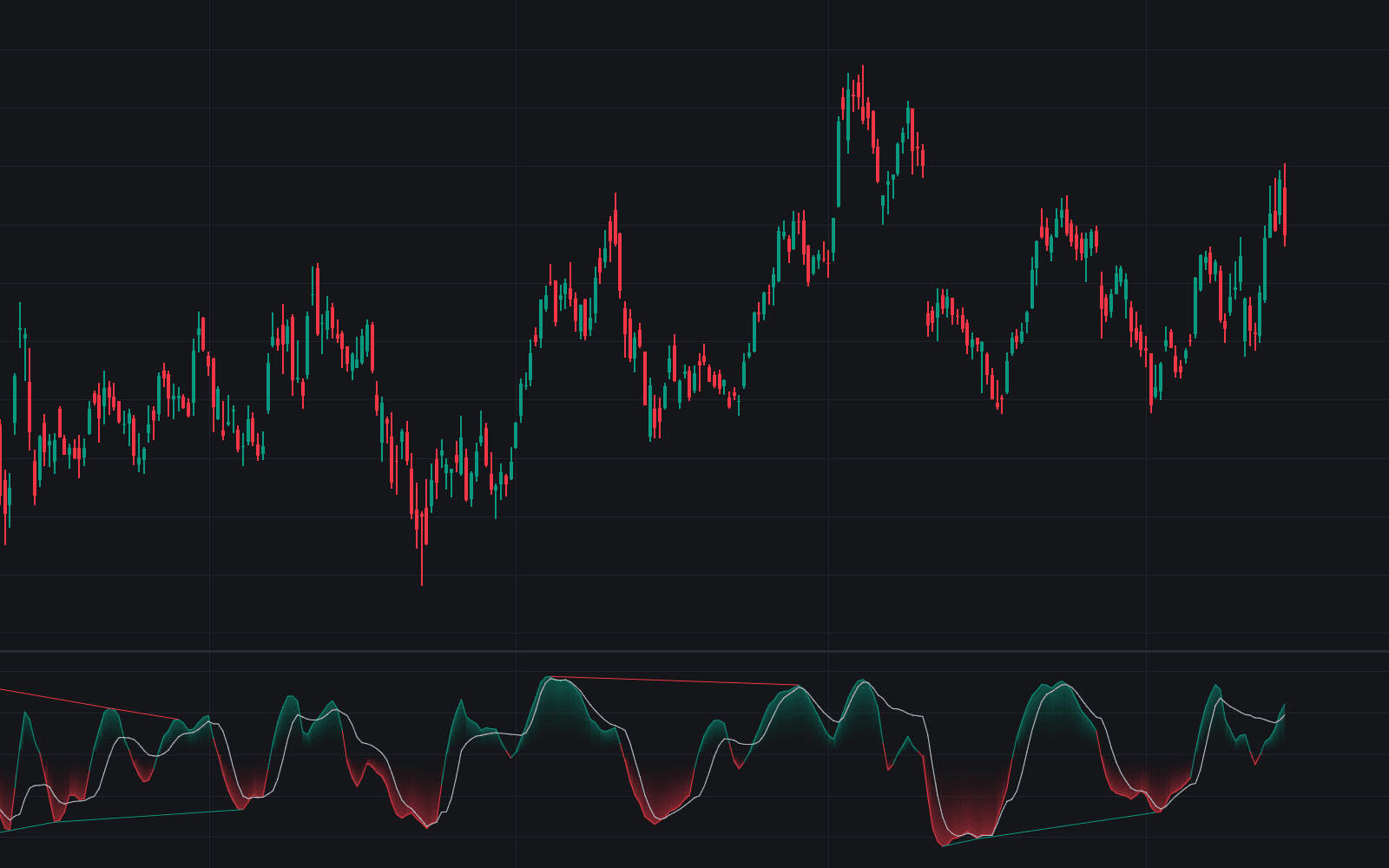
Normalized Resonator

Feb 15, 2026

Static chart image
Signals
Oscillators
Cycle
Works on the following platforms:
tradingviewSymbolTradingView
For free use on the TradingView platform
ninjatraderNinjaTrader
For free use on the NinjaTrader platform
metatrader4MetaTrader 4/5
For free use on the MetaTrader 4/5 platform
thinkorswimThinkorswim
For free use on the Thinkorswim platform

The Normalized Resonator is an advanced trading indicator built to isolate and amplify specific market cycles using a digital bandpass filter, while maintaining a consistent, normalized oscillator range for reliable overbought and oversold analysis. By combining frequency-based cycle detection with adaptive normalization, this trading strategy tool helps traders identify high-probability reversals, momentum shifts, and trend continuation setups across all markets and timeframes.

How to Trade the Normalized Resonator Indicator?

The Normalized Resonator indicator is designed to extract a single dominant market cycle (defined by the Center Period) and remove irrelevant price noise. Unlike traditional oscillators such as RSI or MACD, which measure momentum indirectly, this trading indicator mathematically isolates a specific frequency and tracks its phase and amplitude in real time.

Traders can use it in several ways:

  • Identify cyclical market turning points.
  • Filter trend direction and momentum strength.
  • Confirm pullbacks in trending conditions.
  • Combine with price action and support/resistance for higher-probability entries.

Because the output is normalized, overbought and oversold levels remain consistent across Forex, stocks, crypto, futures, and indices.

Identifying Cyclical Reversals

The primary use of this oscillator is detecting cyclical turns in the market.

Reversal setups occur when:

  • The oscillator reaches an extreme (Overbought or Oversold).
  • The main line crosses its signal line.
  • Price shows confluence (support, resistance, structure, or trendline).

This combination isolates moments where a dominant cycle is statistically stretched and beginning to reverse.

Using It as a Trend Filter

Beyond reversal trading, the Normalized Resonator works as a momentum and trend confirmation tool.

  • Sustained values above zero indicate a bullish cycle phase.
  • Sustained values below zero indicate a bearish cycle phase.
  • Greater distance from zero = stronger cyclical momentum.

In trending markets, traders can apply a directional bias:

  • In an uptrend → focus on bullish crossovers near oversold levels.
  • In a downtrend → focus on bearish crossovers near overbought levels.

This makes the indicator highly adaptable for both mean-reversion trading strategies and trend-following systems.

Bandwidth: Precision vs Reactivity

The Bandwidth setting controls how selective the filter is:

  • Low Bandwidth (0.1 – 0.3)

    • Very sharp and selective
    • Isolates extremely specific cycles
    • Cleaner signals
    • Slightly more lag
  • Higher Bandwidth (0.5 – 0.8)

    • Allows broader frequency participation
    • Faster reaction to momentum shifts
    • More responsive to short-term swings

Traders optimizing systematic trading strategies can fine-tune this parameter depending on volatility and timeframe.

Built-In Trading Signals

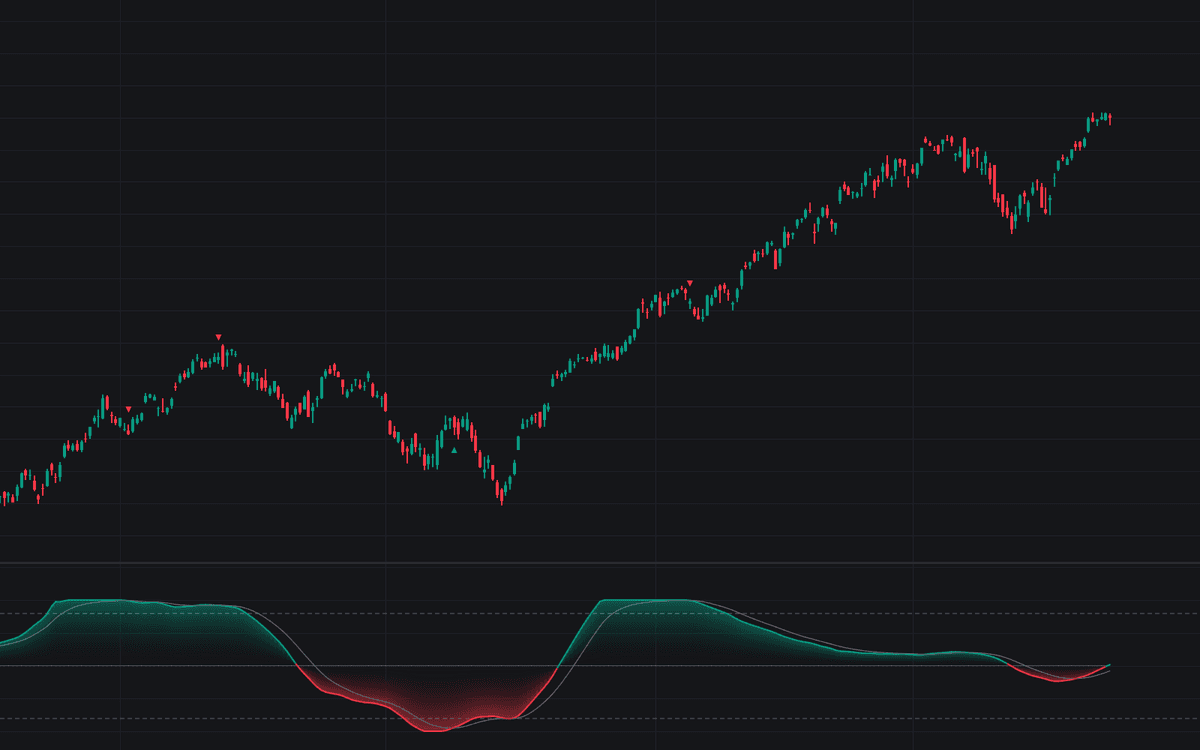
The indicator plots actionable signals directly on the chart:

  • Bullish Reversal (▲ green label)
    Triggered when:

    • Oscillator crosses above the signal line
    • Oscillator is below the oversold threshold
  • Bearish Reversal (▼ red label)
    Triggered when:

    • Oscillator crosses below the signal line
    • Oscillator is above the overbought threshold

These signals highlight potential exhaustion points where cycle phase shifts align with extreme positioning.

Combining the Resonator with Price Action

For best performance, combine this trading indicator with:

  • Horizontal support and resistance
  • Market structure breaks
  • Trendlines and channels
  • Higher timeframe bias
  • Volume or order flow confirmation

For example, a bullish resonator crossover at a major support level during a higher-timeframe uptrend provides strong confluence.

This approach improves signal quality and reduces false positives in choppy conditions.

Indicator Construction & Technical Details

The Normalized Resonator is built using a second-order digital resonator filter, a type of bandpass filter tuned to oscillate at a specific frequency.

Unlike standard oscillators based on moving average differences, this structure:

  • Targets a specific cycle length (Center Period).
  • Suppresses unwanted frequencies.
  • Tracks phase shifts within the dominant cycle.

This makes it particularly useful for traders focused on cycle analysis, digital signal processing in finance, and quantitative trading models.

Why Normalization Matters

Traditional bandpass filters produce variable amplitudes depending on volatility. This creates inconsistency when applying fixed overbought and oversold thresholds.

To solve this, the script:

  1. Calculates the highest absolute peak of the filter output over a rolling lookback window.
  2. Divides the raw output by that peak value.
  3. Compresses the oscillator into a stable range (typically between -1 and +1).

This ensures:

  • Stable OB/OS levels across assets.
  • Better cross-market consistency.
  • More reliable backtesting for systematic trading strategies.

Indicator Settings Explained

  • Center Period
    Defines the dominant cycle length (in bars) that the filter isolates.

  • Bandwidth
    Controls frequency selectivity. Lower = sharper filter. Higher = broader participation.

  • Lookback Multiplier
    Determines the normalization window relative to the Center Period.
    Example: 1.0 = normalization window equals Center Period.

  • Signal Line Period
    EMA smoothing applied to the oscillator for crossover signals.

  • Overbought / Oversold Levels
    Thresholds used for exhaustion and reversal detection.

  • Signal Size
    Adjusts visual size of the ▲ and ▼ labels.

Who Should Use This Trading Indicator?

The Normalized Resonator is ideal for:

  • Cycle traders
  • Quantitative analysts
  • Momentum traders
  • Swing traders
  • Mean-reversion strategy builders
  • Traders looking for adaptive oscillators beyond RSI/MACD

It works effectively across:

  • Forex markets
  • Cryptocurrency trading
  • Stock trading
  • Futures and indices

Frequently Asked Questions (FAQ)

Is the Normalized Resonator better than RSI or MACD?

It serves a different purpose. While RSI and MACD measure general momentum, the Normalized Resonator isolates a specific cycle frequency, making it more precise for cyclical market analysis and frequency-based trading strategies.

What timeframe works best?

It adapts to all timeframes. Lower timeframes benefit from tighter bandwidth settings, while higher timeframes may favor slightly wider bandwidth for smoother cycle representation.

Does it repaint?

The indicator does not rely on future data. Signals are generated based on confirmed bar data and standard filtering logic.

How do I access the Normalized Resonator?

You can get access on the LuxAlgo Library for charting platforms like TradingView, MetaTrader (MT4/MT5), and NinjaTrader for free.

Trading & investing are risky and many will lose money in connection with trading and investing activities. All content on this site is not intended to, and should not be, construed as financial advice. Decisions to buy, sell, hold or trade in securities, commodities and other investments involve risk and are best made based on the advice of qualified financial professionals. Past performance does not guarantee future results.

Hypothetical or Simulated performance results have certain limitations. Unlike an actual performance record, simulated results do not represent actual trading. Also, since the trades have not been executed, the results may have under-or-over compensated for the impact, if any, of certain market factors, including, but not limited to, lack of liquidity. Simulated trading programs in general are designed with the benefit of hindsight, and are based on historical information. No representation is being made that any account will or is likely to achieve profit or losses similar to those shown.

Testimonials appearing on this website may not be representative of other clients or customers and is not a guarantee of future performance or success.

As a provider of technical analysis tools and strategies, we do not have access to the personal trading accounts or brokerage statements of our customers. As a result, we have no reason to believe our customers perform better or worse than traders as a whole based on any content, tool, or platform feature we provide.

Charts used on this site are by TradingView in which the majority of our technical indicators are built on. TradingView® is a registered trademark of TradingView, Inc. www.TradingView.comTradingView® has no affiliation with the owner, developer, or provider of the Services described herein.

Market data is provided by CBOE, CME Group, BarChart, CoinAPI. CBOE BZX real-time US equities data is licensed from CBOE and provided through BarChart. Real-time futures data is licensed from CME Group and provided through BarChart. Select cryptocurrency data, including major coins, is provided through CoinAPI. All data is provided “as is” and should be verified independently for trading purposes.

This does not represent our full Disclaimer. Please read our full disclaimer.

© 2026 LuxAlgo Global, LLC.