On-neck / In-neck / Thrusting
 By LuxAlgoJul 20, 2026
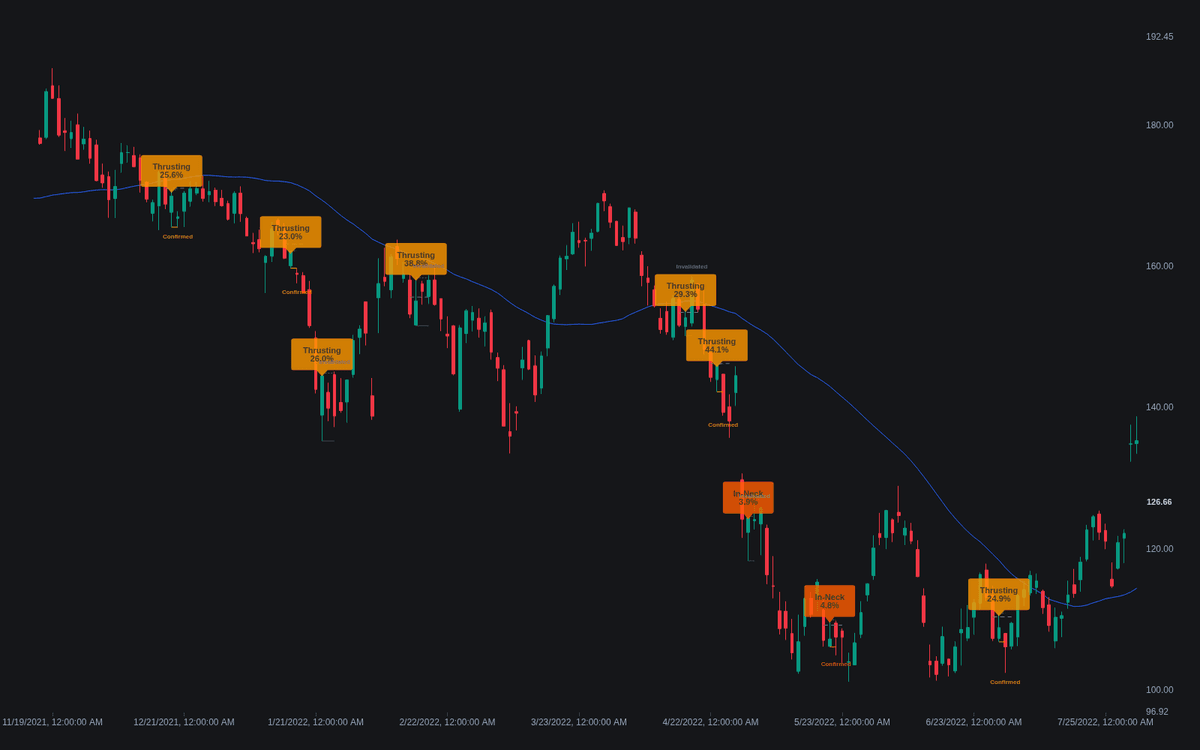

On-neck / In-neck / Thrusting classifies the failed rallies of a downtrend by exactly how far they reach. After a long dark candle below the trend average, a white candle opening lower and stalling beneath the body midpoint is graded into one of the three on-neck, in-neck and thrusting lines and labeled with its recovery depth: 0% at the prior close, 50% at the midpoint. Each detection can be tracked live: a trigger level at the pattern low and an invalidation level at the second candle's high extend until one side resolves.
How to Trade the On-neck / In-neck / Thrusting?
- Label printed: dip buying reached a specific, measured depth and failed: classical bearish continuation evidence, most telling when labels repeat down a trend.
- Confirmed: a break below the pattern low resolves the formation in the trend's favor, marker and alert on the bar that does it.
- Invalidated: a push above the second candle's high shows the rally was soaking up supply rather than failing; the trigger level fades to neutral and an alert fires.
On-neck / In-neck / Thrusting Settings
- Downtrend SMA Length (default 50): the first candle must close below this average: no decline, no pattern.
- Body Average Length (default 20) and Long Body Multiplier (default 1.2): the long-dark-candle filter; 0 disables the length test.
- Open Requirement (default Below prior close (relaxed)): the strict Japanese form demands a gap under the prior candle's low, rare where trading is continuous.
- Tolerance % (default 5): band width around the neck boundaries, in percent of the first body.
- Merge Variants (default off) and the On-Neck / In-Neck / Thrusting toggles (all on): classify separately or as one Weak Line signal colored by depth.
- Track Confirmation & Invalidation (on) with Tracking Limit (bars) (default 100), plus display options.
Frequently Asked Questions

Original indicatorBuilt in-house by LuxAlgo
The Library is free. Quant makes it yours.
Pull any concept or indicator into Quant: rebuild it, retune it, or turn it into a backtested strategy of your own.