Order Flow VWAP Deviation
May 7, 2026

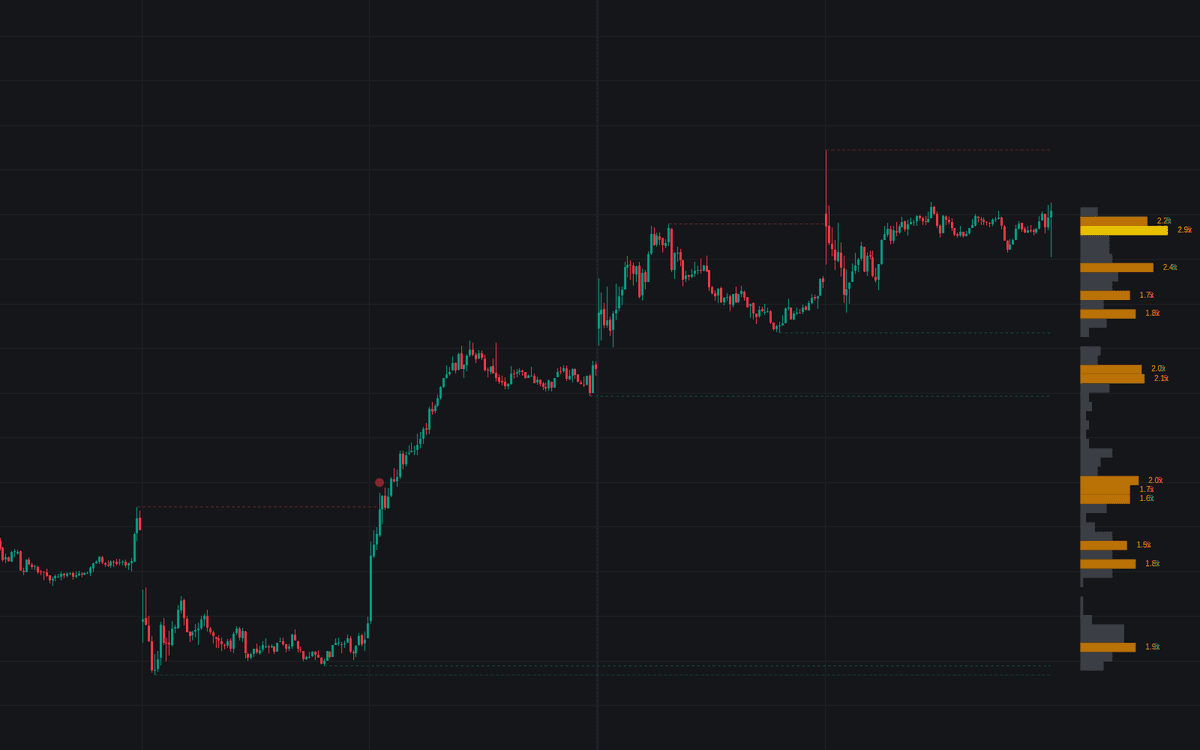
The Order Flow VWAP Deviation indicator is a trading indicator designed to help traders analyze VWAP deviation bands, liquidity stop zones, anchored volume profile levels, and order flow imbalances in one complete market structure toolkit. By combining volume-weighted average price analysis with stop-run detection, localized volume profiling, and optional Inversion Fair Value Gaps, this indicator helps traders identify areas where price may reverse, mean revert, or expand after sweeping liquidity.
How to Trade with the Order Flow VWAP Deviation Indicator
This tool is built for intraday traders, swing traders, and price action traders who focus on liquidity sweeps, VWAP mean reversion, institutional order flow, and high-probability reversal zones.
The indicator plots VWAP standard deviation bands to show when price is stretched above or below its volume-weighted fair value. These VWAP deviation bands can help traders identify overextended market conditions, potential mean reversion setups, and continuation zones when price holds outside a deviation level with strong volume.
At the same time, the indicator tracks major pivot highs and lows as Stop Zones. These areas often represent resting liquidity, including stop-loss orders, breakout orders, and trapped trader positions. When price pushes beyond one of these levels with elevated volume, the indicator flags a possible stop-run, helping traders spot moments where liquidity has been swept and a reversal or expansion move may follow.
Understanding Stop Zones and Liquidity Sweeps
Stop Zones are created from significant historical pivot points. The script extends these levels forward as dashed horizontal liquidity lines, allowing traders to see where price may be drawn toward in future market movement.
When price crosses a Stop Zone with a volume surge, based on the Stop Zone Volume Multiplier setting, the indicator marks the event with a circle on the chart. This suggests that resting orders may have been triggered and that the market is experiencing a shift in order flow.
Traders can use these signals to watch for:
- Potential liquidity sweeps above swing highs or below swing lows
- Stop-run reversals near VWAP deviation bands
- Breakout continuation when price accepts beyond a Stop Zone
- Areas where aggressive buyers or sellers may be trapped
- High-volume reactions around important market structure levels
A stop-run does not automatically mean price will reverse, but it highlights a key moment where liquidity has been taken. Traders can combine these alerts with candlestick structure, VWAP positioning, volume profile nodes, and broader trend context to build a more complete trading strategy.
Using the Anchor Volume Profile for Order Flow Analysis
The indicator includes a specialized Anchor Volume Profile that collects volume from a user-defined time range, such as the New York Open. This profile appears on the right side of the chart and helps traders identify where the most important volume activity has occurred during the selected period.
The Point of Control, or POC, is highlighted in yellow. This represents the price level with the highest traded volume in the anchored profile and often acts as a key fair value area, support zone, resistance zone, or magnet for price.
High-volume Stop Nodes are highlighted in orange. These nodes show where unusually large trading activity occurred compared to surrounding price levels. Each significant node displays:
- A volume multiplier, such as 2.5x, showing how strong the volume concentration is
- A buyer/seller bias, marked as B/S, showing which side of the market was more dominant at that price level
This makes the Anchor Volume Profile useful for traders who want to identify high-interest liquidity zones, volume-based support and resistance, and areas where order flow may influence future price action.
Reading Buyer and Seller Bias
The indicator estimates buyer and seller pressure using a proxy for delta volume. Instead of requiring true bid/ask data, the script calculates directional bias based on where the close occurs relative to the high and low of each bar.
This helps traders understand whether buyers or sellers were more active inside the anchored profile calculation. A strong buyer bias near a major liquidity zone may suggest accumulation or aggressive demand, while a strong seller bias may indicate distribution or aggressive supply.
This order flow bias can be especially useful when combined with VWAP deviation bands. For example, if price sweeps a low below a lower VWAP deviation band and the profile shows strong buyer activity, traders may interpret that as a potential absorption or reversal setup.
Trading with Inversion Fair Value Gaps
The Order Flow VWAP Deviation indicator can optionally display Inversion Fair Value Gaps, also known as IFVGs. These are Fair Value Gaps that have been invalidated and then transformed into potential support or resistance.
An IFVG occurs when:
- A bearish Fair Value Gap is closed above, turning it into a potential support zone
- A bullish Fair Value Gap is closed below, turning it into a potential resistance zone
The indicator visualizes these zones as boxes on the chart until they are mitigated by price action. Traders can use IFVGs to identify refreshed imbalance zones, potential retest areas, and continuation levels after a liquidity sweep or VWAP deviation move.
How VWAP Deviation Bands Improve the Trading Strategy
VWAP is one of the most widely used trading indicators for understanding fair value because it weights price by volume. When price moves far away from VWAP, it can signal that the market is becoming extended.
The standard deviation bands help traders measure this extension. Upper deviation bands can act as potential resistance or overbought zones, while lower deviation bands can act as potential support or oversold zones.
This indicator becomes especially powerful when multiple signals align, such as:
- Price sweeps a Stop Zone
- The sweep occurs near a VWAP deviation band
- Volume surges above the Stop Zone Volume Multiplier
- The Anchor Volume Profile shows a major POC or Stop Node nearby
- An IFVG forms or gets retested after the sweep
These confluences can help traders build a more structured trading strategy instead of reacting to price movement alone.
Technical Details Behind the Indicator
The script uses VWAP standard deviation calculations to create dynamic upper and lower bands around the volume-weighted average price. These bands adjust as market volume and price action evolve, making them useful for both active intraday trading and broader swing trading analysis.
For Stop Zone logic, the indicator uses a pivot lookback period to detect only meaningful swing highs and swing lows. This helps reduce chart clutter and keeps the focus on major liquidity pools rather than every minor price fluctuation.
The Anchor Volume Profile calculates volume distribution across a selected time window and divides that activity into profile rows. This lets traders see where volume has concentrated vertically across price, making it easier to identify important price levels, high-volume nodes, and potential liquidity magnets.
The delta volume proxy estimates buyer and seller pressure by analyzing each candle’s close relative to its high-low range. While this is not the same as true exchange-level order flow data, it gives traders a practical way to visualize directional pressure directly on the chart.
Recommended Indicator Settings and Inputs
- VWAP Anchor: Determines the VWAP calculation period, including Session, Week, Month, or Year.
- Std. Dev Multiplier: Controls the distance between VWAP and the upper/lower deviation bands.
- Pivot Lookback: Sets how many bars are used to identify important swing highs and swing lows for Stop Zones.
- Max Active Lines: Limits the number of active horizontal liquidity levels displayed on the chart.
- Profile Rows: Adjusts the vertical detail and granularity of the anchored Volume Profile.
- Anchor Time Range: Defines the exact start time, in HHMM format, used to begin volume collection for the anchored profile.
- Stop Zone Volume Multiplier: Sets the volume threshold required to highlight a stop-run or high-volume Stop Node.
- Show IFVGs: Enables or disables the display of Inversion Fair Value Gaps.
- IFVG Volatility Filter: Filters IFVGs by requiring the gap to form from a significant price move.
FAQ
What is the Order Flow VWAP Deviation indicator?
The Order Flow VWAP Deviation indicator is a trading indicator that combines VWAP deviation bands, liquidity Stop Zones, anchored volume profile analysis, stop-run detection, and optional Inversion Fair Value Gaps to help traders analyze market structure and order flow.
How can traders use this indicator in a trading strategy?
Traders can use it to identify VWAP mean reversion setups, liquidity sweeps, stop-run reversals, volume-based support and resistance, and potential continuation zones. The strongest setups often occur when Stop Zones, VWAP deviation bands, volume profile nodes, and IFVGs align.
What are Stop Zones?
Stop Zones are liquidity levels based on significant pivot highs and lows. These areas often contain resting stop-loss orders or breakout orders. When price crosses them with high volume, the indicator marks a possible stop-run.
What does the Anchor Volume Profile show?
The Anchor Volume Profile shows where volume has accumulated during a selected time range. It highlights the Point of Control, high-volume Stop Nodes, volume multipliers, and buyer/seller bias at important price levels.
What are Inversion Fair Value Gaps?
Inversion Fair Value Gaps are Fair Value Gaps that have been invalidated and then flipped into potential support or resistance. The indicator can display these zones as boxes until price mitigates them.
How do I access the Order Flow VWAP Deviation indicator?
You can get access on the LuxAlgo Library for charting platforms like TradingView, MetaTrader (MT4/MT5), and NinjaTrader for free.
Trading & investing are risky and many will lose money in connection with trading and investing activities. All content on this site is not intended to, and should not be, construed as financial advice. Decisions to buy, sell, hold or trade in securities, commodities and other investments involve risk and are best made based on the advice of qualified financial professionals. Past performance does not guarantee future results.
Hypothetical or Simulated performance results have certain limitations. Unlike an actual performance record, simulated results do not represent actual trading. Also, since the trades have not been executed, the results may have under-or-over compensated for the impact, if any, of certain market factors, including, but not limited to, lack of liquidity. Simulated trading programs in general are designed with the benefit of hindsight, and are based on historical information. No representation is being made that any account will or is likely to achieve profit or losses similar to those shown.
Testimonials appearing on this website may not be representative of other clients or customers and is not a guarantee of future performance or success.
As a provider of technical analysis tools and strategies, we do not have access to the personal trading accounts or brokerage statements of our customers. As a result, we have no reason to believe our customers perform better or worse than traders as a whole based on any content, tool, or platform feature we provide.
Charts used on this site are by TradingView in which the majority of our technical indicators are built on. TradingView® is a registered trademark of TradingView, Inc. www.TradingView.comTradingView® has no affiliation with the owner, developer, or provider of the Services described herein.
Market data is provided by CBOE, CME Group, BarChart, CoinAPI. CBOE BZX real-time US equities data is licensed from CBOE and provided through BarChart. Real-time futures data is licensed from CME Group and provided through BarChart. Select cryptocurrency data, including major coins, is provided through CoinAPI. All data is provided “as is” and should be verified independently for trading purposes.
This does not represent our full Disclaimer. Please read our full disclaimer.
© 2026 LuxAlgo Global, LLC.