





Predictive Monte Carlo Engine
Apr 15, 2026
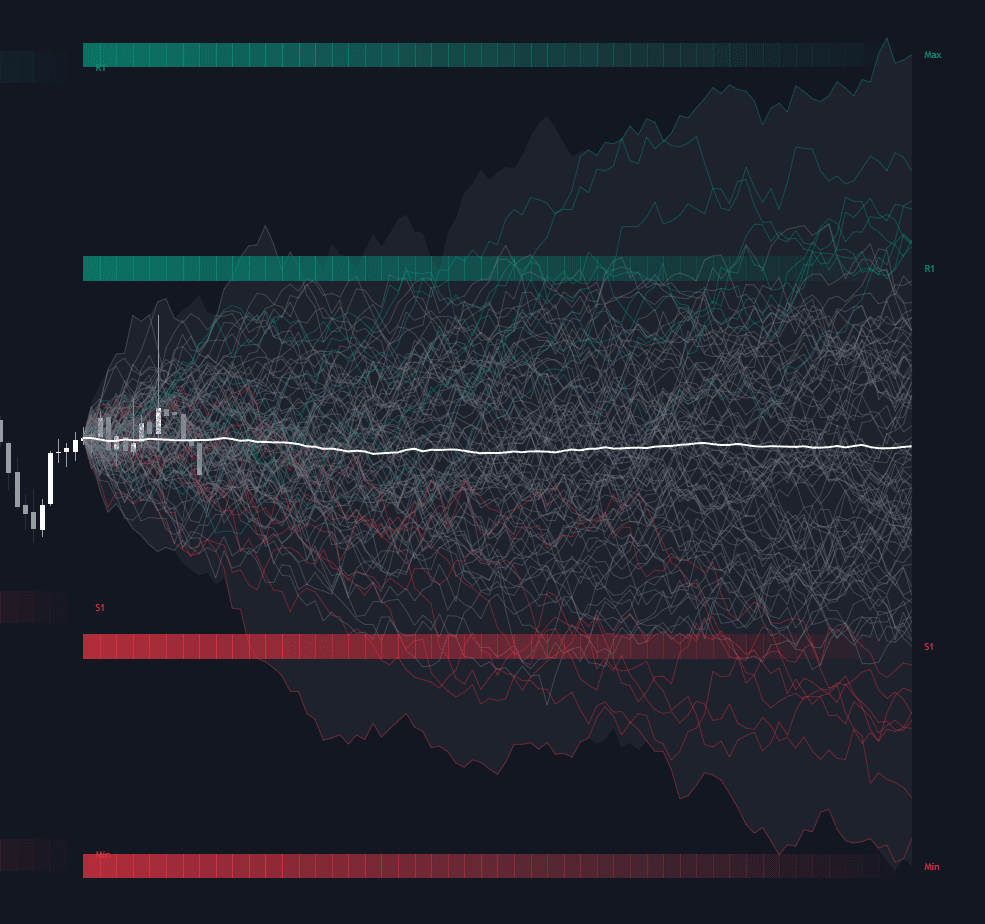
The Predictive Monte Carlo Engine is a powerful trading indicator and forecasting tool that helps traders simulate hundreds of potential future price paths using probability, historical volatility, and market regime analysis. Instead of presenting a single rigid target, it maps out a range of likely outcomes, helping traders visualize future price distribution, identify volatility-adjusted support and resistance zones, and make better decisions around risk, trade planning, and market expectations.
How to Trade the Predictive Monte Carlo Engine
The indicator projects a wide set of statistically generated price paths from the current bar or from a manually anchored point on the chart. This makes it especially useful for traders who want to evaluate probable future scenarios, estimate expected price ranges, and understand how uncertainty expands over time.
Rather than acting like a traditional directional signal tool, the Predictive Monte Carlo Engine functions as a probabilistic trading strategy aid. It helps traders frame the market in terms of likely distribution, potential volatility envelopes, and scenario-based planning. This makes it valuable for swing traders, day traders, position traders, and anyone building a more data-driven trading strategy.
Users can select from multiple simulation models, filter the historical inputs based on current market conditions, and monitor a real-time dashboard that includes a projected next candle view. The result is a more advanced way to study future price behavior using simulation rather than guesswork.
Using Monte Carlo Projections for Trading Decisions
The engine simulates many possible future paths starting from the current market price. These paths reveal where price could reasonably travel over a chosen projection window based on historical return behavior.
Traders can use the output in several ways:
- Estimate probable upside and downside ranges
- Identify high-probability support and resistance zones
- Measure whether current price is extended relative to expected distribution
- Compare actual future price action against projected paths
- Build better entries, targets, and stop placement using volatility-aware expectations
Because the indicator produces a distribution of outcomes instead of a fixed line, it is particularly helpful in markets where uncertainty and volatility matter more than single-point predictions.
Anchor Mode for Historical Forecast Validation
By default, the simulation updates on every new bar so the projection constantly adapts to the latest conditions. When Anchor Mode is enabled, the forecast starting point becomes fixed and the engine only refreshes after a user-defined number of bars.
This feature is highly practical for traders who want to study how well historical Monte Carlo forecasts performed after they were generated. Instead of recalculating every bar, the projection remains visible so you can observe whether price respected the projected range, swept simulated support or resistance zones, or deviated beyond expectations.
Anchor Mode is useful for:
- Reviewing forecast quality over time
- Backtesting expectation-based trade ideas visually
- Studying how markets behave after volatility-based projections are drawn
- Learning whether projected levels tend to act as magnets, pivots, or failure zones
Monte Carlo Simulation Models Explained
The engine includes three distinct forecasting methodologies, giving traders flexibility depending on the asset class, trading style, and preferred statistical assumptions.
Geometric Brownian Motion (GBM)
Geometric Brownian Motion is one of the most recognized models in financial forecasting. It assumes returns follow a log-normal process, which is useful because it keeps simulated prices positive while incorporating both drift and volatility.
For traders, GBM can be a strong choice when modeling markets that behave relatively continuously and where proportional returns matter more than raw point movement. It is widely used in finance because it offers a realistic structure for price evolution while still being computationally efficient.
Simple Random Walk (SRW)
Simple Random Walk uses an additive process where price changes are sampled from a normal distribution built from historical mean and standard deviation. This method is more direct and easier to interpret.
Traders may prefer SRW when they want a more stripped-down price projection model that focuses on average movement and dispersion without the multiplicative structure of GBM. It can be useful for simpler market forecasting scenarios or for comparing how sensitive a market is to different simulation assumptions.
Historical Shuffle (Bootstrapping)
Historical Shuffle, also known as bootstrapping, does not rely on synthetic random draws in the same way as the other models. Instead, it randomly samples actual historical returns from the selected lookback window.
This is especially valuable because it preserves the real statistical character of the market being traded, including fat tails, volatility clusters, and non-normal return behavior. For many traders, this makes bootstrapping one of the most practical methods for building a more realistic trading forecast.
How Regime Filtering Improves Forecast Quality
One of the most powerful features of the Predictive Monte Carlo Engine is Regime Filtering. Instead of calculating drift and volatility from all historical bars equally, the engine can limit its analysis to periods that resemble the current market environment.
For example, if the current market is trending upward, the indicator can pull inputs only from previous bullish trend phases. If momentum conditions match a certain profile, it can forecast from bars that displayed similar momentum characteristics.
This can help improve relevance because the projection is based on comparable historical behavior rather than unrelated market states.
Trend and Momentum Regimes
The regime filters allow traders to isolate simulations based on:
- Trend conditions, typically defined through moving average logic such as SMA-based direction
- Momentum conditions, typically defined through oscillators such as RSI
This makes the tool more adaptable to different trading strategies. A trader focused on trend continuation can model future scenarios using historical trend-aligned data, while a momentum trader can forecast using bars that matched the current momentum regime.
Forecast-Based Support and Resistance Zones
The Predictive Monte Carlo Engine also functions as a support and resistance mapping tool. After running its simulations, it identifies four important levels from the future price distribution:
- Max: The upper extreme of the projected range
- R1: The 90th percentile resistance zone
- S1: The 10th percentile support zone
- Min: The lower extreme of the projected range
These are displayed as horizontal zones that gradually fade as they move farther into the future. This fading effect is not just visual polish. It communicates a key principle of forecasting: uncertainty increases with time.
For traders, these levels can serve as:
- Profit-taking references
- Risk boundaries
- Price reaction zones
- Mean reversion targets
- Context for breakout or exhaustion analysis
Real-Time Dashboard and Next Candle Projection
The built-in dashboard adds a practical layer of usability by summarizing the forecast visually and statistically. One of the most unique features is the Next Candle Prediction, which uses the one-bar-ahead mean and distribution to generate a text-based forecast candle.
This offers a fast read on what the model expects for the next period and can be useful for traders who want a compact summary of short-term directional bias, expected range, and probabilistic candle structure.
The dashboard helps turn a complex simulation engine into a readable trading workspace, making advanced forecasting more accessible during live market analysis.
Indicator Settings
Monte Carlo Engine Settings
- Simulation Method: Select between Geometric Brownian Motion, Simple Random Walk, or Historical Shuffle depending on how you want future paths generated.
- Regime Filter: Restrict historical inputs to Trend or Momentum conditions that resemble the current environment.
- Historical Lookback: Sets how many past bars are used to calculate return behavior, drift, and volatility.
- Projection Length: Controls how far into the future the simulated paths extend.
- Simulation Count: Defines how many individual price paths are generated, up to 200.
- Volatility Multiplier: Increases or decreases the volatility input to simulate normal conditions or more aggressive stress-test scenarios.
- Anchor Mode: Locks the projection so it only refreshes after a chosen number of bars instead of updating continuously.
Style Settings
- Path Percentiles: Controls the thresholds used to classify and color upper and lower path groups.
- Colors: Lets users customize bullish, bearish, neutral, and average projection colors.
- Show S/R Levels: Turns the fading support and resistance projection zones on or off.
Dashboard Settings
- Show Dashboard: Displays or hides the statistical summary table.
- Next Candle Prediction: Enables the forecasted candle visualization based on the one-step-ahead projected distribution.
Why Traders Use the Predictive Monte Carlo Engine
This trading indicator stands out because it helps traders think in probabilities instead of fixed predictions. Markets are uncertain by nature, and the Predictive Monte Carlo Engine embraces that reality by offering a full range of statistically possible outcomes.
It can be especially useful for traders who want to:
- Improve scenario planning
- Build more realistic expectations for future price movement
- Understand whether current volatility supports a breakout or reversal idea
- Map projected support and resistance zones using data instead of guesswork
- Add a probabilistic layer to an existing trading strategy
For traders who value risk management, volatility forecasting, and price distribution analysis, this tool offers a more advanced framework than traditional single-line projection indicators.
FAQ
What is the Predictive Monte Carlo Engine trading indicator?
The Predictive Monte Carlo Engine is a forecasting and probability-based trading indicator that simulates many possible future price paths using historical returns, volatility, and market regime filters. It helps traders visualize future price distribution, estimate expected ranges, and identify projected support and resistance zones.
How does the Predictive Monte Carlo Engine help with trading strategy development?
It helps traders build more informed trading strategies by showing likely future market outcomes instead of just one prediction. This can improve trade planning, target placement, stop-loss decisions, and overall market context.
Which simulation method is best: GBM, SRW, or Historical Shuffle?
Each method serves a different purpose. GBM is a classic financial model, SRW offers a simpler additive structure, and Historical Shuffle is often preferred when traders want to preserve the asset’s actual return behavior, including fat tails and irregular volatility.
What does Anchor Mode do?
Anchor Mode fixes the starting point of the projection and only updates the simulation after a chosen number of bars. This allows traders to compare actual price action against older forecasts and visually evaluate how the projection performed over time.
Can this indicator be used for support and resistance analysis?
Yes. The tool generates projected Max, Min, R1, and S1 levels from the simulation distribution, making it useful for identifying future support and resistance zones based on probability rather than static chart structure alone.
How do I access the Predictive Monte Carlo Engine?
You can get access on the LuxAlgo Library for charting platforms like TradingView, MetaTrader (MT4/MT5), and NinjaTrader for free.
Trading & investing are risky and many will lose money in connection with trading and investing activities. All content on this site is not intended to, and should not be, construed as financial advice. Decisions to buy, sell, hold or trade in securities, commodities and other investments involve risk and are best made based on the advice of qualified financial professionals. Past performance does not guarantee future results.
Hypothetical or Simulated performance results have certain limitations. Unlike an actual performance record, simulated results do not represent actual trading. Also, since the trades have not been executed, the results may have under-or-over compensated for the impact, if any, of certain market factors, including, but not limited to, lack of liquidity. Simulated trading programs in general are designed with the benefit of hindsight, and are based on historical information. No representation is being made that any account will or is likely to achieve profit or losses similar to those shown.
Testimonials appearing on this website may not be representative of other clients or customers and is not a guarantee of future performance or success.
As a provider of technical analysis tools and strategies, we do not have access to the personal trading accounts or brokerage statements of our customers. As a result, we have no reason to believe our customers perform better or worse than traders as a whole based on any content, tool, or platform feature we provide.
Charts used on this site are by TradingView in which the majority of our technical indicators are built on. TradingView® is a registered trademark of TradingView, Inc. www.TradingView.comTradingView® has no affiliation with the owner, developer, or provider of the Services described herein.
Market data is provided by CBOE, CME Group, BarChart, CoinAPI. CBOE BZX real-time US equities data is licensed from CBOE and provided through BarChart. Real-time futures data is licensed from CME Group and provided through BarChart. Select cryptocurrency data, including major coins, is provided through CoinAPI. All data is provided “as is” and should be verified independently for trading purposes.
This does not represent our full Disclaimer. Please read our full disclaimer.
© 2026 LuxAlgo Global, LLC.