Predictive Ranges
 By LuxAlgoJun 29, 2023
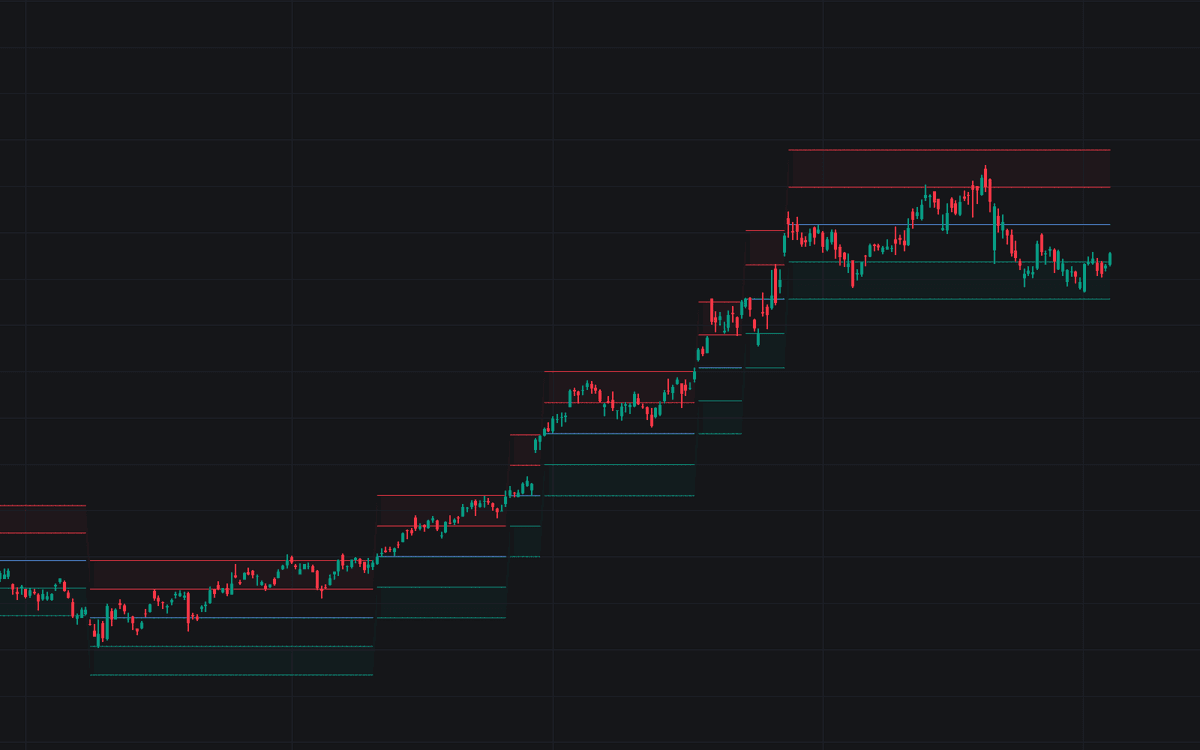

Predictive Ranges forecasts the trading range price is likely to respect next, projecting support and resistance levels around a central estimate of price's tendency. Its width logic rests on the same foundation as ATR bands, an average-true-range measure scaled by a factor, but the output is a forward range that holds its ground instead of an envelope glued to price. Originally a premium feature, it was open-sourced in response to its popularity and remains one of the house's signature tools.
How to Trade the Predictive Ranges?
- Range extremes: price approaching the upper or lower boundary often precedes a reversal (cues for fades, exits, or tightening stops).
- Central level slope: a rising central level reads as an uptrend, a falling one as a downtrend, the quickest trend check the tool offers.
- Range breaks: when price escapes the projected range, new levels print in real time, so the map never goes stale.
- Stability by design: levels do not repaint. They hold their positions until a new range is defined, which makes them dependable planning references.
Raising the Factor produces broader, longer-lived ranges that are statistically less likely to be exceeded, a steadier frame for longer-term analysis.
Predictive Ranges Settings
- Length: the ATR length used in the calculation; higher values generally yield ranges of consistent width.
- Factor: controls range width. Higher values give broader, less frequent ranges.
- Timeframe: generates the output from a timeframe other than the chart's.
- Source: the indicator's input source; matching it to the price scale keeps readings coherent.
Frequently Asked Questions
Free indicator
Get free access to this indicator on the platforms below.

The Library is free. Quant makes it yours.
Pull any concept or indicator into Quant: rebuild it, retune it, or turn it into a backtested strategy of your own.