Pretty Good Oscillator
 By LuxAlgoJul 19, 2026
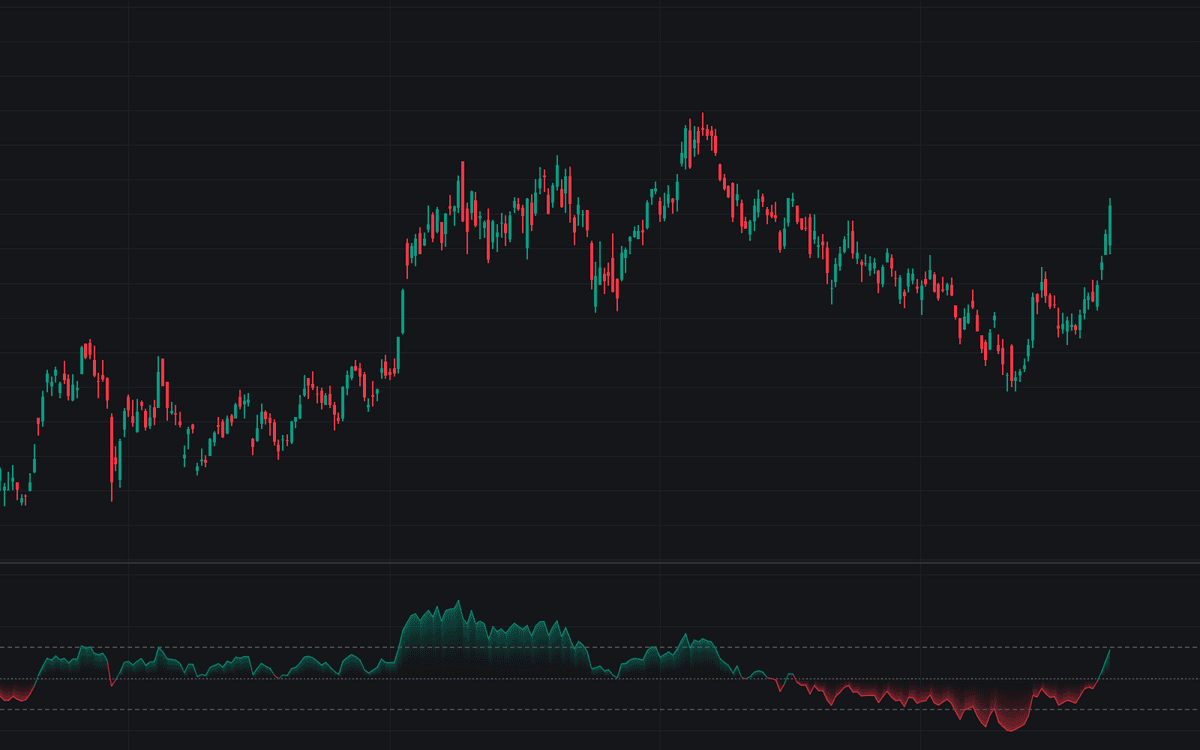

Pretty Good Oscillator answers one question in portable units: how far has the close traveled from its own average, measured in typical bar ranges? The build follows the original recipe for the Pretty Good Oscillator (source minus its simple moving average, divided by a smoothed true range of the same length), so a reading of +3 means price sits about three average bars above its baseline on any instrument. The PGO line colors by sign, with a gradient fill to zero and dashed threshold lines.
How to Trade the Pretty Good Oscillator?
- Cross above the Upper Threshold (+3): displacement has reached the territory Johnson's long-term system treated as an upside breakout; the Bullish Breakout alert marks it.
- Cross below the Lower Threshold (-3): the mirrored downside condition, covered by the Bearish Breakout alert.
- Zero crosses: the source moved back through its baseline, the slower trend-side read, with alerts both ways.
Because the denominator is a true-range average, the thresholds keep one meaning whether the tape is quiet or wild, the reason to prefer it over a raw distance-from-average plot.
Pretty Good Oscillator Settings
- Length (default 89): lookback for both the baseline and the smoothed true range. The default is Johnson's long-term setting; dropping to 14 or 21 speeds the line up and adds noise.
- Source (default close): the series measured against its baseline.
- True Range Smoothing (default EMA): average type in the denominator; SMA is the variant, with modestly different readings.
- Upper Threshold (default 3) and Lower Threshold (default -3): the breakout levels, in smoothed true-range units. Shorter lengths usually pair with tighter values.
- Gradient Fill (default on) plus bullish, bearish and level colors.
Frequently Asked Questions

The Library is free. Quant makes it yours.
Pull any concept or indicator into Quant: rebuild it, retune it, or turn it into a backtested strategy of your own.