


Proximal Range Filter
Feb 13, 2026
The Proximal Range Filter is an advanced trading indicator designed to identify true market trends while filtering out random price noise. By leveraging an L1 soft-thresholding mechanism and volatility-adjusted thresholds, this trading strategy tool helps traders focus on meaningful price movements instead of reacting to every minor fluctuation. The result is a smoother, more structured trend filter that minimizes lag while maintaining strong responsiveness in dynamic markets like crypto, indices, forex, and equities.
How to Trade with the Proximal Range Filter Indicator
The Proximal Range Filter is primarily used to detect trend direction and significant price shifts while ignoring low-probability market noise. Unlike traditional moving averages that constantly adjust to every tick, this trading indicator remains stable during consolidation and only “steps” when price exceeds a statistically meaningful threshold.
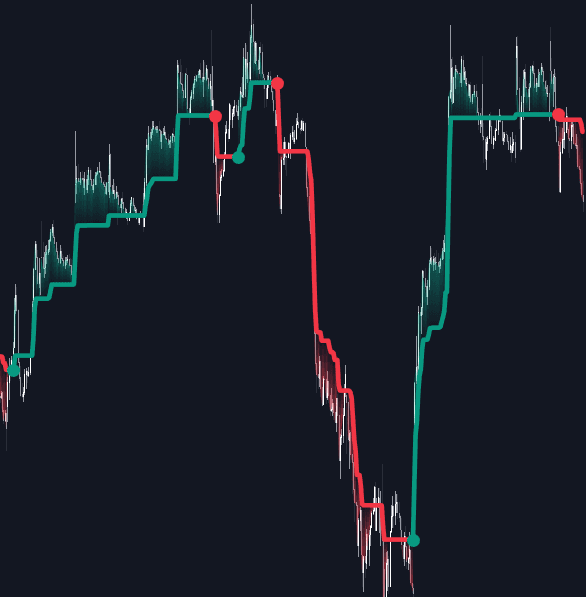
The filter is plotted directly on the chart as a colored line with gradient fill, making trend conditions visually intuitive.
Identifying Bullish and Bearish Trends
Traders can quickly assess market sentiment by observing the filter’s color and position relative to price:
- Green Line + Green Fill: Indicates a bullish trend. Price has exceeded the upper noise threshold, signaling sustained upward momentum.
- Red Line + Red Fill: Indicates a bearish trend. Price has broken below the lower threshold, confirming downside pressure.
This structure makes the indicator highly suitable for trend-following strategies, breakout trading, and systematic position management.
Trading Trend Switches
One of the most powerful features of this trading strategy tool is the Trend Switch Dots.
These dots are plotted exactly where the filter confirms a directional shift. Instead of repainting or reacting prematurely, the filter confirms the trend reversal only after price has convincingly broken beyond the defined noise range.
The dots are positioned at the previous filter level to mark:
- The origin of the new trend
- The breakout level that invalidated the prior range
- A potential entry or confirmation point for systematic traders
This makes the Proximal Range Filter particularly effective for traders who rely on objective trend confirmation rather than subjective price interpretation.
Adjusting Responsiveness for Different Market Conditions
The indicator is highly adaptable across asset classes and volatility environments.
- High-Volatility Assets (e.g., Crypto): Increasing the ATR Multiplier filters out fake breakouts and reduces whipsaws during consolidation.
- Strong Trending Markets: A higher Adaptation Rate (μ) allows the filter to track price more aggressively once the threshold is exceeded, reducing lag.
- Range-Bound Markets: Lower ATR Multiplier and lower Adaptation Rate create a more stepped structure, highlighting major support and resistance levels formed during flat periods.
This flexibility allows traders to optimize the indicator for scalping, swing trading, or position trading strategies.
How the Proximal Range Filter Works
At its core, the Proximal Range Filter uses an L1 Proximal Optimization approach with soft-thresholding logic. This mathematical framework ensures that only statistically meaningful price movements influence the trend state.
Unlike standard moving averages that react continuously, this filter operates using a structured prediction–adaptation cycle.
Core Calculation Logic
The internal process follows four key steps:
-
Noise Threshold (Volatility Scaling):
A 200-period ATR is calculated and multiplied by the user-defined ATR Multiplier. This creates a dynamic volatility-adjusted threshold that automatically adapts to changing market conditions. -
State Prediction:
The algorithm predicts the next filter value using the previous filtered state and current velocity (rate of change). -
Adaptive Blending:
The prediction is blended with new price data using the Adaptation Rate (μ). This blending produces a temporary candidate value. -
L1 Soft-Thresholding:
If the difference between the candidate and the previous state is smaller than the threshold, the filter remains flat (velocity = 0).
If the difference exceeds the threshold, only the excess beyond the threshold is applied, isolating the meaningful portion of the move.
This approach allows the trading indicator to:
- Ignore random volatility
- Reduce lag compared to traditional smoothing methods
- Preserve strong directional moves
- Create clear “step-like” support and resistance structures
Why L1 Soft-Thresholding Matters in Trading
Most smoothing-based indicators (like EMA or SMA) apply uniform weighting, which means they react to both noise and real moves.
The Proximal Range Filter uses a selective update mechanism:
- Small moves = ignored
- Large statistically significant moves = applied
This makes it ideal for traders who want a volatility-aware trend filter without the excessive lag of conventional moving averages.
Understanding Trend Switch Dots
Trend changes are confirmed only after the current bar establishes a new filter direction relative to the previous one. Because of this confirmation logic, Trend Switch Dots are plotted with a -1 offset.
This ensures:
- No premature signals
- Clear confirmation-based entries
- Objective identification of breakout levels
For systematic traders and algorithmic strategies, this structure provides a clean binary trend state (bullish or bearish).
Indicator Settings Explained
The Proximal Range Filter offers simple but powerful configuration options:
-
Source:
Defines the price input used in calculations (typically Close). -
ATR Multiplier:
Controls the noise threshold.
Higher values = smoother filter, fewer signals, stronger breakout confirmation.
Lower values = more responsive filter, earlier trend detection. -
Adaptation Rate (μ):
Controls how quickly the filter adapts to price once the threshold is exceeded.
1.0 = most aggressive reaction
Lower values = more gradual adaptation and smoother transitions
Balancing these two parameters allows traders to tailor the indicator to different market regimes and trading strategies.
Practical Trading Strategy Applications
The Proximal Range Filter can be integrated into multiple trading approaches:
- Trend-Following Systems: Trade only in the direction of the filter color.
- Breakout Strategies: Enter positions at Trend Switch Dots after threshold confirmation.
- Volatility Filtering: Avoid trading during flat filter periods to reduce chop exposure.
- Dynamic Support & Resistance: Use flat filter segments as structural price levels.
Because of its mathematical foundation and volatility adaptation, the indicator performs consistently across crypto, forex, stocks, and futures markets.
FAQ
What makes the Proximal Range Filter different from a moving average?
Unlike traditional moving averages that react to every price fluctuation, the Proximal Range Filter only updates when price exceeds a volatility-adjusted threshold. This reduces noise and false signals while maintaining strong trend detection.
Is this trading indicator suitable for crypto markets?
Yes. By increasing the ATR Multiplier, the filter can handle high-volatility assets like Bitcoin and altcoins while minimizing fake breakouts.
Can I use this indicator for scalping?
Yes. Lower ATR Multiplier and moderate Adaptation Rate settings can make the filter responsive enough for lower timeframes.
How do I access the Proximal Range Filter?
You can get access on the LuxAlgo Library for charting platforms like TradingView, MetaTrader (MT4/MT5), and NinjaTrader for free.
Trading & investing are risky and many will lose money in connection with trading and investing activities. All content on this site is not intended to, and should not be, construed as financial advice. Decisions to buy, sell, hold or trade in securities, commodities and other investments involve risk and are best made based on the advice of qualified financial professionals. Past performance does not guarantee future results.
Hypothetical or Simulated performance results have certain limitations. Unlike an actual performance record, simulated results do not represent actual trading. Also, since the trades have not been executed, the results may have under-or-over compensated for the impact, if any, of certain market factors, including, but not limited to, lack of liquidity. Simulated trading programs in general are designed with the benefit of hindsight, and are based on historical information. No representation is being made that any account will or is likely to achieve profit or losses similar to those shown.
Testimonials appearing on this website may not be representative of other clients or customers and is not a guarantee of future performance or success.
As a provider of technical analysis tools and strategies, we do not have access to the personal trading accounts or brokerage statements of our customers. As a result, we have no reason to believe our customers perform better or worse than traders as a whole based on any content, tool, or platform feature we provide.
Charts used on this site are by TradingView in which the majority of our technical indicators are built on. TradingView® is a registered trademark of TradingView, Inc. www.TradingView.com TradingView® has no affiliation with the owner, developer, or provider of the Services described herein.
Market data is provided by CBOE, CME Group, BarChart, Massive, CoinAPI. Select U.S. equities data is provided through Massive. CBOE BZX real-time U.S. equities data is licensed from CBOE and provided through BarChart. Real-time futures data is licensed from CME Group and provided through BarChart. Select cryptocurrency data, including major coins, is provided through CoinAPI. All data is provided “as is” and should be verified independently for trading purposes.
This does not represent our full Disclaimer. Please read our full disclaimer.
© 2026 LuxAlgo Global, LLC.