Rainbow Adaptive RSI
 By LuxAlgoDec 16, 2020
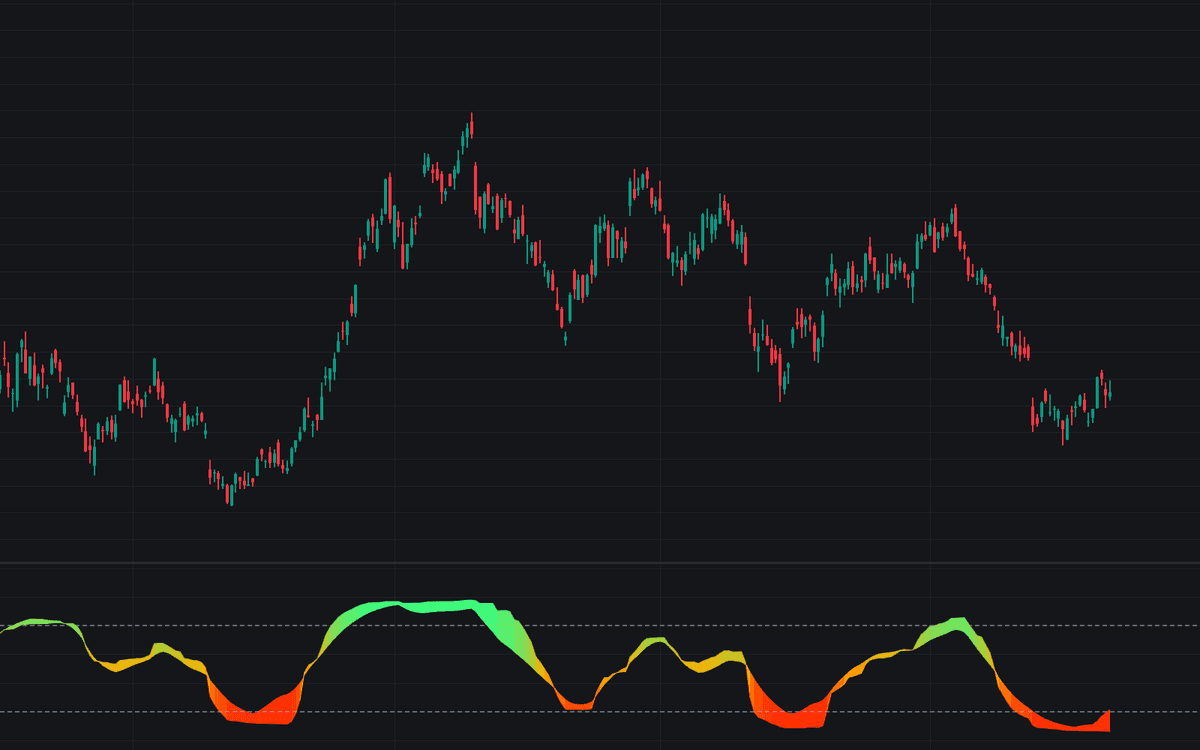

Rainbow Adaptive RSI feeds an RSI with an adaptive moving average instead of raw price, placing it in the adaptive RSI family. The smoothing factor is computed from an RSI of the moving average's own error (not of the closing price), which lets the oscillator minimize retracement impact without introducing significant lag. And unlike a classical RSI, which converges toward 50 as Length grows, this one keeps its range thanks to the smooth input.
How to Trade the Rainbow Adaptive RSI?
- Extremes: read it like any normalized oscillator. Stretched values warn that the current move is extended.
- Trigger line crosses: the trigger is a smoothed RSI built on an EMA input, deliberately avoiding the extremes near 0 and 100; crosses against the main oscillator, optionally marked with circles, highlight entry points while staying quiet through retracements.
- Power tuning: raise Power to mute minor fluctuations when conditions turn choppy.
It slots into the same workflows as other momentum oscillators, with one specific aim: keeping signals steady through pullbacks that would whip a conventional oscillator around.
Rainbow Adaptive RSI Settings
- Length: the oscillator's period.
- Power: sensitivity to retracements. Increase it to stabilize the line in volatile conditions.
- Src: the source series the oscillator runs on.
- Gradient / Color Fill / Circles: appearance options, gradient palette ("Red To Green", "Red To Blue", or "None"), the fill between oscillator and trigger (on by default), and markers on crosses.
Frequently Asked Questions
Free on Vela
Run it on Vela. Go further with a paid plan.
- Up to 500 strategy alerts, with webhook automation
- Up to 10× the chart history of Free
- Orderflow lookback up to full history
- Up to 100,000 monthly credits for Quant to customize it
- Futures data alongside crypto, stocks, forex and commodities
Also on other platforms
Get free access to this indicator elsewhere.

The Library is free. Quant makes it yours.
Pull any concept or indicator into Quant: rebuild it, retune it, or turn it into a backtested strategy of your own.