Sector Correlation Matrix
Feb 19, 2026

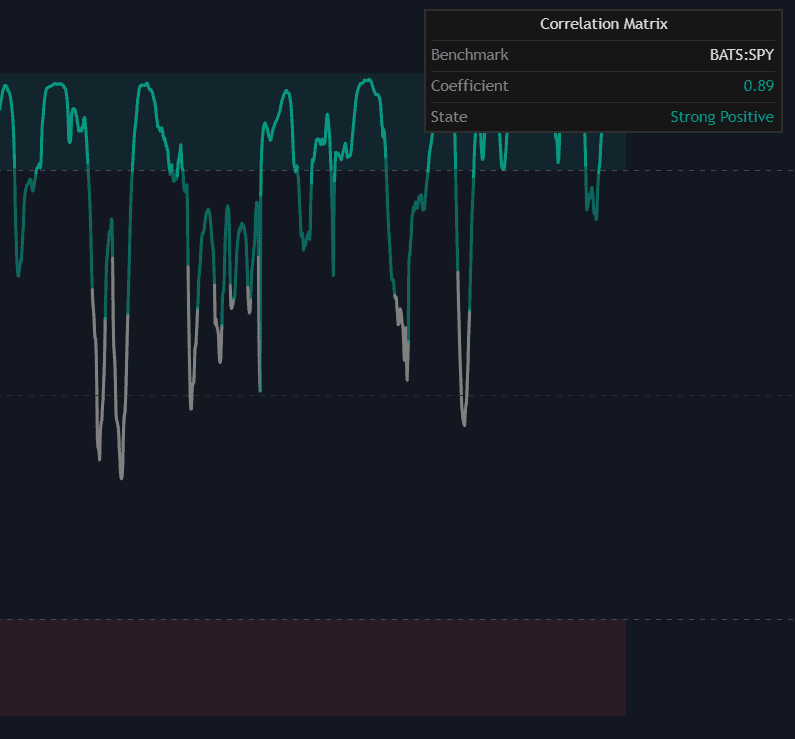
The Sector Correlation Matrix is a powerful trading indicator designed to measure the statistical relationship between any asset and a chosen benchmark. By calculating rolling correlation values, this tool helps traders instantly understand whether a stock, ETF, forex pair, or cryptocurrency is moving in sync with the broader market or acting independently. It is an essential addition to any trading strategy focused on relative strength, sector rotation, and market confirmation.
How to Trade the Sector Correlation Matrix Indicator?
This trading indicator is particularly effective for identifying market synchronization, divergence, and hidden strength or weakness.
For example:
- If a stock is Decoupled while the benchmark (such as SPY or QQQ) is falling sharply, this may signal strong relative performance and institutional accumulation.
- If correlation is Strong Positive, a price breakout is more likely part of a broader market trend rather than an isolated move.
- If correlation turns Strong Negative, traders can identify hedging opportunities or defensive positioning.
By monitoring correlation states in real time, traders can:
- Confirm breakouts and breakdowns.
- Identify sector leadership and laggards.
- Detect early signs of trend rotation.
- Filter false signals in volatile conditions.
- Improve risk management through diversification awareness.
This makes the Sector Correlation Matrix a valuable confirmation tool for day traders, swing traders, and long-term investors alike.
Understanding the Correlation States
The indicator categorizes the market relationship into five distinct states based on the Pearson Correlation Coefficient value:
- Strong Positive (> 0.7): High degree of synchronization; both assets move closely together.
- Moderate Positive (> 0.3): General tendency to move in the same direction.
- Decoupled / Neutral (-0.3 to 0.3): No significant linear relationship; the asset is moving independently.
- Moderate Negative (< -0.3): General tendency to move in opposite directions.
- Strong Negative (< -0.7): High degree of inverse synchronization.
These clearly defined zones make the indicator easy to interpret, even for traders new to statistical tools. Instead of manually comparing charts side by side, the correlation oscillator summarizes the relationship into actionable trading insights.
Indicator Calculation & Statistical Foundation
At its core, this trading tool uses the Pearson Correlation Coefficient to calculate rolling correlation between the current chart’s closing price and a user-defined benchmark.
The Pearson coefficient measures linear correlation between two datasets and outputs a value between:
- +1 → Perfect positive correlation
- 0 → No linear correlation
- -1 → Perfect negative correlation
The core calculation logic:
// Core Calculation Logic correlationValue = ta.correlation(close, benchClose, corrLenInput)
This rolling correlation ensures the indicator adapts dynamically to changing market conditions, making it suitable for short-term scalping strategies and longer-term portfolio analysis.
Why Correlation Matters in Trading Strategies
Correlation is one of the most overlooked components of technical analysis. However, understanding synchronization between assets can dramatically improve trading performance.
1. Market Confirmation
If an asset is strongly correlated with a benchmark like SPY, confirming a breakout becomes statistically stronger when both move together.
2. Relative Strength & Decoupling
When correlation weakens or turns neutral, the asset may be entering an independent trend phase — often an early signal of leadership.
3. Risk Management
High positive correlation across portfolio positions increases exposure risk. Negative or neutral correlation improves diversification.
4. Sector Rotation Detection
Sudden shifts in correlation can indicate capital rotation between sectors, indices, or crypto assets.
Visual Output & Dashboard
The indicator includes:
- A dedicated correlation oscillator pane.
- Clearly defined state zones.
- An on-screen dashboard with real-time correlation metrics.
The dashboard allows traders to quickly assess:
- Current correlation value.
- Market state classification.
- Statistical synchronization at a glance.
This eliminates the need to manually overlay and compare multiple charts.
Customization & Settings
Logic Settings
- Benchmark Asset: Select the ticker symbol to compare against (e.g., SPY, QQQ, BTCUSDT, major indices, forex pairs, or commodities).
- Correlation Length: Adjust the lookback period used to calculate the Pearson Correlation Coefficient. Shorter lengths react faster; longer lengths smooth noise.
Dashboard Settings
- Show Dashboard: Enable or disable the real-time information table.
- Position: Choose dashboard placement (Top Right, Bottom Right, Bottom Left).
- Size: Adjust text and cell size (Tiny to Huge) for optimal visibility.
These flexible settings allow the trading indicator to adapt to different charting styles and timeframes.
Frequently Asked Questions
What is the Sector Correlation Matrix indicator used for?
It is used to measure statistical correlation between an asset and a benchmark, helping traders identify synchronization, divergence, relative strength, and hedging opportunities.
Is this indicator suitable for crypto and forex?
Yes. It works on stocks, ETFs, crypto pairs like BTCUSDT, forex pairs, and commodities — as long as a benchmark symbol is provided.
How does correlation improve trading decisions?
Correlation helps confirm trends, detect early decoupling, improve diversification, and reduce false breakout signals.
How do I access the Sector Correlation Matrix?
You can get access on the LuxAlgo Library for charting platforms like TradingView, MetaTrader (MT4/MT5), and NinjaTrader for free.
Trading & investing are risky and many will lose money in connection with trading and investing activities. All content on this site is not intended to, and should not be, construed as financial advice. Decisions to buy, sell, hold or trade in securities, commodities and other investments involve risk and are best made based on the advice of qualified financial professionals. Past performance does not guarantee future results.
Hypothetical or Simulated performance results have certain limitations. Unlike an actual performance record, simulated results do not represent actual trading. Also, since the trades have not been executed, the results may have under-or-over compensated for the impact, if any, of certain market factors, including, but not limited to, lack of liquidity. Simulated trading programs in general are designed with the benefit of hindsight, and are based on historical information. No representation is being made that any account will or is likely to achieve profit or losses similar to those shown.
Testimonials appearing on this website may not be representative of other clients or customers and is not a guarantee of future performance or success.
As a provider of technical analysis tools and strategies, we do not have access to the personal trading accounts or brokerage statements of our customers. As a result, we have no reason to believe our customers perform better or worse than traders as a whole based on any content, tool, or platform feature we provide.
Charts used on this site are by TradingView in which the majority of our technical indicators are built on. TradingView® is a registered trademark of TradingView, Inc. www.TradingView.comTradingView® has no affiliation with the owner, developer, or provider of the Services described herein.
Market data is provided by CBOE, CME Group, BarChart, CoinAPI. CBOE BZX real-time US equities data is licensed from CBOE and provided through BarChart. Real-time futures data is licensed from CME Group and provided through BarChart. Select cryptocurrency data, including major coins, is provided through CoinAPI. All data is provided “as is” and should be verified independently for trading purposes.
This does not represent our full Disclaimer. Please read our full disclaimer.
© 2026 LuxAlgo Global, LLC.