





Spline Quantile Regression Channel
Mar 18, 2026
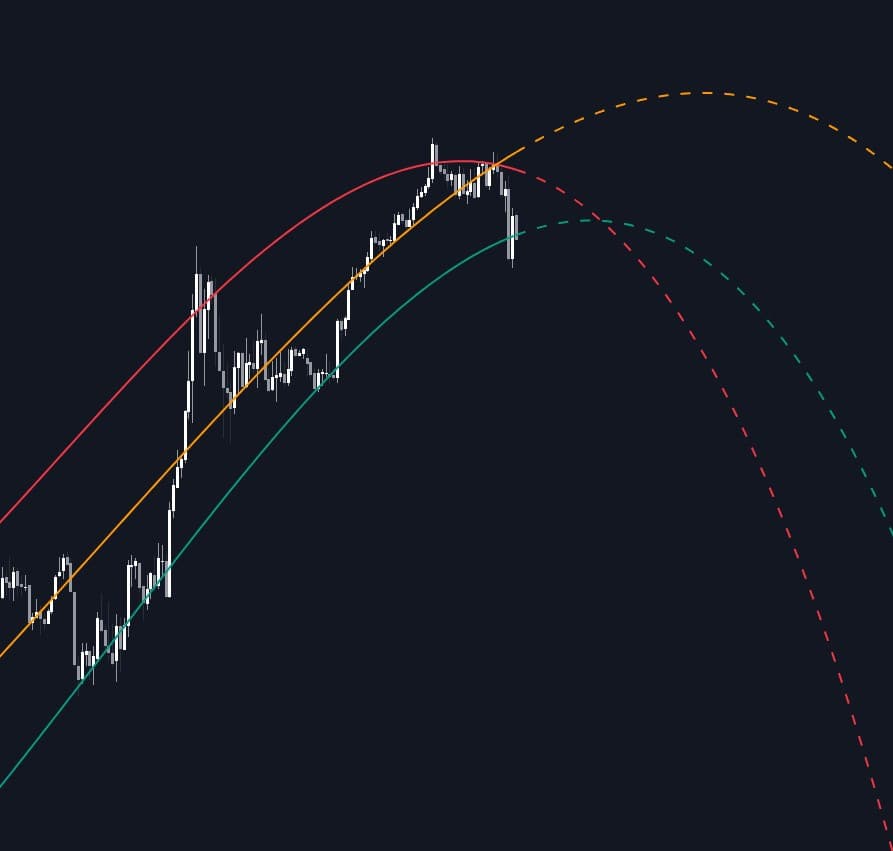
The Spline Quantile Regression Channel indicator is a non-linear trading indicator that maps price into a flexible regression channel using cubic spline quantile modeling instead of a standard straight-line average. By estimating the upper, median, and lower portions of recent price distribution, it creates adaptive support and resistance levels that can better reflect curved trends, changing volatility, and uneven market structure. For traders looking for a more advanced trend-following and mean-reversion framework, this indicator offers a dynamic way to analyze both the direction of the market and where price sits within its recent statistical range.
How to Trade the Spline Quantile Regression Channel Indicator
This trading indicator is built to give a more realistic view of price behavior than traditional linear regression tools. Rather than forcing price into a single straight trend line, it uses cubic splines to create a bendable channel that adjusts to the actual shape of the market. That makes it especially useful for traders analyzing trending markets, pullbacks, overextensions, and non-linear price action.
Because the channel is based on quantiles, it does not just show an average path. It shows where the market has recently traded near its center and where it has reached statistically higher or lower extremes. This gives traders a cleaner framework for reading trend strength, identifying dynamic support and resistance, and spotting when price may be stretched.
Identifying Trend Direction With the Median Spline
The median spline line, typically set to the 0.5 quantile, acts as the core trend reference. It represents the middle of the recent price distribution and helps traders judge whether the market is generally moving higher, lower, or flattening out.
When the median spline slopes upward, it points to a bullish environment with non-linear upward momentum. When it slopes downward, it suggests a bearish regime. If the slope begins to flatten or change direction, that can signal weakening momentum or an early transition in market structure.
This makes the median line useful for:
- Confirming the prevailing trend before entering a trade.
- Filtering long setups to bullish conditions and short setups to bearish conditions.
- Watching for changes in curvature that may hint at slowing momentum or a developing reversal.
Using the Upper and Lower Bands as Dynamic Support and Resistance
The upper and lower spline bands represent selected quantiles of the recent price distribution, such as the 90th and 10th percentiles. These outer levels act like dynamic support and resistance zones that move with the structure of the market.
- Prices reaching the upper band often indicate overextended conditions within the current lookback period.
- Prices reaching the lower band suggest the asset is trading at the lower end of its recent distribution.
In practice, traders can use these bands in several ways. In a strong uptrend, pullbacks toward the lower or median region may present continuation opportunities. In a strong downtrend, rallies toward the upper or median region may act as resistance. In range-like conditions, repeated touches of the upper and lower quantile bands can help frame mean-reversion ideas.
Because the channel bends with price, these levels can often provide a more context-aware read than flat horizontal zones or rigid regression channels.
Visualizing Potential Future Price Structure
One of the more powerful features of this trading strategy tool is its forward projection. The indicator extends the spline into future bars using a dashed forecast line, giving traders a mathematical extrapolation of the current non-linear trend.
This forecast is not a guarantee of future price. It is best understood as a continuation model based on the existing slope and curvature of the channel. If current momentum, structure, and volatility remain similar, the projected path shows where the distribution may continue to travel.
Traders can use the forecast to:
- Visualize likely path continuation.
- Estimate where future support and resistance may develop.
- Judge whether price is accelerating away from or reverting back toward the modeled trend.
Like any forecasting method, it works best when combined with price action, volume, and broader market context rather than used in isolation.
Why This Trading Indicator Is Different
What separates the Spline Quantile Regression Channel from a traditional regression channel is that it focuses on both shape and distribution. Standard linear regression is centered on the mean and assumes price follows a straight-line tendency. Real markets often do not behave that way. Trends curve, accelerate, stall, and change pace over time.
This indicator addresses that by modeling multiple quantiles with cubic splines. That means traders are not only seeing the central trend but also the upper and lower structure of price movement. The result is a channel that can adapt more naturally to market swings and provide clearer context for trend analysis, support and resistance, and overextension.
Technical Details Behind the Spline Quantile Model
The script uses several advanced mathematical methods to make the channel flexible, robust, and stable enough for charting applications. Even though the calculations are sophisticated, the practical result is straightforward: a more adaptive trend channel trading indicator.
- Cubic Spline Basis: The model uses a piecewise polynomial basis ($1, x, x^2, x^3$) combined with truncated power functions at "knots." This allows the curve to change its curvature locally, adapting to swings that a simple polynomial cannot capture.
- Quantile Optimization: Instead of minimizing squared errors (OLS), the script uses an Iteratively Reweighted Least Squares (IRLS) solver to minimize the "check function." This allows the script to target specific percentiles of the price data.
- Numerical Stability: To prevent matrix overflows common in high-degree polynomial calculations, the script standardizes price data (Z-score) and scales time coordinates between 0 and 1 before performing matrix inversion.
These methods help the indicator remain responsive without becoming overly erratic, which is important when traders need a channel that is both flexible and usable in live market conditions.
Indicator Settings and How to Adjust Them
How to Configure the Spline
- Lookback Period: The number of historical bars used to fit the spline regression. Larger windows result in a more "macro" trend, while smaller windows react quickly to recent changes.
- Internal Knots: Determines the "flexibility" of the spline. More knots allow the curve to follow price swings more tightly, while fewer knots yield a smoother, more rigid curve.
For trading strategy purposes, a longer lookback with fewer knots usually produces a smoother channel that is better for swing trading and higher timeframe trend analysis. A shorter lookback with more knots will make the indicator more reactive, which can be useful for fast-moving markets and short-term trading.
Optimization Settings
- IRLS Iterations: The number of optimization passes for the solver. Higher values improve the accuracy of the quantile fit, especially in volatile markets.
- Forecast Length: The number of bars to project the calculated spline into the future.
More IRLS iterations can improve precision, but traders should balance that against chart responsiveness. Forecast length can be increased for broader visualization or shortened for a more immediate forward view.
Quantile Levels and Channel Width
- Upper Quantile: The specific percentile for the upper band (e.g., 0.95 for the top 5%).
- Median Quantile: The central percentile (typically 0.5 for the median).
- Lower Quantile: The specific percentile for the lower band (e.g., 0.05 for the bottom 5%).
Wider quantile spacing creates a broader channel that captures more extreme price behavior. Narrower spacing creates a tighter channel that may generate more frequent interactions with price. Traders can tune these levels based on the asset, timeframe, and whether they want a more conservative or more reactive support and resistance framework.
Visual Settings
- Colors: Individual color settings for the upper, median, and lower bands.
- Line Width: Controls the thickness of the polylines rendered on the chart.
These settings let traders personalize the chart layout without affecting the underlying model.
Best Ways to Use This Indicator in a Trading Strategy
The Spline Quantile Regression Channel can fit into multiple trading strategies depending on how a trader wants to interpret the channel.
Trend-Following Use Case
In trending markets, traders can use the slope of the median spline as a directional filter. Long trades may be favored when the median is rising and price is holding above it. Short trades may be favored when the median is falling and price is holding below it.
The outer bands can then be used to judge whether price is extending too far from the central trend or pulling back into an area that may offer continuation opportunities.
Mean-Reversion Use Case
When markets are rotating within a contained structure, touches of the upper and lower quantile bands can act as signals that price is reaching a statistically stretched area. In that context, traders may watch for rejection, momentum shifts, or confirmation from other tools before fading the move.
Structure and Forecast Alignment
The projected spline can help traders see whether the current path of price is still aligned with the modeled channel. If price continues respecting the forecast and the median slope remains stable, that can reinforce the current bias. If price sharply diverges from the projection, it may suggest a changing regime or a breakdown in the recent structure.
FAQ
What is the Spline Quantile Regression Channel indicator?
It is a non-linear regression trading indicator that uses cubic splines and quantile regression to create a flexible price channel. Instead of only showing an average trend, it maps the median and outer portions of recent price distribution to create adaptive support and resistance zones.
How is this different from a linear regression channel?
A linear regression channel assumes price follows a straight-line trend around a mean value. The Spline Quantile Regression Channel is more flexible because it can bend with market structure and model specific percentiles of price action, making it better suited for curved trends and changing volatility.
Is this indicator better for trend trading or mean reversion?
It can be used for both. Trend traders can use the slope of the median spline and pullbacks within the channel, while mean-reversion traders can watch for price reaching the upper or lower quantile extremes.
What do the upper and lower bands represent?
They represent user-defined quantiles of recent price behavior, such as the 90th and 10th percentiles. These levels act as dynamic resistance and support zones and help traders see when price is trading near the extremes of its recent distribution.
How should I choose the lookback period and knots?
A larger lookback and fewer knots generally create a smoother channel for higher timeframe analysis. A smaller lookback and more knots make the channel more sensitive to recent price swings, which may be better for short-term trading.
How to access the Spline Quantile Regression Channel?
You can get access on the LuxAlgo Library for charting platforms like TradingView, MetaTrader (MT4/MT5), and NinjaTrader for free.
Trading & investing are risky and many will lose money in connection with trading and investing activities. All content on this site is not intended to, and should not be, construed as financial advice. Decisions to buy, sell, hold or trade in securities, commodities and other investments involve risk and are best made based on the advice of qualified financial professionals. Past performance does not guarantee future results.
Hypothetical or Simulated performance results have certain limitations. Unlike an actual performance record, simulated results do not represent actual trading. Also, since the trades have not been executed, the results may have under-or-over compensated for the impact, if any, of certain market factors, including, but not limited to, lack of liquidity. Simulated trading programs in general are designed with the benefit of hindsight, and are based on historical information. No representation is being made that any account will or is likely to achieve profit or losses similar to those shown.
Testimonials appearing on this website may not be representative of other clients or customers and is not a guarantee of future performance or success.
As a provider of technical analysis tools and strategies, we do not have access to the personal trading accounts or brokerage statements of our customers. As a result, we have no reason to believe our customers perform better or worse than traders as a whole based on any content, tool, or platform feature we provide.
Charts used on this site are by TradingView in which the majority of our technical indicators are built on. TradingView® is a registered trademark of TradingView, Inc. www.TradingView.comTradingView® has no affiliation with the owner, developer, or provider of the Services described herein.
Market data is provided by CBOE, CME Group, BarChart, CoinAPI. CBOE BZX real-time US equities data is licensed from CBOE and provided through BarChart. Real-time futures data is licensed from CME Group and provided through BarChart. Select cryptocurrency data, including major coins, is provided through CoinAPI. All data is provided “as is” and should be verified independently for trading purposes.
This does not represent our full Disclaimer. Please read our full disclaimer.
© 2026 LuxAlgo Global, LLC.