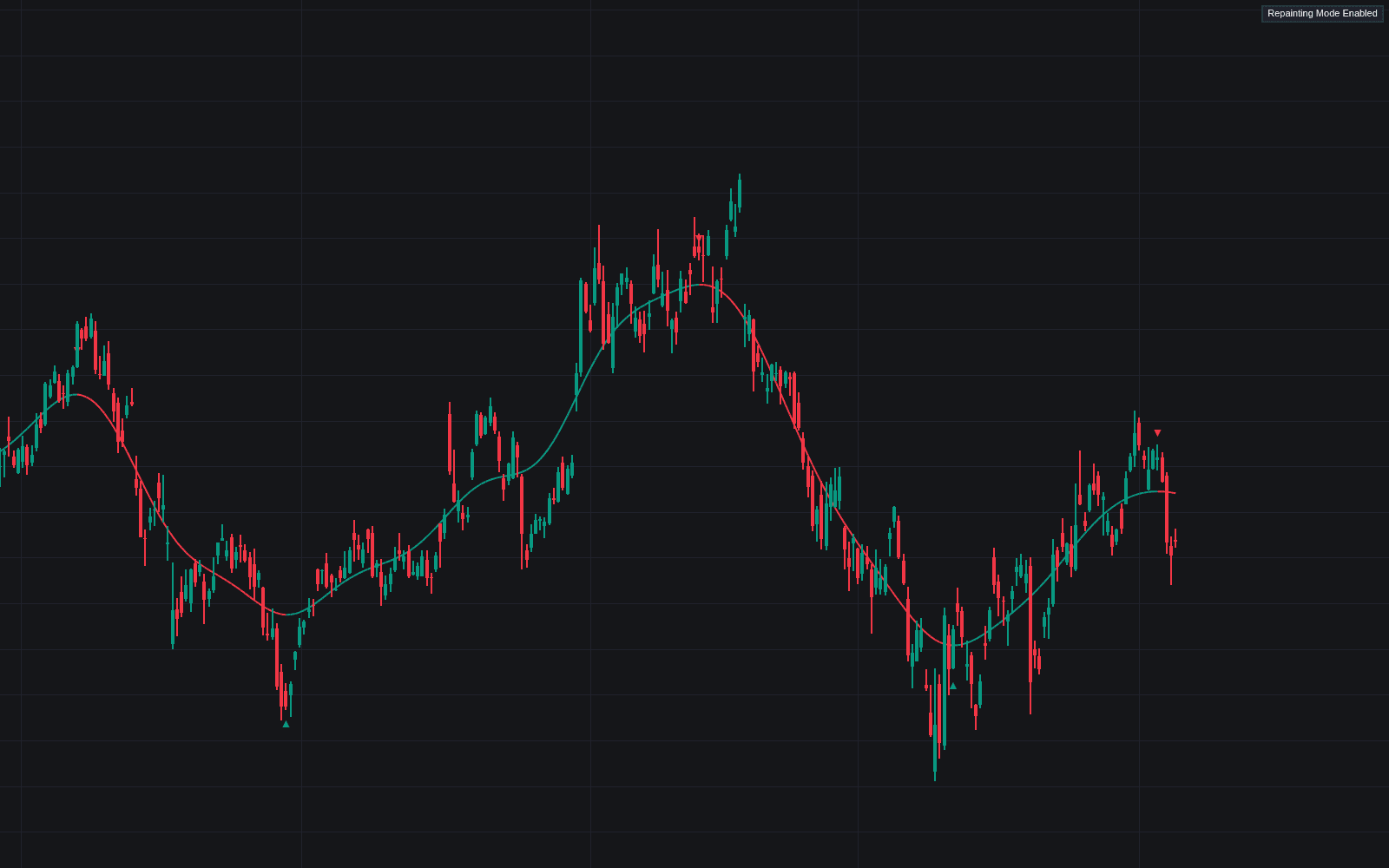
Structural SVM Ranker
Mar 10, 2026

The Structural SVM Ranker is a market structure trading indicator designed to evaluate the strength of structural price movements using a machine learning–inspired ranking model. By applying a linear Support Vector Machine (SVM)–style scoring system to every Break of Structure (BOS) and Change of Character (CHoCH), the indicator ranks structural shifts from 0 to 100 based on volume participation, momentum strength, and price expansion. This allows traders to quickly identify which market structure breaks are statistically meaningful and which are likely weak or false signals.
Unlike traditional market structure indicators that treat every BOS or CHoCH equally, the Structural SVM Ranker provides context and probability by measuring the underlying quality of each break. This helps traders filter out low-quality setups and focus on high-conviction structural moves backed by strong market participation.
How to Trade Market Structure Using the Structural SVM Ranker
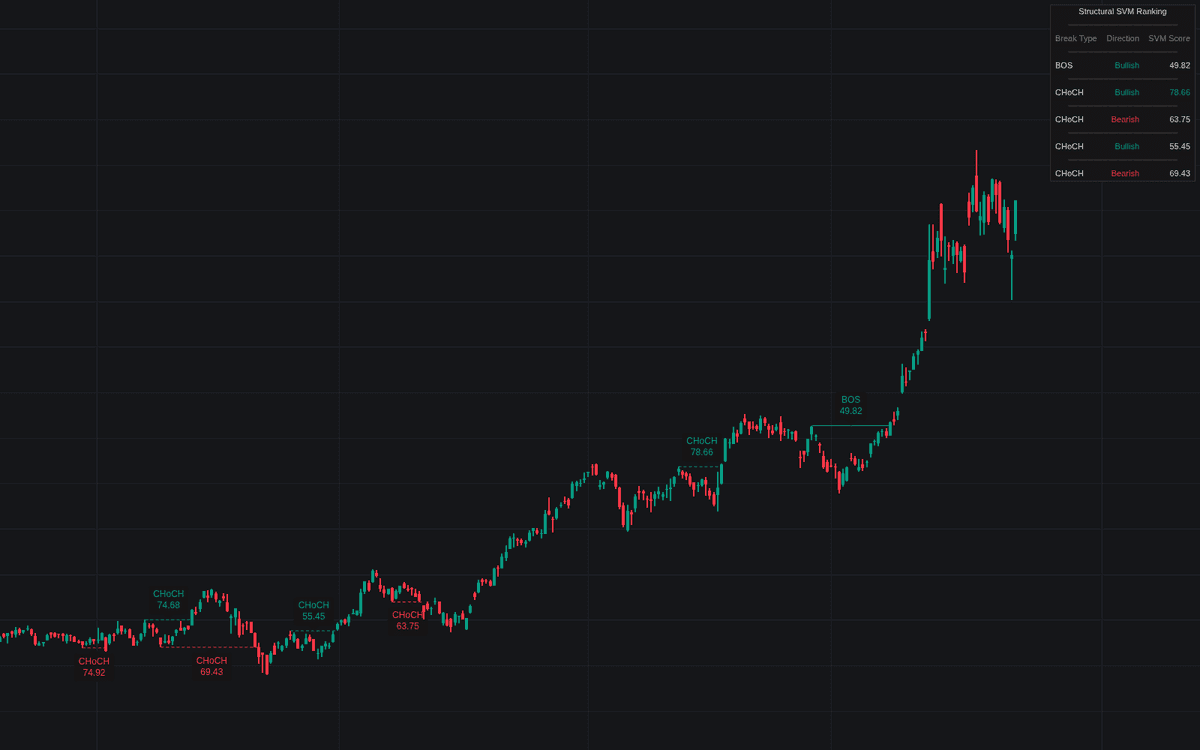
The indicator detects pivot highs and lows to construct a real-time map of market structure. When price closes beyond these structural levels, the script identifies a structural break and assigns it a machine learning–inspired score reflecting the strength of the move.
Traders can then use this score to determine whether the structural break represents a meaningful trend continuation or a potential reversal signal.
-
BOS (Break of Structure): Displayed using solid lines. These signals indicate that price has broken a previous structural level in the direction of the prevailing trend, suggesting potential trend continuation.
-
CHoCH (Change of Character): Displayed using dashed lines. These signals occur when price breaks a structural level in the opposite direction of the current trend, signaling a possible market reversal.
-
SVM Score: Each structural break receives a score between 0 and 100. Higher scores indicate stronger confirmation through volume, momentum, and price expansion.
Because the score incorporates multiple market factors, traders can use it as a filter when building trading strategies. For example:
- A CHoCH above 70 may indicate a strong reversal supported by momentum and volume.
- A BOS above 60–70 may suggest a reliable continuation move.
- A score below 30 often signals weak market participation and may represent a false breakout or liquidity sweep.
This scoring system helps traders avoid reacting to every structural break and instead focus on the highest-probability trading setups.
How the Structural SVM Ranking Model Works
At the core of the indicator is a simplified machine learning approach inspired by linear Support Vector Machines. The algorithm evaluates the strength of each structural break using three key features commonly associated with meaningful price movements.
These features are weighted, combined, and passed through a Sigmoid function to produce a normalized score between 0 and 100.
Relative Volume Analysis
Relative volume measures whether the breakout occurs with significant market participation.
The indicator compares the current volume to its 20-period average. Breakouts that occur during high relative volume conditions typically signal stronger institutional activity and more reliable market structure shifts.
RSI Momentum Confirmation
Momentum plays a critical role in validating structural moves.
The indicator evaluates the distance of the Relative Strength Index (RSI) from its midpoint of 50. The further RSI moves away from 50, the stronger the directional momentum behind the structural break.
This helps confirm whether the breakout is supported by real trend strength or simply short-term price noise.
Break Distance Strength
Break distance measures how far price closes beyond the structural pivot level.
The distance is normalized using the Average True Range (ATR), ensuring the move is evaluated relative to the instrument’s volatility. Large expansions beyond the pivot level typically indicate stronger conviction and increased probability of continuation.
By combining volume, momentum, and volatility-adjusted price expansion, the Structural SVM Ranker produces a more comprehensive evaluation of market structure breaks.
Indicator Settings
The Structural SVM Ranker provides a flexible set of configuration options so traders can tailor the ranking model to different markets and trading strategies.
Market Structure
-
Pivot Lookback: Defines how many bars are required to confirm a pivot high or pivot low. Larger values detect broader swing structures, while smaller values capture more frequent intraday shifts.
-
Show BOS/CHoCH: Enables or disables the visualization of structural break lines and labels on the chart.
SVM Ranking Parameters
These parameters control the weighting of each feature used in the SVM-inspired scoring model.
-
Relative Volume Weight: Adjusts how much influence volume participation has on the final structural score.
-
RSI Momentum Weight: Controls how strongly momentum confirmation contributes to the ranking.
-
Break Distance Weight: Adjusts the influence of price expansion beyond the pivot level relative to ATR.
-
ATR Length: Defines the period used to calculate the Average True Range used for volatility normalization.
Traders can experiment with these weights to align the indicator with different market environments, such as trending markets, high-volatility assets, or lower-liquidity instruments.
Dashboard
The indicator also includes a real-time dashboard that summarizes structural signals and their associated scores.
-
Dashboard: Enables or disables the on-chart ranking table.
-
Position: Allows traders to place the dashboard in different corners of the chart (Top Right, Bottom Right, Bottom Left).
-
Size: Adjusts the size of the dashboard text for improved readability.
The dashboard provides an easy way to monitor the strength of recent structural breaks without needing to inspect each label individually.
Why Structural Ranking Improves Trading Strategies
Many traders rely on market structure concepts such as BOS and CHoCH to identify trend continuation or reversals. However, not every structural break carries the same probability of success.
The Structural SVM Ranker solves this problem by introducing a quantitative scoring system that evaluates the underlying strength of each break. By incorporating volume participation, momentum confirmation, and volatility-adjusted price expansion, traders gain a more reliable way to filter structural signals.
This approach can significantly improve trading strategies that rely on market structure analysis by reducing false breakouts and highlighting the most meaningful price movements.
FAQ
What is the Structural SVM Ranker trading indicator?
The Structural SVM Ranker is a market structure trading indicator that evaluates Break of Structure (BOS) and Change of Character (CHoCH) signals using a machine learning–inspired ranking model. It assigns a score from 0–100 based on volume, momentum, and price expansion.
What does a high SVM score mean?
A higher score indicates that the structural break occurred with strong relative volume, meaningful price expansion beyond the pivot level, and strong RSI momentum. These conditions often signal higher-probability trend continuation or reversal setups.
Can the Structural SVM Ranker be used for any market?
Yes. The indicator can be used across different asset classes including crypto, forex, stocks, and futures. The adjustable parameters allow traders to adapt the scoring model to different market conditions.
How do traders use BOS and CHoCH signals?
BOS signals are typically used to identify trend continuation opportunities, while CHoCH signals can indicate potential market reversals. The SVM score helps traders determine which signals are strongest and most reliable.
How can I access the Structural SVM Ranker?
You can get access on the LuxAlgo Library for charting platforms like TradingView, MetaTrader (MT4/MT5), and NinjaTrader for free.
Trading & investing are risky and many will lose money in connection with trading and investing activities. All content on this site is not intended to, and should not be, construed as financial advice. Decisions to buy, sell, hold or trade in securities, commodities and other investments involve risk and are best made based on the advice of qualified financial professionals. Past performance does not guarantee future results.
Hypothetical or Simulated performance results have certain limitations. Unlike an actual performance record, simulated results do not represent actual trading. Also, since the trades have not been executed, the results may have under-or-over compensated for the impact, if any, of certain market factors, including, but not limited to, lack of liquidity. Simulated trading programs in general are designed with the benefit of hindsight, and are based on historical information. No representation is being made that any account will or is likely to achieve profit or losses similar to those shown.
Testimonials appearing on this website may not be representative of other clients or customers and is not a guarantee of future performance or success.
As a provider of technical analysis tools and strategies, we do not have access to the personal trading accounts or brokerage statements of our customers. As a result, we have no reason to believe our customers perform better or worse than traders as a whole based on any content, tool, or platform feature we provide.
Charts used on this site are by TradingView in which the majority of our technical indicators are built on. TradingView® is a registered trademark of TradingView, Inc. www.TradingView.comTradingView® has no affiliation with the owner, developer, or provider of the Services described herein.
Market data is provided by CBOE, CME Group, BarChart, CoinAPI. CBOE BZX real-time US equities data is licensed from CBOE and provided through BarChart. Real-time futures data is licensed from CME Group and provided through BarChart. Select cryptocurrency data, including major coins, is provided through CoinAPI. All data is provided “as is” and should be verified independently for trading purposes.
This does not represent our full Disclaimer. Please read our full disclaimer.
© 2026 LuxAlgo Global, LLC.