




Support & Resistance Pro Toolkit
 by LuxAlgo · Mar 9, 2026
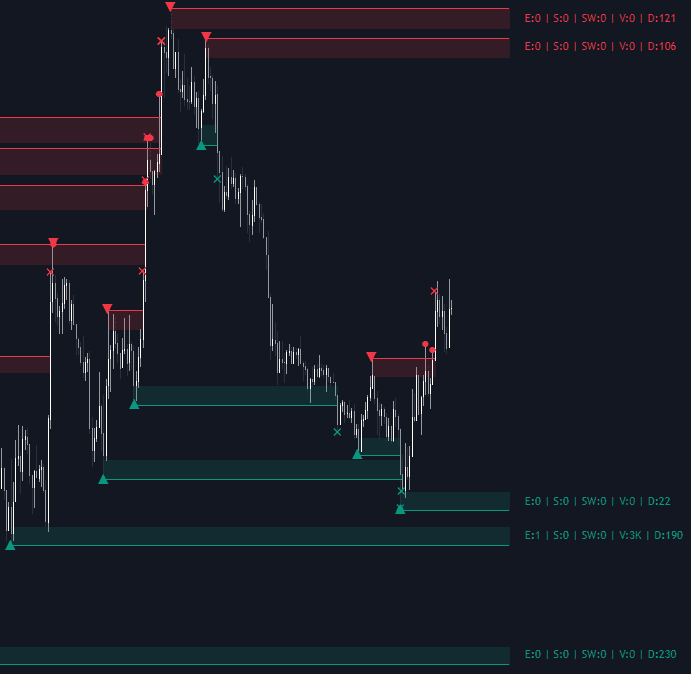
The Support & Resistance Pro Toolkit indicator is a comprehensive structural analysis trading indicator designed to help traders identify high-probability support and resistance levels on TradingView. By combining multiple advanced swing detection algorithms with adaptive volatility zones, institutional filtering, and liquidity analysis, this toolkit transforms traditional support and resistance into a data-driven trading strategy tool. Whether you are a day trader, swing trader, or long-term market analyst, the indicator provides clear visual structures, high-conviction levels, and performance insights to help you understand how price reacts to key market zones.
Unlike simple support and resistance indicators that rely on one detection method, this trading indicator integrates four professional detection engines—Pivots, Donchian Alternating, CSID, and ZigZag—to detect structural turning points with greater precision. These swing points are marked with directional triangle signals, while additional analytics such as liquidity sweeps, re-test counts, and accumulated volume help traders filter for only the most meaningful market structures.
How to Trade With the Support & Resistance Pro Toolkit Indicator
The Support & Resistance Pro Toolkit identifies important market structures using one of four sophisticated detection methods. After a structure is detected, traders can display it as either a precise horizontal level or a dynamic volatility-based zone.
Dynamic zones are calculated using the Average True Range (ATR), allowing the indicator to adapt to market volatility. This ensures support and resistance areas remain realistic regions of price interaction rather than overly precise lines.
Traders can further refine their support and resistance trading strategy by applying filters such as minimum volume participation, liquidity sweeps, re-test counts, or structural duration. These filters help eliminate weak or irrelevant levels so only institutional-grade structures remain on the chart.
Advanced Detection Engines
At the core of any support and resistance trading strategy is accurate swing detection. This toolkit includes four advanced detection methodologies designed to suit different trading styles and market environments:
- Pivots: The classic support and resistance detection approach using configurable left and right lookback strengths to detect local highs and lows.
- Donchian (Alternating): A high-performance state-machine algorithm that detects alternating swing structures. Rather than using fixed lag, it confirms extremes when the market shifts directional state.
- CSID: A momentum-driven detection method that identifies structural turning points based on consecutive bullish or bearish candles, highlighting strong trend initiation zones.
- ZigZag: A volatility-based algorithm that filters minor price fluctuations by requiring a minimum percentage deviation before identifying a swing.
These four detection engines allow traders to adapt the indicator to scalping, intraday trading, or longer-term swing trading strategies.
Adaptive Zone Sizing & Breakout Security Buffer
Support and resistance rarely occur at a single price point. Markets tend to react within zones rather than exact levels. This trading indicator treats support and resistance as adaptive regions using ATR-based calculations.
- Zone Depth (ATR Mult): Determines the thickness of each zone based on the Average True Range. This allows zones to scale automatically with market volatility.
- Breakout Buffer (ATR Mult): A unique security buffer that extends the zone beyond the breakout side. Price must move beyond this additional volatility layer before the indicator confirms a breakout, reducing false signals and fakeouts.
These adaptive zones make the Support & Resistance Pro Toolkit particularly useful for volatile assets such as crypto, forex, and high-beta equities.
Overlap Management & Structural Clarity
Markets often produce multiple overlapping structures, which can clutter charts and reduce clarity. This toolkit includes institutional-grade overlap management to keep support and resistance levels organized.
- Merge Overlapping: Combines intersecting zones into a larger “Super Zone” that represents the full historical interaction range.
- Hide Oldest First: Prioritizes recent market structure by hiding older zones when overlap occurs.
- Hide Youngest First: Preserves established historical structures by ignoring smaller new zones that appear within existing ranges.
This structural hygiene ensures traders can focus on the most relevant price levels when making trading decisions.
Institutional-Level Filtering
Many support and resistance indicators plot too many levels, leading to noise and analysis paralysis. The Support & Resistance Pro Toolkit introduces powerful filters that display only high-conviction structures.
- Price Entries (E): Requires a level to be re-tested a specified number of times before appearing on the chart.
- Strength (S): Measures how many additional swing points develop within the zone during its lifetime.
- Sweeps (SW): Detects liquidity traps where price briefly violates a level with a wick but closes back inside the zone.
- Traded Volume (V): Tracks the total traded volume that occurs while price interacts with the zone, highlighting institutional participation.
- Duration (D): Requires zones to survive for a minimum number of bars before being considered valid structural levels.
These filters allow traders to build highly selective support and resistance trading strategies.
Indicator Details
Visual Signals & Analytic Feedback
To provide actionable insights directly on the chart, the indicator includes several visual markers and analytic overlays:
- ▲/▼ Triangles: Mark the exact bar where swing highs and swing lows are detected by the active algorithm.
- ● Large Dots: Highlight liquidity sweeps where price temporarily breaches a zone but closes back inside.
- Future Projections: Active, unmitigated support and resistance levels extend up to 25 bars into the future, helping traders anticipate potential reaction areas.
Each zone also displays a compact analytic label that updates in real time:
E:Entries | S:Strength | SW:Sweeps | V:Volume | D:Duration
This data provides a quick overview of the structural strength and historical interaction of each support or resistance zone.
The Structural Performance Dashboard
The built-in performance dashboard acts as a command center for evaluating structural behavior across the chart.
The dashboard compares Support, Resistance, and overall totals across several metrics:
- Active / Total: Displays how many structures are currently active compared to the total detected historically.
- Mitigation %: Measures how frequently levels are broken or mitigated, providing insight into market structure reliability.
- Avg Duration: The average number of bars a support or resistance zone survives before being broken.
- Avg Volume: Indicates the average institutional participation within zones before a breakout occurs.
- Total Sweeps: Tracks liquidity hunting behavior across the market.
This dashboard helps traders refine their support and resistance trading strategy by analyzing structural performance.
Indicator Settings
Detection Settings
- Detection Method: Select between Pivots, Donchian, CSID, or ZigZag swing detection logic.
- Swing Sensitivity: Adjusts the required deviation or lookback length needed to confirm swing highs and lows.
Zone & Level Configuration
- Display Style: Switch between precise horizontal support and resistance lines or ATR-based zones.
- ATR Period: Determines the volatility period used for zone calculations.
- Zone Depth (ATR Mult): Adjusts the thickness of support and resistance zones.
- Breakout Buffer (ATR Mult): Adds a volatility buffer to filter out false breakouts.
Chart Visibility & Structure Control
- Overlap Handling: Choose how overlapping zones are handled (Merge, Hide Oldest, or Hide Youngest).
- Max Active (Unmitigated): Limits the number of active support and resistance zones displayed on the chart.
- Show Broken S&R: Toggle whether broken levels remain visible for historical analysis.
- Extend Active S&R: Projects active levels into future price bars.
Minimum Structural Requirements
- Min Price Entries: Sets the required number of re-tests before a level becomes visible.
- Min Overall Strength: Defines the minimum strength score based on internal swing points.
- Min Sweeps: Requires a certain number of liquidity sweeps before displaying the zone.
- Min Traded Volume: Ensures zones meet a minimum institutional participation threshold.
- Min Duration (Bars): Requires levels to exist for a specified number of bars before they appear.
FAQ
What is the Support & Resistance Pro Toolkit indicator?
The Support & Resistance Pro Toolkit is a professional trading indicator that automatically detects high-probability support and resistance levels using advanced swing detection algorithms, liquidity analysis, and adaptive ATR-based zones.
What trading strategies can this indicator be used for?
This indicator can support many trading strategies including support and resistance trading, breakout trading, liquidity sweep trading, and institutional order flow analysis.
Does the indicator work for crypto, forex, and stocks?
Yes. Because the toolkit uses volatility-adjusted zones and multiple detection algorithms, it works effectively across cryptocurrencies, forex pairs, equities, and other financial markets.
How do I access the Support & Resistance Pro Toolkit?
You can get access on the LuxAlgo Library for charting platforms like TradingView, MetaTrader (MT4/MT5), and NinjaTrader for free.

Trading & investing are risky and many will lose money in connection with trading and investing activities. All content on this site is not intended to, and should not be, construed as financial advice. Decisions to buy, sell, hold or trade in securities, commodities and other investments involve risk and are best made based on the advice of qualified financial professionals. Past performance does not guarantee future results.
Hypothetical or Simulated performance results have certain limitations. Unlike an actual performance record, simulated results do not represent actual trading. Also, since the trades have not been executed, the results may have under-or-over compensated for the impact, if any, of certain market factors, including, but not limited to, lack of liquidity. Simulated trading programs in general are designed with the benefit of hindsight, and are based on historical information. No representation is being made that any account will or is likely to achieve profit or losses similar to those shown.
Testimonials appearing on this website may not be representative of other clients or customers and is not a guarantee of future performance or success.
As a provider of technical analysis tools and strategies, we do not have access to the personal trading accounts or brokerage statements of our customers. As a result, we have no reason to believe our customers perform better or worse than traders as a whole based on any content, tool, or platform feature we provide.
Charts used on this site are by TradingView in which the majority of our technical indicators are built on. TradingView® is a registered trademark of TradingView, Inc. www.TradingView.com TradingView® has no affiliation with the owner, developer, or provider of the Services described herein.
Market data is provided by CBOE, CME Group, BarChart, Massive, CoinAPI. Select U.S. equities data is provided through Massive. CBOE BZX real-time U.S. equities data is licensed from CBOE and provided through BarChart. Real-time futures data is licensed from CME Group and provided through BarChart. Select cryptocurrency data, including major coins, is provided through CoinAPI. All data is provided “as is” and should be verified independently for trading purposes.
This does not represent our full Disclaimer. Please read our full disclaimer.
© 2026 LuxAlgo Global, LLC.