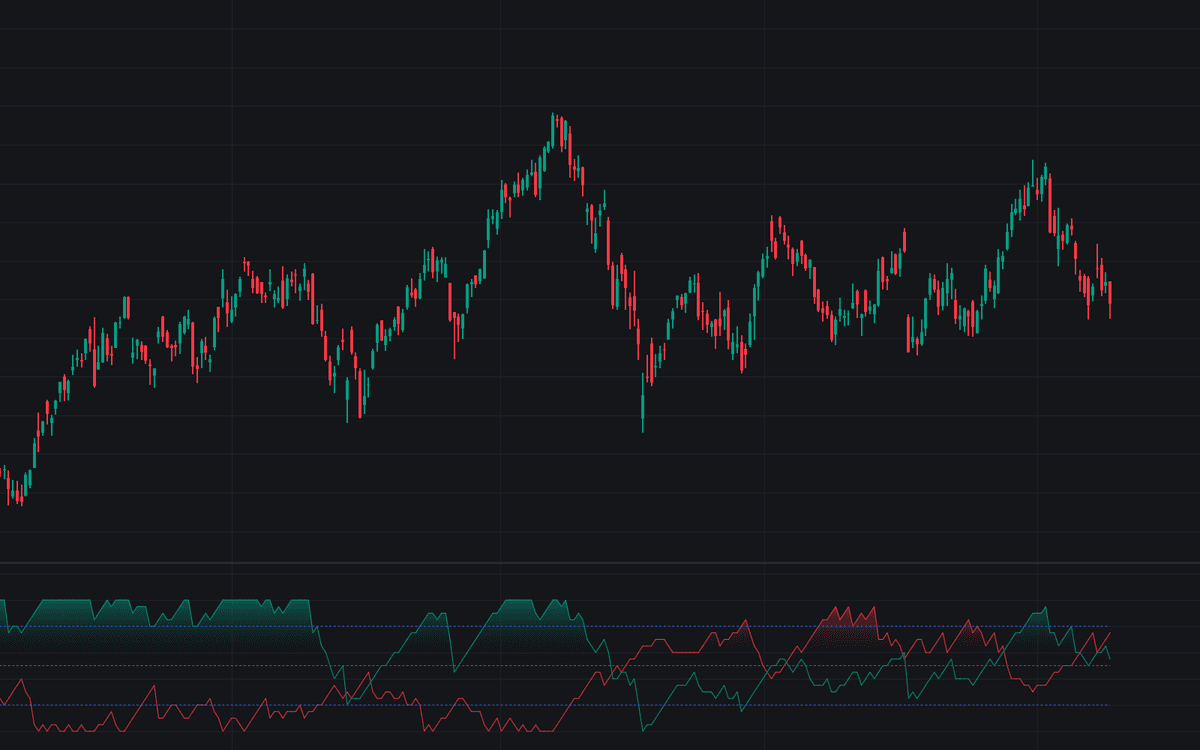
Unreached Highs/Lows Oscillator

Jan 21, 2026

Static chart image
Oscillators
Volatility
Works on the following platforms:
tradingviewSymbolTradingView
For free use on the TradingView platform
ninjatraderNinjaTrader
For free use on the NinjaTrader platform
metatrader4MetaTrader 4/5
For free use on the MetaTrader 4/5 platform
thinkorswimThinkorswim
For free use on the Thinkorswim platform

The Unreached Highs/Lows Oscillator is a momentum-based trading indicator that measures how many price highs or lows remain unretested over time, expressed as a percentage. By tracking these unreached levels, the oscillator helps traders clearly identify trend strength, directional bias, and shifts in market participation between bullish and bearish traders. It is especially useful as both a trading indicator and a complementary trading strategy tool when combined with price action and trend analysis.

USAGE

indicator image This trading indicator is designed to visualize the strength of directional price movement by quantifying how aggressively one side of the market is in control. Strong trends tend to leave price levels behind, while weak or ranging markets frequently revisit prior highs and lows.

  • In a strong bullish trend, price continues to push higher without revisiting previous lows. As a result, unreached lows accumulate, signaling sustained buying pressure.
  • In a strong bearish trend, price continues lower without revisiting previous highs. This leads to an increase in unreached highs, signaling persistent selling pressure.

High readings of unreached highs (red) combined with low readings of unreached lows (green) are considered bearish, especially when confirmed by a downtrend in price. Conversely, high readings of unreached lows and low readings of unreached highs are considered bullish, typically aligning with an uptrend.

Because the oscillator is normalized, it also includes predefined overbought and oversold levels, making it easier to interpret momentum exhaustion and continuation zones.

The Unreached Highs/Lows Oscillator can also be used to identify breakouts. A rapid decrease in unreached highs or lows suggests that price is aggressively reclaiming previous levels, often signaling strong momentum expansion or a regime shift in market structure.

indicator image In this gold chart example, the oscillator is combined with price behavior to illustrate different market environments:

  • 1. Uptrend: Bullish readings remain above 80 while bearish readings stay below 20, confirming a strong bullish trend.
  • 2. Range: Both bullish and bearish readings fluctuate around 50, indicating a sideways market.
  • 3. Uptrend: Bullish readings again hold above 80 with bearish below 20, confirming trend continuation.
  • 4. Pullback: Bullish readings dip from above 80 toward 50, while bearish remains below 20, signaling a corrective move within an uptrend.
  • 5. Range: Mixed readings above and below thresholds reflect consolidation and indecision.
  • 6. Uptrend: Bullish dominance resumes with readings above 80 and bearish below 20.
  • 7. Pullback: Bullish dips and bearish rises toward 50 suggest another corrective phase.
  • 8. Uptrend: Bullish readings regain strength above 80, confirming continued upside momentum.

indicator image This Bitcoin example demonstrates how extreme readings can be used to detect potential reversals. When both bullish and bearish values reach opposite extremes (0 and 100), traders can adjust the threshold levels from the default 80/20 to 100/0 to better isolate these conditions.

  • Extreme readings at points 1 and 5 highlight major reversals that lead to sustained trend changes.
  • Extreme readings at points 2, 3, 4, and 6 indicate minor reversals that occur within the existing trend structure.

This makes the Unreached Highs/Lows Oscillator a powerful trading indicator for distinguishing between meaningful reversals and temporary pullbacks.

indicator image From the settings panel, traders can fine-tune the Length parameter to adapt the indicator to different trading styles and timeframes. Shorter lengths react faster to small price movements, while longer lengths smooth the data and focus on larger-scale trends. A default length of 20 provides a balanced view for most market conditions.

The chart above illustrates how adjusting the length affects the sensitivity of both bullish and bearish measurements.

SETTINGS

  • Length: Defines the maximum number of highs and lows used in the calculation. Smaller values increase sensitivity; larger values emphasize broader trends.

Style

  • Bullish: Customize the color used for unreached lows.
  • Bearish: Customize the color used for unreached highs.
  • Top Threshold: Set the upper threshold level and color. Enable Auto to use the default styling.
  • Bottom Threshold: Set the lower threshold level and color. Enable Auto to use the default styling.

FAQ

What type of trading strategy is the Unreached Highs/Lows Oscillator best suited for?
This trading indicator works well for trend-following strategies, momentum confirmation, breakout detection, and identifying pullbacks within strong trends.

Can this indicator be used for reversals?
Yes. Extreme readings near 0 and 100 can highlight potential reversal zones, especially when combined with price action and market structure analysis.

How do I access the Unreached Highs/Lows Oscillator?
You can get access on the LuxAlgo Library for charting platforms like TradingView, MetaTrader (MT4/MT5), and NinjaTrader for free.

Trading & investing are risky and many will lose money in connection with trading and investing activities. All content on this site is not intended to, and should not be, construed as financial advice. Decisions to buy, sell, hold or trade in securities, commodities and other investments involve risk and are best made based on the advice of qualified financial professionals. Past performance does not guarantee future results.

Hypothetical or Simulated performance results have certain limitations. Unlike an actual performance record, simulated results do not represent actual trading. Also, since the trades have not been executed, the results may have under-or-over compensated for the impact, if any, of certain market factors, including, but not limited to, lack of liquidity. Simulated trading programs in general are designed with the benefit of hindsight, and are based on historical information. No representation is being made that any account will or is likely to achieve profit or losses similar to those shown.

Testimonials appearing on this website may not be representative of other clients or customers and is not a guarantee of future performance or success.

As a provider of technical analysis tools and strategies, we do not have access to the personal trading accounts or brokerage statements of our customers. As a result, we have no reason to believe our customers perform better or worse than traders as a whole based on any content, tool, or platform feature we provide.

Charts used on this site are by TradingView in which the majority of our technical indicators are built on. TradingView® is a registered trademark of TradingView, Inc. www.TradingView.comTradingView® has no affiliation with the owner, developer, or provider of the Services described herein.

Market data is provided by CBOE, CME Group, BarChart, CoinAPI. CBOE BZX real-time US equities data is licensed from CBOE and provided through BarChart. Real-time futures data is licensed from CME Group and provided through BarChart. Select cryptocurrency data, including major coins, is provided through CoinAPI. All data is provided “as is” and should be verified independently for trading purposes.

This does not represent our full Disclaimer. Please read our full disclaimer.

© 2026 LuxAlgo Global, LLC.