



Volume Grid Heatmap
Feb 14, 2026
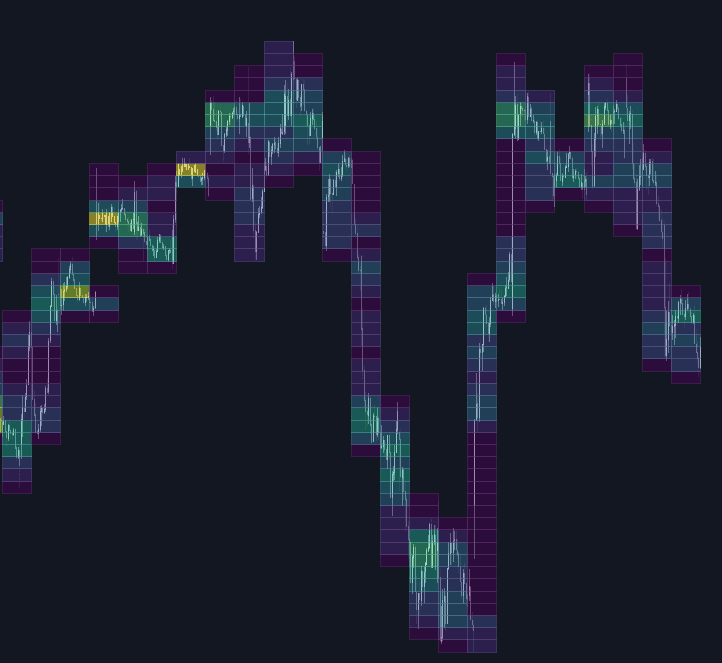
The Volume Grid Heatmap is an advanced trading indicator that delivers a powerful two-dimensional view of volume distribution across both price and time. Instead of relying on a traditional volume histogram or standard Volume Profile, this tool maps trading activity into a structured grid, helping traders uncover hidden liquidity zones, institutional participation, and high-probability support and resistance areas within a customizable lookback window.
By transforming raw volume data into a dynamic heatmap, the indicator makes it easier to spot where meaningful market participation has occurred — not just at what price, but also when.
How to Trade the Volume Grid Heatmap Indicator?
This trading strategy tool is designed for traders who want deeper insight into liquidity clusters and volume-based structure. It is especially useful for intraday traders, swing traders, and algorithmic traders looking to refine entries and exits using volume-driven analysis.
Identifying High-Activity Liquidity Zones
The heatmap displays a grid where:
- The vertical axis represents price levels.
- The horizontal axis represents time intervals.
- Each cell’s color intensity reflects the amount of traded volume.
Brightly colored cells indicate areas where a large number of shares or contracts were exchanged at a specific price during a specific time segment. These “hot zones” often act as:
- Future price magnets
- Key support and resistance levels
- Institutional accumulation or distribution zones
- Areas of temporary price friction or consolidation
When price revisits these zones, traders can monitor for reactions such as bounces, breakouts, or absorption.
Understanding Volume Distribution Over Time
Unlike a traditional Volume Profile — which only shows aggregated volume by price — the Volume Grid Heatmap trading indicator reveals how volume was distributed across time.
This distinction is critical:
- A single bright cell may indicate a sharp volume spike caused by news, liquidation, or aggressive market orders.
- A horizontal cluster of bright cells suggests sustained trading interest and long-term participation at that price level.
- A vertical cluster may signal concentrated activity during a specific time window.
This time-conditioned volume perspective allows traders to differentiate between transient volatility and structurally important price levels.
Indicator Mechanics & Volume Mapping Logic
The Volume Grid Heatmap operates by dividing the selected historical range into a customizable grid based on price and time.
Here’s how the trading indicator processes data:
- The recent price range (Highest High to Lowest Low within the lookback period) is segmented into user-defined rows (price levels).
- The lookback window is segmented into user-defined columns (time intervals).
- For each bar:
- The script calculates total volume.
- Volume is proportionally distributed across grid rows based on the overlap between the candle’s high-low range and grid boundaries.
- The distributed volume is assigned to the corresponding time column.
- All grid cells are aggregated.
- The grid is normalized against the highest-volume cell.
- A perceptually uniform colormap is applied for accurate visual interpretation.
This method ensures that both narrow-range and wide-range candles contribute realistically to the volume grid, preserving analytical integrity for serious traders and quantitative strategies.
Trading Applications & Strategy Ideas
The Volume Grid Heatmap can be integrated into multiple trading strategies:
1. Support & Resistance Confirmation
Use bright heatmap zones as confirmation for:
- Breakout retests
- Pullback entries
- Stop placement refinement
2. Institutional Activity Detection
Large concentrated cells may reflect:
- Block trades
- Algorithmic accumulation
- Smart money positioning
Combining this tool with market structure analysis or order block detection can significantly enhance trade confidence.
3. Liquidity-Based Mean Reversion
When price moves away from a strong liquidity cluster, it may revert back toward that zone — especially in range-bound markets.
4. Volatility Context
Compare isolated spikes vs sustained participation:
- Spikes often lead to short-term reactions.
- Sustained clusters often define longer-term equilibrium zones.
SETTINGS
Grid Configuration
These inputs allow traders to tailor the trading indicator to different markets and timeframes.
-
Lookback Bars: Defines the historical window used to calculate volume and price range.
Shorter lookbacks suit scalping and intraday trading. Longer lookbacks help swing traders identify structural liquidity. -
Rows (Price Resolution): Controls vertical grid precision.
More rows = finer price-level detail.
Fewer rows = broader liquidity zones. -
Columns (Time Resolution): Controls horizontal timing precision.
More columns = detailed timing of volume spikes.
Fewer columns = simplified structural overview.
Visual Customization
Professional perceptually uniform colormaps ensure accurate visual interpretation.
- Heatmap Theme: Choose from Viridis, Inferno, Magma, Plasma, Cividis, or Turbo.
- Transparency: Adjust grid opacity so underlying price action remains clearly visible.
These customization features make the indicator suitable for clean chart layouts and multi-indicator workflows.
Why Use a 2D Volume Heatmap Instead of a Standard Volume Indicator?
Most volume indicators only answer one question: How much volume traded?
The Volume Grid Heatmap answers two critical questions:
- At what price did volume trade?
- When did that volume occur?
This dual-dimension approach provides deeper market microstructure insight, helping traders:
- Filter false breakouts
- Identify high-probability liquidity zones
- Improve entry timing
- Strengthen confluence with trend-based trading indicators
For traders building systematic or discretionary trading strategies, this tool offers a significant edge over conventional volume analysis.
FAQ
What makes the Volume Grid Heatmap different from Volume Profile?
Volume Profile only shows total volume at each price level. The Volume Grid Heatmap adds the time dimension, revealing whether volume was formed by a single spike or sustained participation across multiple periods.
Is this trading indicator suitable for crypto, stocks, and futures?
Yes. The Volume Grid Heatmap works across all liquid markets including crypto, equities, indices, and futures. It is especially powerful in high-volume instruments where liquidity clustering is common.
How do I access the Volume Grid Heatmap?
You can get access on the LuxAlgo Library for charting platforms like TradingView, MetaTrader (MT4/MT5), and NinjaTrader for free.
Trading & investing are risky and many will lose money in connection with trading and investing activities. All content on this site is not intended to, and should not be, construed as financial advice. Decisions to buy, sell, hold or trade in securities, commodities and other investments involve risk and are best made based on the advice of qualified financial professionals. Past performance does not guarantee future results.
Hypothetical or Simulated performance results have certain limitations. Unlike an actual performance record, simulated results do not represent actual trading. Also, since the trades have not been executed, the results may have under-or-over compensated for the impact, if any, of certain market factors, including, but not limited to, lack of liquidity. Simulated trading programs in general are designed with the benefit of hindsight, and are based on historical information. No representation is being made that any account will or is likely to achieve profit or losses similar to those shown.
Testimonials appearing on this website may not be representative of other clients or customers and is not a guarantee of future performance or success.
As a provider of technical analysis tools and strategies, we do not have access to the personal trading accounts or brokerage statements of our customers. As a result, we have no reason to believe our customers perform better or worse than traders as a whole based on any content, tool, or platform feature we provide.
Charts used on this site are by TradingView in which the majority of our technical indicators are built on. TradingView® is a registered trademark of TradingView, Inc. www.TradingView.comTradingView® has no affiliation with the owner, developer, or provider of the Services described herein.
Market data is provided by CBOE, CME Group, BarChart, CoinAPI. CBOE BZX real-time US equities data is licensed from CBOE and provided through BarChart. Real-time futures data is licensed from CME Group and provided through BarChart. Select cryptocurrency data, including major coins, is provided through CoinAPI. All data is provided “as is” and should be verified independently for trading purposes.
This does not represent our full Disclaimer. Please read our full disclaimer.
© 2026 LuxAlgo Global, LLC.