Volumetric Order Flow Structure
 By LuxAlgoFeb 16, 2026
Volumetric Order Flow Structure is an indicator on Vela, our next-generation charting platform, written in Pine Script®.
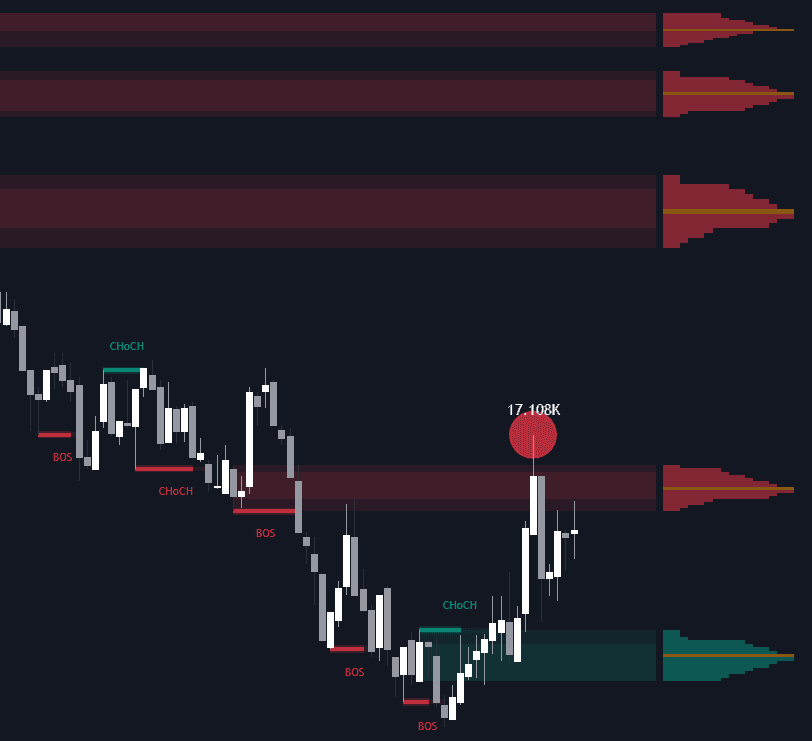

Volumetric Order Flow Structure judges market structure by the participation behind it. When price breaks a level, glowing bars fill horizontally in proportion to where the breakout candle closed within its own range, so breaks that close near the extreme stand apart from hesitant ones. Each active supply or demand zone carries a stepped 15-row profile of its pivot candle, a fixed shape that widens toward the candle's middle and body rather than a measured volume distribution, with its widest row highlighted in orange.
How to Trade the Volumetric Order Flow Structure?
- BOS with a wide volumetric bar: a break of structure whose breakout candle closed near its extreme favors continuation; a narrow bar warns the break closed without conviction.
- CHoCH: a change of character gives early caution that the prevailing trend may be reversing.
- Orange row: a fixed reference near the middle of the pivot candle, favoring its body; refine entries and stop placement around it instead of treating the whole zone as one undifferentiated block.
- Manipulation bubbles: a wick pushing beyond a zone without closing through it flags a likely liquidity raid, engineered stop-triggering that often precedes a reversal or a continuation after the grab.
Zones extend across the chart until price closes decisively beyond them; the overlap filter keeps only the highest-volume block when zones stack, and ATR-based scaling keeps thickness and labels proportional across assets.
Volumetric Order Flow Structure Settings
- Pivot Length: the lookback for structural highs and lows. Larger values isolate major structure, smaller ones catch intraday shifts.
- Volume Lookback: currently has no effect on the plotted output; manipulation bubbles are scaled against the highest volume of the last 200 bars.
- Max Recent Blocks: how many active zones stay on the chart.
- Base Transparency / Hide Overlapping Blocks: zone opacity, and whether overlapping blocks are reduced to the one whose pivot candle had the highest volume.
- Show Manipulation Bubbles / Bubble Sensitivity: toggles the raid markers and how sharply their size responds to volume.
Frequently Asked Questions
Free to use
Run it on Vela. Go further with a paid plan.
- Up to 500 strategy alerts, with webhook automation
- Up to 10× the chart history of Free
- Orderflow lookback up to full history
- More Quant usage to customize it, plus extra usage when you need it
- Futures data alongside crypto, stocks, forex and commodities
Also works on

Related indicators
All 10 Volume Delta indicators
.png&w=3840&q=75)
.png&w=3840&q=75)
.png&w=3840&q=75)
Run it on Vela. Make it yours with Quant.
Open this indicator free on Vela, our next-generation charting platform. Then ask Quant, our coding agent built into Vela, to retune it or turn it into a backtested strategy of your own.