





Whittaker Envelope
 by LuxAlgo · Feb 16, 2026
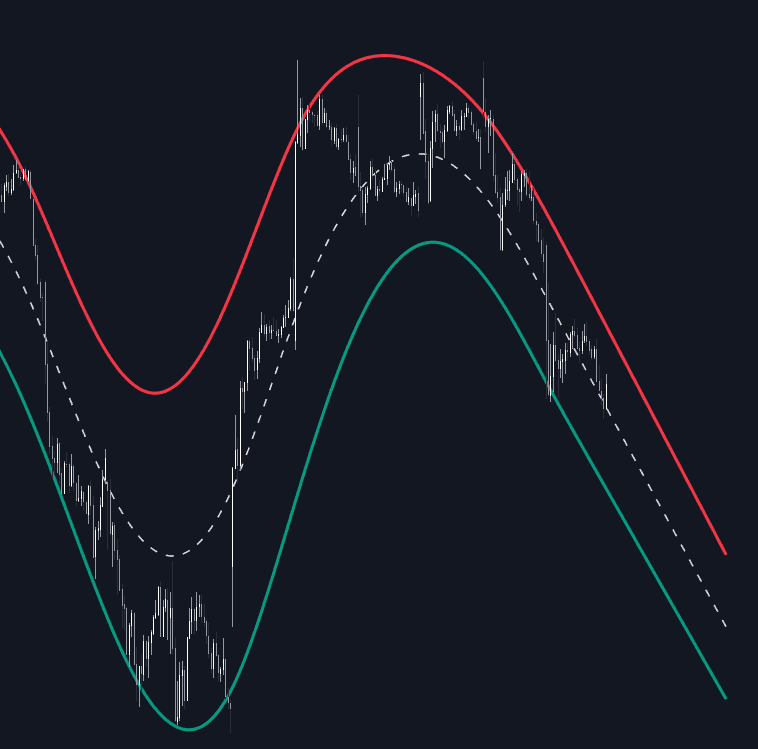
The Whittaker Envelope indicator is an advanced trading indicator designed to visualize market structure and volatility using the Whittaker-Eilers smoothing algorithm combined with Asymmetric Least Squares (ALS). Instead of relying on fixed-width channels or simple moving averages, this tool builds a dynamic, non-linear envelope that adapts to price peaks and troughs, offering traders a powerful way to study trend behavior, volatility expansion, and structural extremes.
This trading indicator is for visualization and structural analysis purposes only. Due to its retrospective calculation and repainting behavior, it should not be used as a standalone real-time trading strategy without additional confirmation.
Because the script fits a smooth curve over a fixed historical window (the last N bars) using an iterative optimization process, the entire envelope can adjust when new price data appears. This means the indicator repaints. It is therefore best suited for discretionary analysis, volatility assessment, and strategy research rather than direct signal execution.
How to Use the Whittaker Envelope Trading Indicator
The Whittaker Envelope provides a structural framework for understanding how price "breathes" within a smoothed volatility boundary. By applying asymmetric weighting, the indicator creates:
- An upper band that adapts toward price peaks
- A lower band that adapts toward price troughs
- A smoothed midline representing the average structural path
This creates a fully adaptive trading envelope that responds to extreme movements without being distorted by short-term noise.
Trend and Volatility Analysis
The space between the upper and lower bands reflects the smoothed price range over the selected lookback window.
- Widening Envelope: Indicates expanding volatility and stronger directional movement.
- Narrowing Envelope: Suggests consolidation, compression, or range-bound market conditions.
- Midline Direction: Acts as a structural trend baseline. A rising midline suggests bullish bias, while a declining midline indicates bearish pressure.
Unlike traditional Bollinger Bands or ATR-based channels, the Whittaker Envelope does not rely on standard deviation or fixed multipliers. Instead, it adapts through an optimization process, allowing traders to study deeper structural shifts in price action.
This makes the indicator particularly useful for:
- Market structure analysis
- Volatility regime detection
- Trend development visualization
- Identifying structural extremes for mean-reversion research
Extrapolation and Structural Projection
The indicator includes a linear extrapolation feature that projects the current slope of the upper and lower bands forward.
This projection does not predict price. Instead, it visualizes how the current structural trajectory would continue if the prevailing momentum and smoothing dynamics remain intact. Traders can use this to:
- Assess trend persistence
- Visualize potential structural continuation
- Compare projected envelope direction against real-time price action
Indicator Mechanics and Algorithm Details
The Whittaker Envelope is built on the Whittaker-Eilers smoothing algorithm, a method widely used in signal processing and time-series analysis.
This method balances two objectives:
- Fit the price data closely.
- Maintain a smooth, stable curve that avoids overreacting to noise.
The key innovation in this trading indicator is the use of Asymmetric Least Squares (ALS).
Instead of treating all deviations equally, ALS assigns different weights depending on whether price is above or below the curve:
- For the upper band, a high asymmetry parameter (p) pushes the curve upward toward price peaks.
- For the lower band, a very low p pulls the curve downward toward troughs.
This asymmetric weighting creates a true structural envelope that conforms to market extremes without requiring fixed multipliers or volatility assumptions.
Because the fitting process is iterative, the algorithm refines the envelope multiple times to achieve a smooth and optimized result. However, this also explains why the indicator repaints when new bars enter the calculation window.
Indicator Settings Explained
Understanding the parameters is essential to using this trading tool effectively.
-
Length
Defines the number of recent bars included in the calculation window.- Shorter length = more reactive envelope
- Longer length = broader structural perspective
-
Lambda (λ)
Controls smoothing intensity.- Higher λ = stiffer, straighter bands
- Lower λ = more flexible, price-following envelope
-
Lower Asymmetry (p)
Determines how strongly the lower band tracks price troughs.
Typically set very low (e.g., 0.001) to ensure the band hugs the bottom structure. -
Upper Asymmetry (p)
Determines how strongly the upper band tracks price peaks.
Typically set very high (e.g., 0.999) to align with the top structure. -
Iterations
Number of ALS refinement passes.
More iterations improve fit accuracy but increase computational load. -
Extrapolation
Number of bars to project the envelope slope forward. -
Source
Defines which price series is used (Close by default, but can be adjusted for different trading strategies).
When Should Traders Use the Whittaker Envelope?
This trading indicator is particularly effective for:
- Studying volatility cycles
- Identifying structural compression before expansion
- Analyzing trend smoothness and curvature
- Backtesting structural envelope-based trading strategies
- Researching adaptive channel systems
Because it repaints, it is best used for:
- Higher timeframe structural analysis
- Strategy development and research
- Supplementing other non-repainting trading indicators
FAQ
Does the Whittaker Envelope repaint?
Yes. The envelope is recalculated over a fixed historical window using an iterative optimization method. As new data arrives, the entire shape can adjust. It should not be used for direct real-time trade entries without confirmation.
Is this a trading strategy or a trading indicator?
It is a structural visualization trading indicator. While it can support trading strategies, it is not designed to generate standalone entry or exit signals.
How do I access the Whittaker Envelope?
You can get access on the LuxAlgo Library for charting platforms like TradingView, MetaTrader (MT4/MT5), and NinjaTrader for free.
What makes this different from Bollinger Bands or ATR channels?
Unlike traditional volatility bands that use standard deviation or fixed multipliers, the Whittaker Envelope uses advanced smoothing and asymmetric optimization to adapt directly to structural price extremes, making it more flexible for market structure and volatility

Unlock Unlimited Access to the LuxAlgo Library
Upgrade your plan to get all indicators, strategies, charts, and full access to Quant, our AI agent.
Trading & investing are risky and many will lose money in connection with trading and investing activities. All content on this site is not intended to, and should not be, construed as financial advice. Decisions to buy, sell, hold or trade in securities, commodities and other investments involve risk and are best made based on the advice of qualified financial professionals. Past performance does not guarantee future results.
Hypothetical or Simulated performance results have certain limitations. Unlike an actual performance record, simulated results do not represent actual trading. Also, since the trades have not been executed, the results may have under-or-over compensated for the impact, if any, of certain market factors, including, but not limited to, lack of liquidity. Simulated trading programs in general are designed with the benefit of hindsight, and are based on historical information. No representation is being made that any account will or is likely to achieve profit or losses similar to those shown.
Testimonials appearing on this website may not be representative of other clients or customers and is not a guarantee of future performance or success.
As a provider of technical analysis tools and strategies, we do not have access to the personal trading accounts or brokerage statements of our customers. As a result, we have no reason to believe our customers perform better or worse than traders as a whole based on any content, tool, or platform feature we provide.
Charts used on this site are by TradingView in which the majority of our technical indicators are built on. TradingView® is a registered trademark of TradingView, Inc. www.TradingView.com TradingView® has no affiliation with the owner, developer, or provider of the Services described herein.
Market data is provided by CBOE, CME Group, BarChart, Massive, CoinAPI. Select U.S. equities data is provided through Massive. CBOE BZX real-time U.S. equities data is licensed from CBOE and provided through BarChart. Real-time futures data is licensed from CME Group and provided through BarChart. Select cryptocurrency data, including major coins, is provided through CoinAPI. All data is provided “as is” and should be verified independently for trading purposes.
This does not represent our full Disclaimer. Please read our full disclaimer.
© 2026 LuxAlgo Global, LLC.