CFD Brokers vs Retail Prop Firms: Key Differences
A CFD broker provides an account for trading contracts for difference with your own deposited funds. A retail prop-firm program usually sells an evaluation or access to a rule-based trading arrangement, which may remain simulated even after you qualify. Compare the actual account, fees, loss rules, and payout contract rather than the headline account size.
Before choosing either route, use LuxAlgo's native charts and Quant, our coding agent, to define and test your strategy. LuxAlgo's separate Prop Firms portal and simulator can then help examine how stated trading assumptions interact with encoded challenge rules. Research results do not establish that an account is suitable, that a firm will pay, or that a challenge will be passed.
CFD Brokers vs Retail Prop Firms at a Glance
| Question | CFD broker account | Retail prop-firm program |
|---|---|---|
| Whose money is in the trading account? | You deposit funds to meet margin and cover trading losses | The displayed balance may be simulated; live funding depends on the program and stage |
| What do you pay? | Trading costs, financing where applicable, and account-related charges | Evaluation or subscription fees and potentially resets, activation, data, or other charges |
| How do you receive money? | Withdraw available account funds under the broker's terms | Receive eligible rewards or profit shares under the program's payout agreement |
| What limits trading? | Margin, available funds, product access, broker policies, and applicable regulation | Challenge and funded-stage rules, including loss limits, position limits, and prohibited practices |
| What can go wrong? | Trading losses, forced liquidation, financing costs, and counterparty problems | Lost fees, failed evaluations, rule breaches, payout disputes, or program changes |
| Is access universal? | No; jurisdiction, client classification, and product permissions matter | No; residency, instruments, eligibility, and account stage matter |
Retail prop evaluations are also different from traditional proprietary-trading employment or institutional trading desks. The word “prop” alone does not tell you whether trades reach a live market, who holds the account, or what legal protections apply.
How CFD Broker Accounts Work
A contract for difference settles the change in an underlying asset's price between opening and closing the position. You generally do not own the underlying asset. The broker's contract specification determines the position value, trading hours, pricing, costs, and margin requirements.
You fund the account with your own money, but a leveraged CFD does not require depositing its entire notional value. Margin permits larger exposure than the deposit supporting it, which magnifies gains and losses relative to that deposit. Margin is not a substitute for deciding how much loss you can afford.
Costs and the broker's role
Relevant costs can include the spread, commissions, overnight financing, currency conversion, and other account charges. Review the provider's execution and pricing policies. Brokers may act as counterparties and hedge some or all exposure; it is too simple to assume that every provider earns only fees independently of client outcomes.
The UK Financial Conduct Authority's CFD guidance identifies conflicts associated with these business models and excessive trading. For covered UK retail accounts, its protections include asset-dependent leverage limits between 30:1 and 2:1, margin close-out rules, and negative balance protection. These protections do not prevent loss of the money in the account, and they should not be assumed to apply worldwide or to professional-client accounts.
Positions can be closed because margin requirements are breached before the balance reaches zero. Check the exact close-out calculation, how it treats several open positions, and whether protections apply to the entity and account classification you are offered.
How Retail Prop-Firm Programs Work
A retail evaluation typically asks you to meet a profit objective while staying within a set of trading rules. Passing may make you eligible for another stage or a reward-bearing account. It does not automatically mean the advertised account balance has been deposited into an account you own.
FTMO states that its accounts use fictitious capital in demo accounts, with rewards governed by the relevant product's terms. Topstep distinguishes its simulated Trading Combine and Express Funded Account from its Live Funded Account. These examples show why you must check the specific program rather than treating all “funded” accounts as equivalent.
The headline balance is not your usable loss budget
An account advertised as $100,000 may permit only a much smaller drawdown. For a hypothetical account with a $100,000 starting balance and a static $5,000 maximum-loss allowance, the initial floor is $95,000. Risking $1,000 on a trade uses 20% of that allowance, even though it is only 1% of the headline balance. Fees, open losses, and the firm's exact breach rule can reduce the available room further.

Do not assume that personal cost is limited to one evaluation fee. Include recurring subscriptions, repeat attempts, resets, activation or data charges, and any obligations in the agreement. Money spent on evaluations can accumulate even when the displayed trading losses are simulated.
Qualifying and getting paid are separate steps
Read the reward agreement before paying. A program may require minimum winning days, a profit buffer, a consistency threshold, identity checks, or a waiting period. Payout caps and the effect of withdrawals on the remaining loss cushion also matter. A large profit split is less useful if the conditions for receiving it do not fit your trading process.
Rules may differ between evaluation, simulated funded, and live stages. For example, Topstep's program overview describes stage-specific objectives and account limits. Do not generalize one firm's rules to another, or assume every daily-loss event permanently terminates the account.
Loss Rules Can Change the Strategy You Can Use
Two programs can advertise the same loss percentage and behave differently. Identify how the loss floor is calculated and when it is checked.
| Rule to inspect | Why it matters |
|---|---|
| Static or trailing maximum loss | A static floor stays tied to a reference balance; a trailing floor can rise as the account reaches new highs |
| Intraday or end-of-day calculation | Open profit and losses may affect the floor or breach test before a trade closes |
| Daily loss definition | The day-start reference, reset timezone, commissions, and open P&L can change the remaining allowance |
| Consistency requirement | An outsized winning day can increase the profit needed to qualify for a payout |
| News, overnight, and weekend rules | A strategy that works historically may violate holding or entry restrictions |
| Automation and copying restrictions | Software, duplicated accounts, or particular execution practices may be prohibited |
| Withdrawal effects | A payout can reduce the balance available above the loss floor |
Consider a hypothetical trailing rule that keeps a $5,000 gap below the relevant high-water mark. If that reference rises from $100,000 to $103,000, the floor becomes $98,000. Whether unrealized profit moves the reference, whether it updates only at the close, and whether it eventually stops trailing must be established from the contract.
Scalpers should inspect costs, execution conditions, and prohibited-practice clauses. Swing traders should examine overnight and weekend permissions, financing or rollover effects, and open-equity drawdown rules. Neither style automatically belongs with one model.
Jurisdiction and Futures Margin Matter
Do not treat an offshore website accepting registrations as evidence that its products are permitted for your location. U.S. traders in particular should verify the exact entity and instrument instead of assuming that a retail CFD account or a prop evaluation has the same status as a regulated futures brokerage account.
In a 2018 enforcement announcement involving 1pool, the CFTC alleged unlawful retail commodity CFD transactions and failure to register as a futures commission merchant. That historical case illustrates the importance of product and intermediary requirements; it is not a substitute for checking current eligibility. Use the CFTC's registration-checking guidance to identify the appropriate records for the service involved.
Futures-focused prop programs introduce another distinction. CME explains that futures margin is money deposited and maintained to support a position, rather than a down payment on the underlying asset. Initial and maintenance requirements can change, and a broker may require additional funds. A firm's simulated position limits are separate from the margin obligations of an actual live futures account.
Research the Strategy in LuxAlgo First
Use LuxAlgo's native charts to define the market, timeframe, entry, exit, and sizing assumptions. Quant can help translate explicit rules into code and revise them. Review the implementation before relying on a backtest: a strategy can compile successfully while using the wrong entry timing or risk logic.
- Match the instrument and data. A futures chart, cash index, and broker's CFD can differ in session, pricing, and contract specification.
- Set realistic assumptions. Include supported commissions, slippage, capital, and sizing settings. Separately account for financing, variable spreads, or other costs not represented by the test.
- Inspect losses and individual trades. A favorable net return can conceal intraday exposure or a losing sequence that breaches an evaluation rule.
- Test a reserved period. Avoid selecting a setup solely because it performs best on the same historical data used to develop it.
- Assess account rules separately. A backtest's maximum-drawdown number is not proof that every challenge, daily-loss, or payout condition was satisfied.
Verify code compatibility when moving between platforms. An indicator or backtest does not automatically enforce a prop firm's contract or place a broker order.
Use Prop Firm Sim to Examine the Constraints
LuxAlgo's Prop Firm Sim is a separate open-source research tool. It models challenge journeys from stated trading statistics or supported trade-history inputs. The Prop Firms portal presents the simulator and reference results. Its numbers describe outcomes under the model's assumptions, not verified real-world pass rates.
- Confirm the ruleset. Compare the selected challenge's encoded rules and verification date with the firm's current published agreement. Presets can become outdated.
- Use defensible inputs. Base win rate, average wins and losses, trading frequency, and risk on relevant evidence. Supported imports need enough information to establish risk multiples.
- Inspect more than pass probability. Review modeled costs, failure causes, payout outcomes, and sensitivity to weaker trading statistics.
- Read the limitations. Check assumptions, inferred fields, and rules the engine cannot simulate before interpreting a result.
The project documentation describes important simplifications, including same-day round trips and observation at trade closes rather than a full reconstruction of each trade's intraday path. This can miss adverse excursions relevant to open-equity and trailing-loss rules. Scaling arrangements and some firm-specific details are not modeled. Reproducibility means the same inputs and seed reproduce a result; it does not make the assumptions certain.
Check any available promotion against the firm's checkout and eligibility terms. A discount does not improve a strategy's edge or make an unsuitable agreement attractive, and no portal can guarantee the highest offer at every moment.
Keep a Record of the Real Costs and Decisions
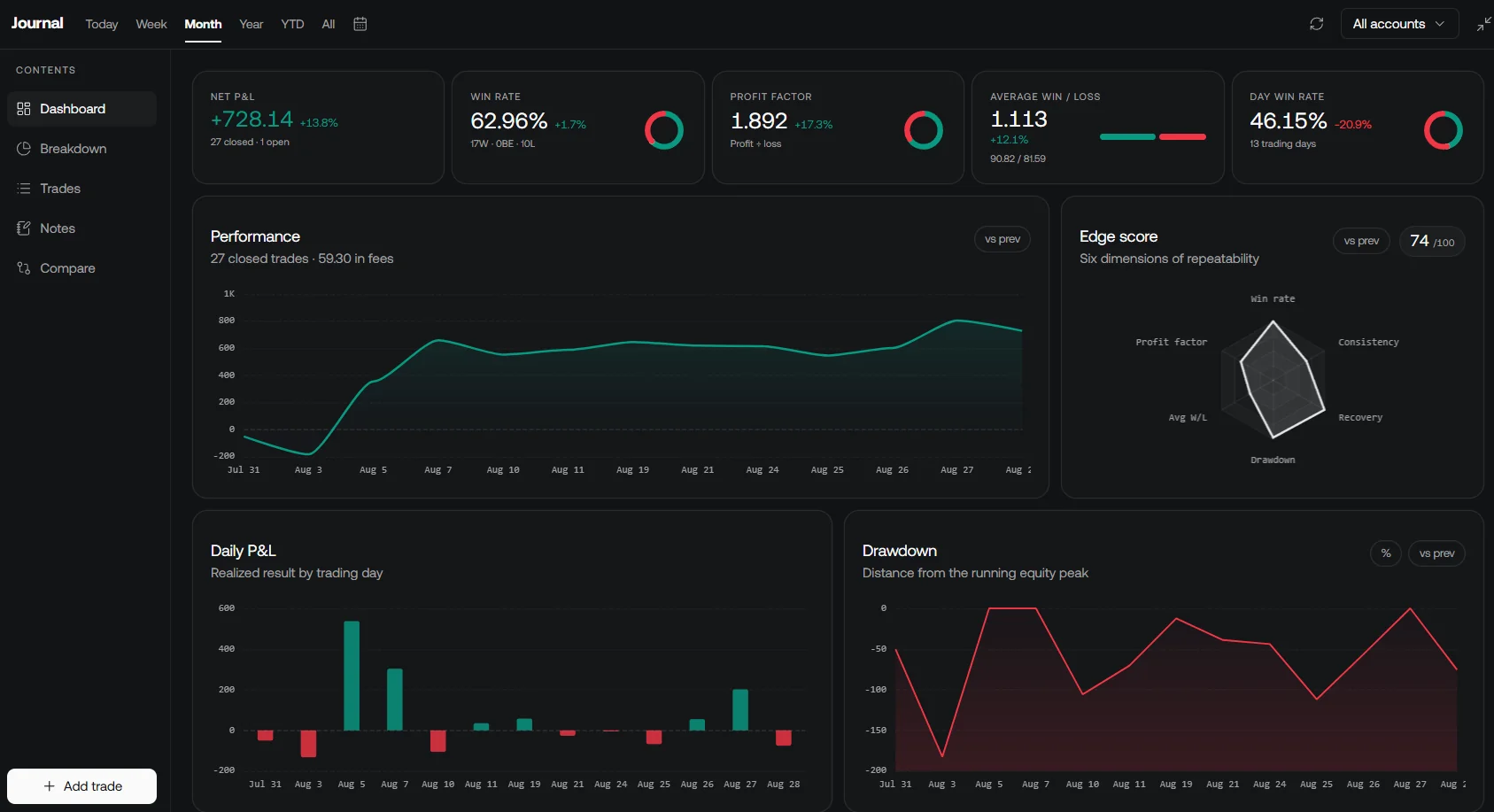
LuxAlgo Journal supports manual entries, supported trade imports, and available broker connections. Use notes to distinguish strategies, evaluation stages, and rule-related interventions. Track program expenses separately when they are not included in the imported trade data.
Choose based on the contract and your tested process. A CFD account puts your deposited capital at risk under its margin framework. A retail prop program adds evaluation and payout conditions and may use simulated balances. Either route deserves careful cost, eligibility, and risk review before money changes hands.
Video: A General Comparison of the Two Models
This older third-party fxprop overview provides background on the comparison. Firm terms, offers, and account structures may have changed; use the current primary sources above, especially the distinction between simulated and live funded accounts.
FAQs
What are the key benefits of choosing a retail prop firm over a CFD broker for traders with limited funds?
A retail prop program can offer an evaluation and potential rewards without requiring you to deposit the advertised account balance. However, that balance may be simulated, fees can recur, and payouts depend on the agreement. Compare total costs and the usable loss allowance before treating the program as access to live capital.
How do the risk management rules of retail prop firms impact trading strategies compared to the flexibility offered by CFD brokers?
Prop programs impose specific loss, position, holding, and payout conditions that can exclude an otherwise profitable strategy. CFD accounts also have margin, product, and broker restrictions. For either model, test the strategy against the exact rules and account for open losses, costs, and forced position closures.
What factors should U.S. traders consider when choosing between offshore CFD brokers and domestic retail prop firms, especially regarding regulations and leverage?
Verify the exact legal entity, product eligibility, residency restrictions, account stage, and available recourse. A simulated prop evaluation is not the same as a live brokerage account, and an offshore provider accepting an application does not establish permitted access. Futures margin and firm-imposed position limits should be evaluated separately.
Read next