Evolution of Algo Trading: From Scripts to AI

Algorithmic trading has expanded from explicit rules into a broad set of statistical, execution and AI-assisted workflows. Simple scripts, quantitative models, high-frequency trading and machine learning still coexist. They solve different problems; a newer technique does not automatically replace an older one or produce better returns.
The useful distinction is between deciding what to trade, estimating risk, executing orders and reviewing results. AI can support any of these tasks, including writing research code, but its role and evidence must be clear. A coding agent generating a moving-average strategy is not the same as a model learning a price forecast.
| Approach | Primary contribution | What still needs verification |
|---|---|---|
| Rule-based scripts | Apply explicit conditions consistently | Correct calculations, timing and order handling |
| Quantitative models | Estimate relationships and portfolio exposures | Statistical validity, costs and later performance |
| Latency-sensitive execution | Process market events and route orders quickly | Liquidity, queue position, infrastructure and controls |
| Machine learning | Estimate patterns from training data | Leakage, generalization, drift and retraining policy |
| AI-assisted development | Help write, explain and revise code | Code correctness and independent execution of tests |
Basic Trading Scripts: Making Rules Explicit
A rule-based script turns a trading specification into repeatable calculations and instructions. For example, a strategy might observe a completed daily close, compare two moving averages, and request an order for the next session. That specification must also define position size, exits, missing data and what happens when an order is rejected.
Automation reduces the need to repeat manual steps, but it can repeat an incorrect instruction rapidly. A script using the completed close to claim a fill at an earlier price creates an unrealistic test. A script retrying an uncertain order without checking broker state can create duplicate exposure.
Simple rules remain useful as baselines. Before adding complexity, keep a fixed version and a small set of trades whose calculations and cash flows can be checked by hand. The goal is to explain the result, not merely generate a favorable equity curve.
Quantitative Models: From Rules to Estimated Relationships
Quantitative methods add statistical estimation, portfolio construction and formal risk measurement. A model may rank securities, estimate volatility, identify relative-value relationships or allocate risk across positions. These methods can operate at slow or fast horizons and need not use machine learning.
The central limitation is that an estimated relationship can weaken or disappear. Costs, borrowing constraints, changing market conditions and crowded positions can turn a plausible historical pattern into an unprofitable live strategy. Different strategy names do not guarantee independent risks.
The Khandani and Lo study of the August 2007 quant meltdown illustrates this issue. Its analysis found evidence consistent with deleveraging and a temporary withdrawal of market-making risk capital. The lesson is to inspect shared exposures and liquidity needs, not to assume that every quantitative model fails for the same reason.
Electronic Execution and High-Frequency Trading
An investment decision and its execution are separate problems. A portfolio may decide to buy a position over days, while an execution algorithm divides that instruction into smaller orders, chooses venues or changes participation as market conditions change. A faster router does not establish a better investment forecast.
High-frequency trading is a latency-sensitive subset of automated trading. Market-making and short-horizon strategies depend on fast data processing, connectivity, inventory controls and detailed execution assumptions. Not every algorithm is high frequency, and not every high-frequency system uses AI.
Trading volume alone does not show how much liquidity is available at the next price. Spread, depth, queue position and adverse price movement matter. A daily-bar backtest cannot recreate every intraday fill or exchange interaction.
LMAX Group’s technology description provides an infrastructure example: it describes proprietary exchange technology, low-latency processing, resilience and a distributed transactional service architecture. That is not evidence that its exchange is a decentralized blockchain. Distributed software architecture and decentralized settlement are different concepts.
Machine Learning: Training Is Different From Live Use
A machine-learning model estimates relationships from a training dataset. Inference applies the fitted model to new inputs. Retraining changes the fitted model, while online learning updates it incrementally under a defined process. A deployed model does not necessarily learn from every new tick, and an update does not necessarily improve it.
A useful workflow records the training period, features, target, model version and evaluation method. Changes should be compared with a baseline before deployment. Monitor both model behavior and the trading system around it: a sound prediction cannot compensate for duplicate orders or incorrect position records.
| AI application | Possible output | Important limitation |
|---|---|---|
| Sentiment analysis | A score or classification for news and text | Publication timing, entity matching and context can be wrong |
| Forecasting | A conditional estimate of a future quantity | Prediction error and changing relationships remain |
| Portfolio construction | Security rankings or proposed weights | Constraints, turnover and costs affect realizable results |
| Risk monitoring | An anomaly flag or estimated exposure | An alert requires an owner and response procedure |
| Code assistance | A proposed indicator or strategy implementation | Generated code must be inspected and run independently |
Data Quality and Evaluation
Alternative data can add information, but coverage, licensing and actual availability matter. A receipt dataset or news score published after the decision cannot be used as if it were available earlier. Preserve timestamps and versions, and distinguish an observation date from the time the information became usable.
Preprocessing can also leak future information. The scikit-learn guidance on common pitfalls explains why transformations and feature selection must be fitted on training data rather than the full dataset. Trading evaluation also needs chronological separation and attention to overlapping prediction horizons.
Synthetic data can help explore scenarios implied by a model. It does not recover unknown historical truth or guarantee coverage of future crises. Preserve coherent relationships between prices, volatility and liquidity, and report the assumptions behind each scenario.
An AI Fund Example: AIEQ
The Amplify AI Powered Equity ETF issuer page describes an objective of generally correlating, before fees and expenses, with the AI Powered Equity Index. The issuer identifies EquBot and IBM Watson-based analysis, including machine learning, natural-language processing and sentiment analysis, as part of security selection.
The page lists monthly index rebalancing. That is a concrete example of AI-supported selection within a defined investment process, not evidence that the fund continuously retrains and trades on every market update. Its use of AI does not establish superior future returns. Review the fund’s current documents, costs and risks when assessing it.
What Modern Trading Tools Actually Do
Evaluate a tool by its documented output and controls. A charting application, a research backtester, an alert service and an execution system can work together, but their responsibilities differ. Avoid treating “AI-powered” as a complete description of any of them.
- For a research tool, inspect inputs, supported markets, calculation rules and reproducibility.
- For a backtester, inspect fill timing, costs, position sizing and the treatment of missing data.
- For alerts, distinguish the detected event from a submitted or filled order.
- For execution, check account identity, permissions, order state and restart recovery.
- For model updates, record the approved version and evidence for the change.
Institutional product names alone do not prove a particular implementation. A platform may offer analytics or execution services without automatically using every AI method discussed in an overview. Use its primary documentation for specific capability claims.
LuxAlgo: Native Charts, Quant and Review
Start with LuxAlgo’s native charts to inspect price behavior and compare hypotheses. Keep the instrument, timeframe and data assumptions consistent throughout the research process.
Ask Quant, our coding agent to implement a clear specification or explain an existing strategy. Inspect the generated code and run it yourself. Review signal timing, warm-up, sizing and costs before interpreting the result.
Example prompt: “Build a simple baseline strategy and explain its entry timing, position sizing and cost assumptions. Identify what I should compare on later data before adding a machine-learning filter.”
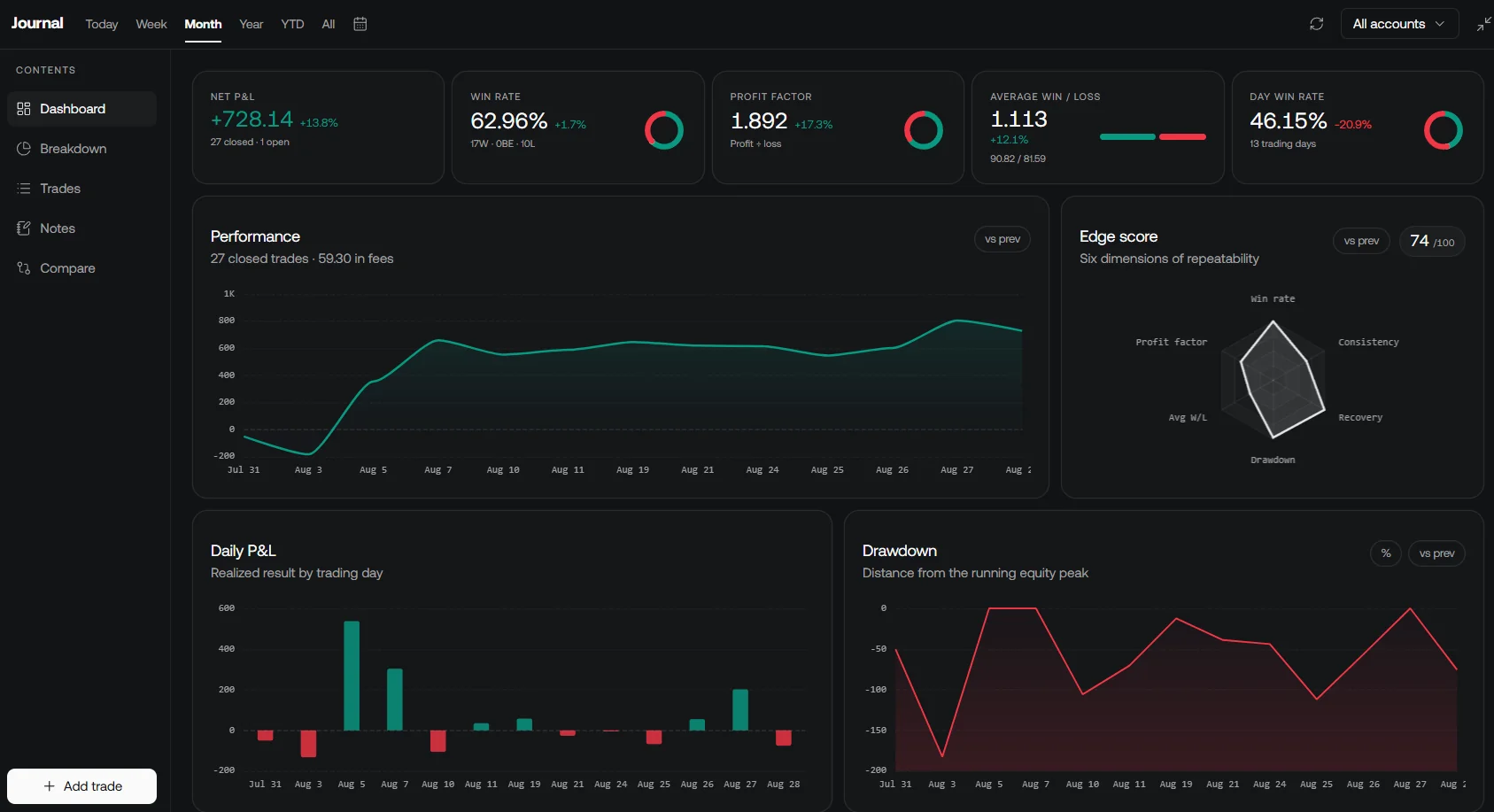
Use the native journal to review compatible recorded trades. Keep simulated outcomes distinct from actual fills, and investigate differences in costs, quantities or timestamps.
Do not conflate a strategy alert with automatic broker execution, or assume Quant independently validates every strategy it writes.
Explore the LuxAlgo Library for documented indicators and examples. Check the supported environment of each tool rather than assuming identical behavior across platforms. Product access and allowances can change; the current product documentation is the appropriate reference for a particular workflow.
Adopt New Methods With a Measurable Process
Start with a specific question, such as whether a feature improves a fixed baseline after costs. Record the decision rule before looking at the evaluation period. Repeatedly tuning after viewing the same period removes its independence.
| Step | Evidence to keep | Failure to avoid |
|---|---|---|
| Define the baseline | Rules, inputs, version and expected behavior | Changing several assumptions at once |
| Evaluate later data | Chronological split and untouched results | Training or selecting on the test period |
| Stress execution | Costs, gaps, liquidity and rejected-order scenarios | Treating ideal fills as guaranteed |
| Test operations | Acknowledgments, partial fills and recovery logs | Retrying uncertain orders blindly |
| Monitor changes | Model version, drift measures and review decision | Automatic replacement without evaluation |
FINRA Regulatory Notice 15-09 discusses development, testing, validation and supervision for algorithmic trading at member firms. Its regulatory scope is those firms; it is a useful reference for control practices, not a certification that a retail script is ready for deployment.
Define who responds when the system behaves unexpectedly. Stopping new orders, requesting cancellations and closing positions are separate actions. A loss threshold needs a response procedure; a stop order does not guarantee its trigger price as the execution price.
What Comes Next: Separate Signals, Infrastructure and Settlement
Trading technology develops along several paths at once. Better data tools can improve research access; faster infrastructure can improve processing; AI coding assistance can shorten implementation work; and new settlement arrangements can change how ownership and obligations are recorded. None automatically solves the others.
For a trader, the practical preparation is durable: understand data provenance, write reproducible specifications, inspect generated code, test realistic execution and keep accountable oversight. More complex technology creates more assumptions to verify, not an exemption from verification.
Video Overview
The original EnochChan01 video on AI and algorithmic trading, published August 14, 2024, offers a short introductory overview. Treat it as background context; the distinctions and primary sources above provide the basis for the specific claims in this article.
Frequently Asked Questions
Has AI replaced rule-based algorithmic trading?
No. Explicit rules, quantitative models, latency-sensitive execution and machine learning coexist. They can address different tasks within the same trading process.
Does an AI trading model continuously improve itself?
Not necessarily. Training, inference and retraining are different processes. Updates require evaluation, and a newly trained model can perform worse than its predecessor.
Is high-frequency trading the same as AI trading?
No. High-frequency trading describes latency-sensitive automated activity. It does not require AI, and many AI-assisted investment workflows operate at much slower horizons.
Can synthetic data replace historical evidence?
Synthetic data represents the assumptions of its generating model. It can support scenario analysis, but it does not recover unknown history or guarantee coverage of future market conditions.
How should I use Quant in a trading research workflow?
Give Quant a clear specification, inspect its generated code and run it yourself. Compare results with a baseline and later data, and separately verify execution and operational controls.
Read next