Concept
Feature Selection
Feature Selection is a Machine Learning concept. The Library holds 1 implementation, a working definition you can pull into Quant.
Top Feature Selection indicator
The top custom implementation, built on the original standard Feature Selection formula.
1 total
This Feature Selection implementation is strategy-ready: open it in Quant, set your rules, and it backtests automatically.
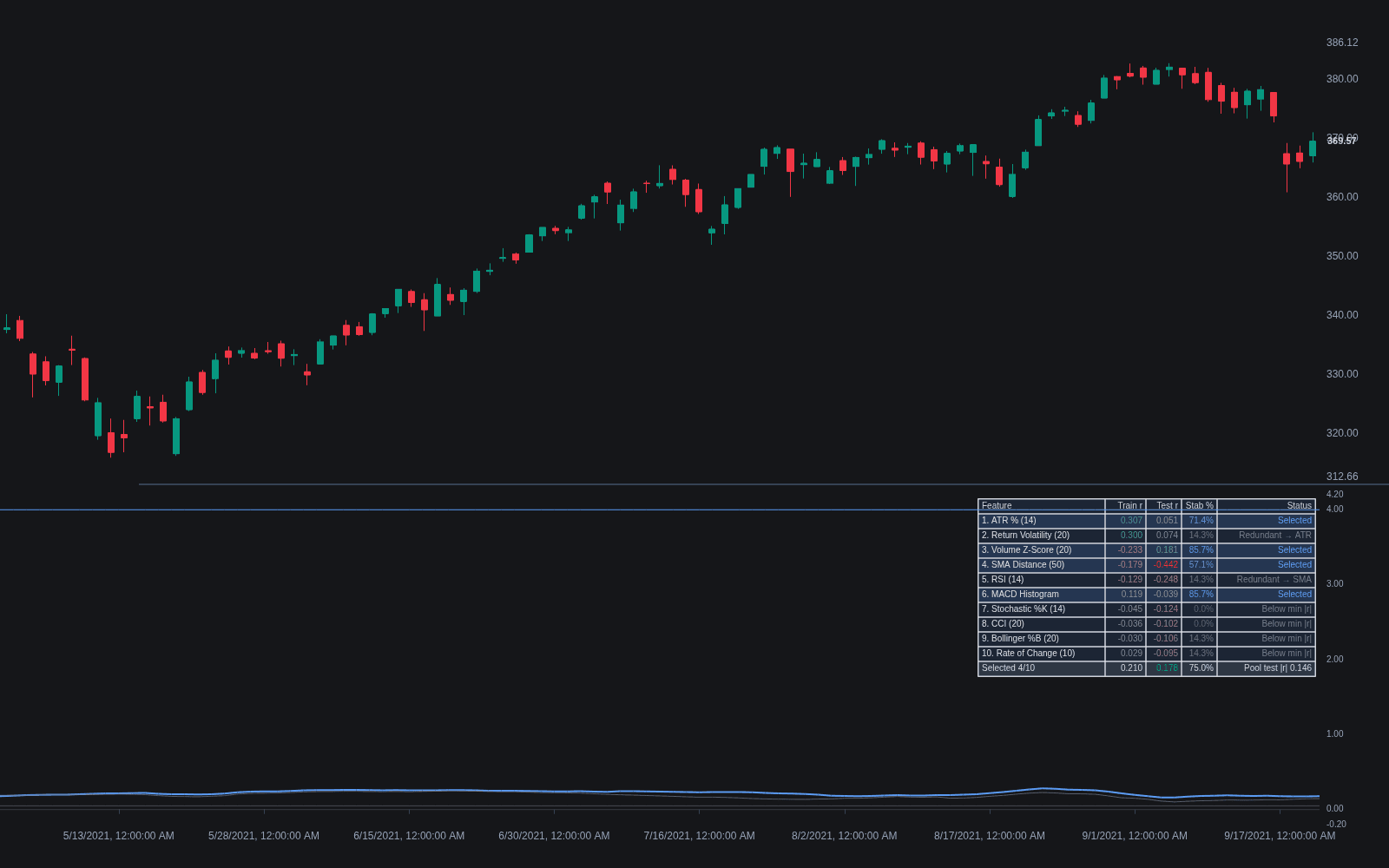
What is feature selection?
Feature selection is the process of choosing which candidate inputs a model is allowed to use and discarding the rest. It sits downstream of feature engineering, which creates candidate inputs, and upstream of model fitting. The motivation is statistical: every extra feature gives a model another degree of freedom to fit noise, and financial datasets are small and noisy enough that irrelevant inputs actively damage out-of-sample performance rather than merely wasting computation.
Methods fall into three broad groups. Filter methods score each feature independently of any model, using correlation with the label, mutual information, or simple statistical tests. Wrapper methods search over feature subsets by repeatedly fitting the model, as in recursive feature elimination. Embedded methods let the model select during training, as with L1-regularized regression that shrinks useless coefficients to zero, or tree ensembles whose importance scores rank inputs. Each group trades computation against how well it accounts for interactions between features.
In trading the stakes are higher than in most domains because candidate features are cheap to generate and mostly redundant: dozens of oscillators and moving-average transforms are near-copies of each other. Selecting among correlated inputs is unstable, small changes in the training window can swap which of two near-duplicates survives, so practitioners often decorrelate first, for example with PCA, or group related features and keep one representative per group. Aggressive selection tuned on the full dataset is also a quiet form of look-ahead: the choice of features is itself a fitted parameter and must be validated as part of the pipeline.
How traders use it
- Pruning an indicator zoo: a large pool of engineered inputs is reduced to the handful a random forest or boosted model actually leans on, judged by importance scores computed on held-out data rather than training data.
- Stabilizing simple models: for logistic regression or other linear scorers, removing redundant inputs shrinks coefficient variance and makes the model's behavior easier to reason about.
- Guarding against false discoveries: when many features are screened, some will correlate with returns by chance; treating selection as part of the model and re-running it inside each walk-forward step reveals whether the chosen set is stable or arbitrary.
- Reducing overfitting pressure: fewer inputs means fewer ways to memorize the training window, which directly lowers the risk of model overfitting, though it cannot remove it.
- Sanity checking: if a feature survives selection but has no plausible economic or behavioral rationale, many practitioners drop it anyway, accepting a small in-sample cost for robustness.
Feature selection vs. adjacent steps
Feature Engineering: Engineering creates candidate inputs from raw data; selection decides which of them a model may use. Good engineering widens the pool, good selection narrows it, and both are fitted choices that need out-of-sample validation.
PCA: PCA compresses correlated features into fewer composite ones rather than discarding any. It handles redundancy well but the components lose interpretability, whereas selection keeps original, nameable features.
Concept family
Machine Learning
32 concepts mapped · 32 in the Library
Feature Selection FAQ
Turn Feature Selection into a trading strategy.
Take the implementation from this page into Quant, then build on it, backtest it on real data, and keep refining it in conversation.