Regulation of Retail Prop Firms: What Traders Need to Know
Retail prop firm regulation depends on what the company actually does, the products involved and the jurisdictions connected to the account. A paid simulated evaluation is a different relationship from holding customer money at a securities broker or futures commission merchant. Calling a program “funded,” “educational” or “simulated” does not, by itself, settle its legal obligations.
The practical question is not simply whether a brand calls itself regulated. Identify the legal entity you pay, the account stage you receive and the protections that apply to that exact relationship. This U.S.-focused guide explains those distinctions using official sources checked in September 2026. A specific dispute or cross-border arrangement may require advice from a qualified professional in the relevant jurisdiction.
First Identify What You Are Buying
Retail programs commonly charge for an assessment, then offer a simulated stage with cash rewards subject to contractual conditions. Some have a later live trading pathway. These stages should not be treated as interchangeable, and the nominal balance displayed on a platform is not necessarily money owned by the participant.
| Relationship | What the displayed amount may represent | Protection question to ask |
|---|---|---|
| Paid evaluation | A simulated balance used to assess performance | What service, refund and dispute rights does the purchase agreement provide? |
| Simulated funded stage | Hypothetical trading results used to calculate possible cash rewards | Which entity owes an approved reward, and under what conditions? |
| Live firm trading | Actual trading using capital under the firm’s arrangement | Who owns the brokerage account, and what is the participant’s legal status? |
| Personal brokerage account | Customer cash and assets held through an intermediary | Which registration, custody and compensation rules apply to this account? |
For example, Topstep’s Live Funded Account policy explicitly describes real capital and real markets and distinguishes that stage from Express Funded Accounts. This shows why a blanket statement that all retail prop trading is simulated is too broad. It does not establish that every participant at every stage owns a protected customer brokerage account.
Keep three amounts separate: the fee you paid for a service, the simulated balance shown in the platform and any cash reward the contract says is payable. A $100,000 simulated account is not evidence that you deposited $100,000 or have a $100,000 claim on protected customer assets.
How U.S. Oversight Applies
Federal Agencies and Self-Regulatory Organizations
The SEC oversees the securities markets under federal securities law, while the CFTC oversees relevant derivatives markets under commodity law. FINRA and the National Futures Association are self-regulatory organizations, not federal agencies. NFA describes itself as the industrywide self-regulatory organization for U.S. derivatives, designated by the CFTC as a registered futures association.
Registration categories turn on activities and applicable rules. NFA’s registration overview distinguishes futures commission merchants, introducing brokers, commodity pool operators and commodity trading advisors. These categories concern different conduct, such as accepting orders and customer assets, soliciting orders without accepting those assets, operating a pool or providing compensated commodity trading advice.
A simulated assessment service may involve a different regulatory analysis from those activities. But a marketing label cannot establish an exemption, and operating through a company that trades its own capital does not answer every registration question. The actual arrangement, instruments, counterparties and any applicable exemptions must be examined.
Likewise, an affiliation with a registered broker does not automatically extend that broker’s permissions to a separate evaluation company. Identify which entity provides which service. A platform license, an exchange-data feed and a company incorporation certificate are different facts from financial-services authorization.
General Consumer and State Laws Still Matter
A business being outside a particular brokerage registration regime does not mean it can disregard all other law. Depending on the facts and jurisdiction, contract, consumer-protection, privacy and fraud rules may still apply. State securities requirements are relevant when the activity falls within their scope; they should not be assumed to apply to every assessment fee simply because the service concerns trading.
The FTC’s enforcement overview explains its authority over unfair or deceptive practices, subject to statutory limits. That is an example of a broader legal framework, not a finding that every retail prop program falls within a specific FTC case or that every dissatisfied customer has the same remedy.
Avoid both extremes: absence from a financial register is not automatically proof of illegality if registration is not required, and a firm’s claim that it is “unregulated” is not permission to mislead customers or ignore enforceable obligations. If the company says it has a particular authorization, verify the claim against the relevant official register and exact legal name.
Customer Protection Is Account-Specific
Securities Custody and SIPC Protection
For firms subject to the SEC’s Customer Protection Rule, FINRA explains requirements for possession or control of customer securities and a special reserve bank account for customer funds. This is a specific securities-custody framework, not a promise that every financial service keeps each customer’s money in a separate personal bank account.
SIPC protection addresses missing customer cash and securities when a SIPC-member brokerage firm fails financially. The limit is $500,000, including a $250,000 cash limit, subject to customer eligibility and applicable account rules. It should not be described as general investment insurance or assumed to multiply automatically with every account number.
SIPC does not cover market losses. Its guidance generally excludes commodity futures and foreign-exchange trades, with a narrow exception for certain futures held in an approved securities portfolio-margining arrangement. Cash protection concerns money held for securities transactions, not every payment connected with a trading business.
A prop evaluation fee or contractual reward claim is not automatically a SIPC-protected asset because the provider uses a broker that is a member. Determine whether you are the eligible customer of that broker and what property it actually holds for you. A logo or affiliate relationship cannot answer those questions.
Futures Customer Funds Have a Different Framework
The CFTC’s customer-fund segregation guidance says customer funds for trading on designated contract markets must be kept apart from an FCM’s own funds. The accounts are held for customers’ benefit, and segregated funds have a bankruptcy preference. These rules are distinct from SIPC’s securities protections.
Segregation does not guarantee complete or immediate recovery in every failure. The CFTC notes that, where customer funds are insufficient, the remaining claims participate in distributions to unsecured creditors. A protection designed to reduce custody risk should not be presented as a guarantee against insolvency or operational misconduct.
A participant trading a prop firm’s live account may have a contractual relationship with the firm rather than a personal customer relationship with the FCM. Confirm account ownership and legal status before assuming that the firm’s brokerage safeguards directly protect an unpaid reward. Simulated trading records do not become segregated customer funds simply because they resemble an account statement.
| Issue | Personal securities brokerage | Futures customer account at an FCM | Retail evaluation or simulated reward program |
|---|---|---|---|
| Primary distinction | Customer securities and cash for securities trading | Customer assets supporting futures trading | Purchased service and possible contractual cash reward |
| Custody framework | Applicable securities customer-protection rules | Applicable CFTC segregation rules | Depends on the service agreement and applicable law |
| SIPC | May apply at a member firm, subject to eligibility and limits | Generally not protection for ordinary commodity futures | Not automatic coverage for fees or rewards |
| Market losses | Not covered by SIPC | Trading risk remains | Simulated losses can affect account and reward eligibility |
| Dispute route | Applicable complaint, arbitration or court process | Applicable complaint, arbitration or court process | Contract and jurisdiction determine available remedies |
Leverage Rules Are Not Universal Broker Limits
The often-quoted 50:1 figure is not a limit for every regulated broker, market or country. NFA Financial Requirements Section 12 sets minimum security deposits for forex transactions with Forex Dealer Members: a 2% baseline for specified currencies and 5% for others, with additional provisions and potential increases.
A 2% deposit corresponds arithmetically to 50:1 exposure, while 5% corresponds to 20:1. Those are baseline illustrations, not a promise of the current maximum for every currency or customer. The rule permits temporary increases under extraordinary conditions, and a dealer can require more margin. Options have separate premium-related provisions.
Exchange-traded futures use their own margin framework. Securities margin and overseas CFD rules also require separate analysis. Comparing a simulated program’s advertised leverage with “regulated brokers: 50:1” combines unlike products and can mislead readers about the available protection.
For an evaluation, focus on the permitted instruments, contract values, position limits and remaining loss cushion. High advertised leverage does not increase the amount you can safely lose or make the account more suitable. A small adverse move can still breach a rule even when the platform permits the position size.
The Main Risks Beyond Trading Performance
Payout Conditions, Rule Changes and Business Failure
Cash rewards can depend on qualifying days, consistency calculations, prohibited-practice reviews, payout caps and retained balances. A simulated profit figure does not prove those conditions have been satisfied. Record the policy version attached to the purchased account, because terms can differ across product generations and purchase dates.
Read any clause dealing with amendments, notice and the effect of changes on existing accounts. Do not assume that every announced change is enforceable against every customer, or that a provider can legally withhold an amount whenever it chooses. Enforceability and remedies depend on the agreement, facts and applicable law.
A company can also experience cash-flow problems or cease operating. Past payouts do not prove that it has sufficient reserves for future obligations. Public prices, reviews and trader screenshots rarely provide a reliable view of the balance sheet. A profitable trading method cannot remove this company-level risk.
Identity Documents and Personal Data
Identity verification is not proof that a service is licensed, financially sound or secure. AML controls and privacy safeguards address different issues. A firm can request KYC documents while using a separate vendor, and the participant should understand who receives and retains the information.
- Identify the entity responsible for personal data and any verification provider named in its policy.
- Review the stated purposes, retention period, cross-border transfers and contact route for privacy requests.
- Use the official account portal and available multifactor authentication; verify unexpected document requests through a known support channel.
- Avoid sending extra sensitive documents that the verified process does not require.
Do not infer weaker security solely from the absence of a brokerage license, or stronger security solely from its presence. Examine actual policies and practices. Applicable privacy obligations also depend on the jurisdiction and processing activity.
Marketing and Reviews
A professional website, long operating history or positive review score can supply context, but none establishes authorization or solvency. Reviews can be selective, incentivized or based on a different account model. Payout screenshots do not show the full cost of failed attempts or whether future claims will be honored.
Treat claims of guaranteed funding, guaranteed payouts or personal pass probabilities with care. Ask what was measured, over what period and for which group. Attempts, individual traders, passed evaluations and cash recipients are different denominators. An estimate from a simulation is not an observed personal outcome rate.
A Practical Due-Diligence Process
1. Match the Legal Entity and Claimed Permissions
Record the company name on the agreement, checkout receipt and reward policy. Compare names, addresses, websites and contact details with official records. If another group company or broker appears, identify its role instead of treating all entities under the brand as interchangeable.
Use NFA’s official site and BASIC access to research derivatives-industry registration and disciplinary information where relevant. FINRA’s customer-protection page also links to BrokerCheck for securities firms and professionals. Enter through the official organization’s site and check the exact entity, current status and registration category.
An entry on a register is not an endorsement of every product offered under a similar name. Conversely, a company registry entry proves a corporate filing, not financial authorization. If a claimed permission cannot be matched, ask the provider to explain the discrepancy before paying.
2. Preserve the Agreement and Full Fee Schedule
Save a dated copy of the evaluation rules, funded-stage agreement, privacy policy, refund terms and payout schedule. Keep receipts and relevant support answers. These records are more useful in a dispute than trying to reconstruct a page after it changes.
| Contract item | Question to resolve |
|---|---|
| Trading status | Is this simulated or live, and who owns any live account? |
| Fee lifecycle | Does billing renew, and are resets, activation or data charged separately? |
| Reward eligibility | How are qualifying days, consistency, caps and review conditions calculated? |
| Loss rules | What balance or equity measure is used, and what changes after a payout? |
| Termination and amendments | What notice, appeal and existing-account provisions apply? |
| Disputes | Which entity, governing law, forum, deadline and process are specified? |
Complex legal language is not proof of wrongdoing, and the absence of a public audit is not automatically proof of fraud. The useful question is whether you can understand the material obligations and obtain consistent answers. If a term would materially affect your decision and remains unclear, do not fill the gap with a marketing assumption.
3. Calculate the Cash Budget
Add evaluation purchases, repeat attempts, renewals, activation, platform, data and payment charges. Compare them with actual cash received rather than the simulated profit balance. Refunds should be counted only when the stated conditions are met and the cash is returned.
For example, three $100 attempts plus $80 of other charges cost $380. A later $500 cash reward leaves $120 before further expenses and tax. The nominal funded balance is not part of this cash calculation. Set a spending limit that does not rely on receiving a reward, and avoid buying another attempt merely to recover sunk costs.
4. Know the Complaint Route Before a Dispute
Start by preserving the relevant rules, transaction records and communications, then use the provider’s documented complaint process. A clear written account of the disputed amount, date and contractual provision helps keep the issue specific. Do not assume that posting publicly substitutes for meeting a contractual or legal deadline.
NFA arbitration addresses eligible disputes involving customers and NFA Members, employees or Associates. It is not automatically available for every retail prop service contract. A provider’s relationship with an NFA Member does not, by itself, establish jurisdiction over a separate reward dispute.
Depending on the matter, a regulator, consumer-protection authority, payment provider, court or contractual arbitration process may be relevant. A complaint does not guarantee recovery, and a chargeback is not an automatic entitlement. Seek jurisdiction-specific advice when the amount, deadline or cross-border arrangement warrants it.
What Regulatory Developments Actually Show
Separate enacted rules, proposed rules, enforcement actions and predictions. They have different legal effects. A proposal is not an effective requirement; an allegation or arrest is not a conviction. A change affecting financial promotions in one jurisdiction does not automatically create a U.S. license for every retail prop program.
The FCA’s international finfluencer announcement concerns coordinated action against unlawful financial promotions beginning in June 2025. It is evidence of scrutiny of promotional conduct across the wider financial sector. It should not be presented as a new U.S. retail prop-firm regulatory framework.
Future measures could address disclosures, marketing or activities that require authorization, but their content and timing cannot be assumed. Before acting on a claimed regulatory change, find the regulator’s original document, the affected activities and jurisdictions, its status and any effective date. Provider program changes can also be commercial decisions rather than legal mandates.
For existing accounts, preserve communications about eligibility changes, withdrawal arrangements and deadlines. A strong research routine helps with trading decisions, but it cannot substitute for understanding a changed agreement or the legal entity responsible for payment.
Build a Research Process with LuxAlgo
Use LuxAlgo’s native charts to define the setup, instrument and session you intend to trade. Work with Quant, our coding agent to turn explicit entry, exit and position-sizing rules into code. Inspect the generated code and run the strategy yourself. A strategy that compiles is not proof that it complies with a provider’s agreement.
In native strategy testing, use standard candles, realistic commission and slippage, and a testing period separate from development. Confirm data availability and account for differences between the research feed and the provider’s platform. Backtest results do not establish authorization, payout eligibility or future returns.
Model account conditions separately where the backtest does not represent them: floating-loss tests, daily reset times, qualifying days, payout caps and the effect of withdrawals. Research tools do not automatically enforce every firm’s rules. Confirm whether automation, copying or the intended execution method is permitted on the purchased account.
Use the native LuxAlgo journal to review supported trade records by instrument, session and strategy. Keep a separate record of fees and cash rewards, plus the agreement version that applied to each account. The provider’s dashboard remains the reference for its own loss limits and eligibility calculations.
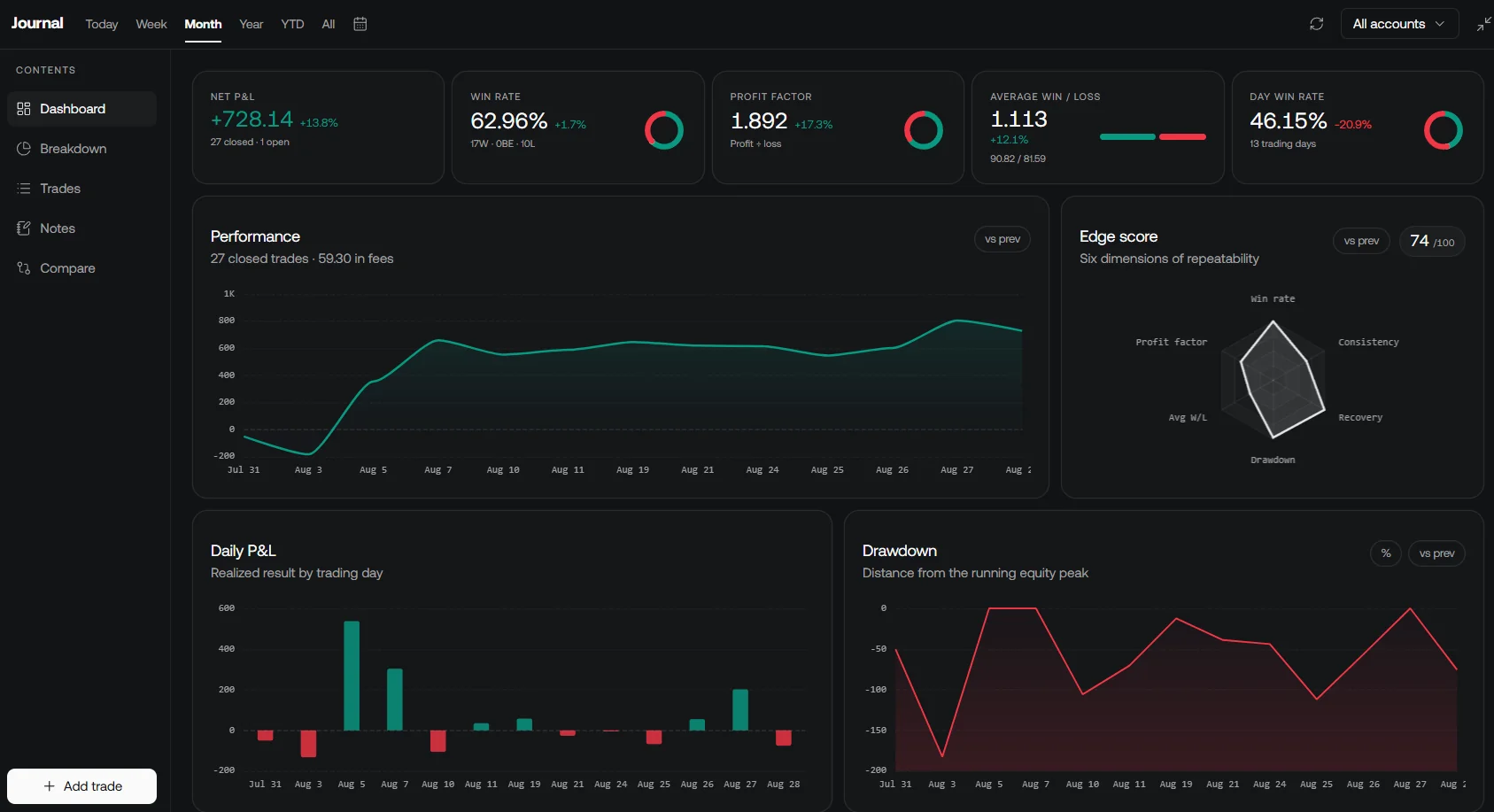
The Library’s market-structure, trend and momentum tools open on a Quant Chart, and Quant backtests a rule set against years of history. See current plans and access for the tools you need.
The LuxAlgo Prop Firms portal can help organize comparisons and explore modeled scenarios. Verify reference rules against the current agreement. Modeled outcomes depend on assumptions and are not observed personal pass probabilities; a partner discount is not evidence of regulatory protection or the lowest total cost.
A disciplined process combines three separate checks: whether the trading idea has supporting evidence, whether the account’s rules fit that process and whether the legal and payment relationship is acceptable. Passing one check does not establish the others.
Frequently Asked Questions
Are all retail prop firms unregulated?
No single label answers that question. Applicable obligations depend on the firm’s actual activities, instruments, entities and jurisdictions. A simulated assessment differs from a customer brokerage account, but a simulated label does not automatically establish an exemption from all law.
Does SIPC protect prop evaluation fees or unpaid rewards?
Not automatically. SIPC protects eligible customer cash and securities at a financially troubled member brokerage firm, subject to its rules and limits. A service fee or contractual reward claim is a different relationship, and broker affiliation alone does not establish coverage.
Is 50:1 the leverage limit for every regulated broker?
No. The commonly cited figure relates to specified forex security-deposit requirements. Futures, securities, other currencies and other jurisdictions have different rules, and higher margin requirements can apply.
Can I use NFA arbitration for any prop firm dispute?
No. NFA arbitration has eligibility and jurisdiction requirements involving NFA Members and related parties. A separate retail evaluation or reward contract does not automatically qualify.
Can backtesting remove the risks of a prop firm closing or withholding payment?
No. Backtesting supports strategy research. It does not establish a company’s solvency, legal authorization or ability to meet a contractual reward obligation. Review those risks separately from trading performance.
Read next