Taxation and Algo Trading: Know Your Liabilities

Algorithmic trading does not create a separate tax category. Your obligations depend on your jurisdiction, account, instruments, activity and any valid elections. An automated strategy can generate thousands of records, but using software alone does not establish trader tax status or make every expense deductible.
This guide covers U.S. federal income-tax principles for individuals, reviewed in September 2026. State, local, foreign and entity rules can differ. Use the forms and instructions for the tax year you are filing, and discuss elections and your specific circumstances with a qualified tax professional.
- Separate status from accounting: being a securities trader and electing section 475(f) mark-to-market treatment are different questions.
- Identify the instrument: stocks, qualifying futures, foreign currency and digital assets can follow different rules.
- Reconcile every account: brokerage statements, tax lots, wash-sale adjustments and foreign-currency records matter more than a headline trading P&L.
- Plan before deadlines: elections and estimated payments can be due well before you file the final return.
Tax Rules for Algo Traders
Trader vs. Investor Status
IRS Topic 429 explains that a securities trading business seeks profit from daily price movements, has substantial activity, and operates with continuity and regularity. The IRS considers holding periods, trade frequency and value, livelihood objectives and time devoted. There is no automatic qualification based on three-times annual turnover, a 30-day holding period, a bot, or an LLC.
A qualifying trader generally reports eligible trading-business expenses on Schedule C. Without a valid section 475(f) election, securities gains and losses remain capital and wash-sale and capital-loss restrictions continue. With a valid election, covered trading gains and losses generally become ordinary and are reported on Form 4797. Separately identified investment holdings remain outside that treatment.
Commissions and transaction costs used to acquire or dispose of securities enter the gain/loss calculation; they are not also separately deducted as business expenses. Securities trading gains themselves generally are not subject to self-employment tax. Maintain records distinguishing business positions from investments from acquisition onward.
For investors, many investment-management expenses are nondeductible miscellaneous itemized deductions under current federal rules. The Form 8960 instructions explain the permanent disallowance introduced by the 2025 legislation. Investment interest and genuine business expenses have their own rules; a software receipt does not settle deductibility by itself.
Types of Trading Income
| Item | General federal treatment | What to check |
|---|---|---|
| Stock or other capital-asset sale | Net short-term gains generally use ordinary income-tax rates; many net long-term gains receive preferential rates. | Basis, holding period, loss netting and adjustments |
| Covered section 475(f) trading position | Generally ordinary gain or loss with year-end marking | Eligibility, valid election and which holdings are covered |
| Qualifying section 1256 contract | Generally year-end mark-to-market and 60% long-term / 40% short-term capital treatment | Exact contract classification, hedging and straddle exceptions |
| Digital-asset disposition | Depends on the asset and transaction; investment dispositions commonly require capital-gain calculations. | Basis, proceeds, transfers, income events and broker reporting |
Under IRS capital-gain guidance, a holding period of more than one year generally distinguishes long-term from short-term gains. For tax year 2026, the top federal marginal individual rate remains 37%. That is not a flat tax on every short-term gain. Filing status, taxable income and other provisions affect the result.
The 3.8% net investment income tax may also apply, including to certain income from trading financial instruments. State taxes can add another layer. Do not treat 37% as an all-in maximum liability.
Form 6781 covers section 1256 contracts and straddles. Its 60/40 treatment is not a blanket rule for every future, option, forex trade or crypto derivative. Section 1256 marking also differs from a trader’s section 475(f) election.
Mark-to-Market Accounting Is a Choice with Consequences
For covered positions, marking to market recognizes year-end changes in value even when a position remains open. It is not the same as calling every security “inventory.” The election can remove the capital-loss limitation and wash-sale treatment for covered trading securities, but it can also recognize an unrealized gain before cash is received from a sale. Investment holdings and other instruments require separate analysis.
Illustrative timing example: assume a covered position has a $10,000 tax basis and a $12,000 year-end value. Ignoring other adjustments, marking recognizes a $2,000 gain and resets the basis to $12,000. Selling it for $11,000 the following year then produces a $1,000 loss. The two-year net is $1,000, but the timing differs from waiting to recognize the gain upon sale.
Revenue Procedure 99-17 describes the election statement and timing. Existing taxpayers generally must elect by the unextended due date of the preceding year’s return. Thus, an election effective for 2026 generally had to accompany the timely 2025 return or extension request by its original deadline. Filing an extension does not extend the election deadline. A new taxpayer not required to file a prior-year return generally records the election within two months and 15 days after the first day of the effective year and attaches a copy to that year’s return.
The election statement and an accounting-method change are separate steps; Form 3115 can be required. Reversing an election also has procedures and deadlines. Have an adviser check the current process, any applicable relief, transition adjustments and loss limitations. Ordinary-loss treatment does not make all losses or all expenses unrestricted.
Video: Understanding Mark-to-Market and Wash Sales
Brian Rivera, CPA, discusses these concepts in this older educational video. Its title advocates an election, but section 475(f) is not mandatory or suitable for every active trader. Use the current IRS guidance above for eligibility, procedures and deadlines.
Tax Problems in Algo Trading
Keep a Reconciled Record of Actual Transactions
Preserve original broker and exchange records before transforming them. A canceled order, a simulated fill and an executed transaction are different events. Partial executions, transfers and corporate actions can make a simple trade-count export incomplete.
| Record | Useful details | Reconciliation purpose |
|---|---|---|
| Trade confirmations and statements | Account, instrument, execution date/time, quantity, price and fees | Match actual proceeds and acquisitions |
| Tax-lot history | Acquisition date, adjusted basis, lot selection and transfers | Support gain/loss and holding-period calculations |
| Tax statements | Forms 1099-B, 1099-DA and other applicable forms, including corrections | Reconcile broker reporting with the return |
| Adjustments and elections | Wash sales, corporate actions, carryforwards, election statements and method changes | Explain differences from platform P&L |
| Foreign and digital-asset activity | Currency rates, wallet transfers, asset identifiers and income events | Avoid missing basis or treating transfers as sales |
For securities, properly executed specific-lot identification can differ from a default FIFO result. Keep evidence of the instructions and broker confirmation rather than retrospectively choosing whichever lot creates the lowest tax. Ask the preparer to verify the method for each asset and account.
Form 1099-DA reports digital-asset proceeds and, in some cases, basis. Missing broker basis does not mean the asset’s basis is zero. Match records across platforms and wallets, and investigate missing acquisition information before finalizing the return.
Wash-Sale Management
Under the stock-and-securities rules in IRS Publication 550, a loss sale can be a wash sale when substantially identical stock or securities are acquired within 30 days before or after the sale. Review purchases across accounts, reinvested dividends, relevant options and applicable spouse transactions. “Different ticker” or “similar but not identical” is not a reliable legal test.
Illustrative taxable-account example: you sell shares with a $5,000 basis for $4,200, then repurchase the same number of identical shares for $4,300 ten days later. Ignoring fees and other transactions, the $800 loss is disallowed currently and added to the replacement basis, making it $5,100. It is generally deferred rather than immediately deductible.
An IRA replacement can be different: Revenue Ruling 2008-5 disallows the loss without increasing the IRA’s basis. Coordinate taxable and retirement accounts instead of assuming a repurchase inside an IRA avoids the rule.
Broker reporting has a narrower scope than your full tax responsibility. The Form 1099-B instructions describe required broker wash-sale reporting; an absent adjustment on a statement is not proof that no adjustment is needed. Reconcile the complete account set and check replacement purchases across year-end.
International Trading Taxes
For taxpayers using the U.S. dollar as their functional currency, the IRS currency guidance requires translating relevant items using the rate when received, paid or accrued. Do not simply convert the final annual foreign-currency P&L at the year-end rate.
For example, a purchase costing €1,000 at $1.10 per euro has a $1,100 dollar cost. A later €1,100 sale at $1.05 per euro produces $1,155 of proceeds: a $55 difference before costs and any separate currency treatment, rather than a $100 gain. Save both exchange-rate records.
Foreign accounts can create information-reporting obligations even when they earn no profit. FBAR rules generally use a $10,000 aggregate foreign-account threshold at any time during the year, subject to the applicable definitions and exceptions. Form 8938 has separate requirements. Ask about treaties, foreign tax credits and foreign investment structures rather than treating a foreign exchange as a tax exemption.
Tax Planning Methods
Choose Accounts for Their Full Rules
Traditional and Roth IRAs have different contribution and withdrawal rules. Traditional IRA earnings generally grow tax-deferred; qualified Roth distributions are tax-free. Contribution deductibility, eligibility and withdrawal conditions still matter. “Self-directed” describes investment control rather than a separate tax treatment.
A retirement account does not automatically support your algorithm, short selling, leverage or chosen assets. Check the custodian’s permissions and applicable prohibited-transaction rules. Employer plans such as 401(k)s have plan-specific investment choices and may include traditional or Roth features. Losses inside retirement accounts generally do not become personal capital-loss deductions.
Evaluate Tax-Loss Harvesting After Costs
Realizing a deductible capital loss can offset capital gains. If net capital losses exceed gains, individuals generally can deduct up to $3,000 against other income per year, or $1,500 if married filing separately, with unused losses carried forward under the applicable rules. This is a deduction, not a dollar-for-dollar tax credit.
For an illustrative single filer with $7,000 of net deductible capital losses and no other relevant adjustments, $3,000 may reduce current income and $4,000 carries forward. Actual tax savings depend on the return. A harvested loss does not create a guaranteed annual performance boost.
- Review unrealized losses alongside the portfolio’s investment objective.
- Check existing purchases, automatic reinvestment and planned replacement trades for wash-sale issues.
- Consider trading costs, time out of the market and future tax basis before selling.
- Document the transaction and reconcile the final tax treatment with the preparer.
Plan Payments and Elections with an Adviser
Discuss trader status, entity choice, section 475 eligibility and deadlines before taking action. Incorporation does not automatically create trader status or reduce overall tax. Compare administrative costs, state obligations, liability considerations and the treatment of distributions.
Trading gains may require estimated tax payments or additional withholding during the year. Review safe-harbor and annualized-income methods where relevant; do not assume paying the final balance with the return avoids an underpayment penalty. Set aside cash for taxes instead of automatically reinvesting every apparent trading profit.
A Practical LuxAlgo Research and Record-Review Workflow
Use LuxAlgo charts and Quant, our coding agent, to develop and inspect trading ideas. A historical backtest is simulated performance, not taxable income or a record of executed trades. Keep strategy research separate from the broker’s actual transaction ledger.
The LuxAlgo Journal supports manual fills, statement imports and supported broker connections for reviewing trading activity. Use notes to explain unusual transactions or differences that need investigation. Connected accounts refresh daily or through manual refresh; supported coverage and the completeness of your imports still need checking.
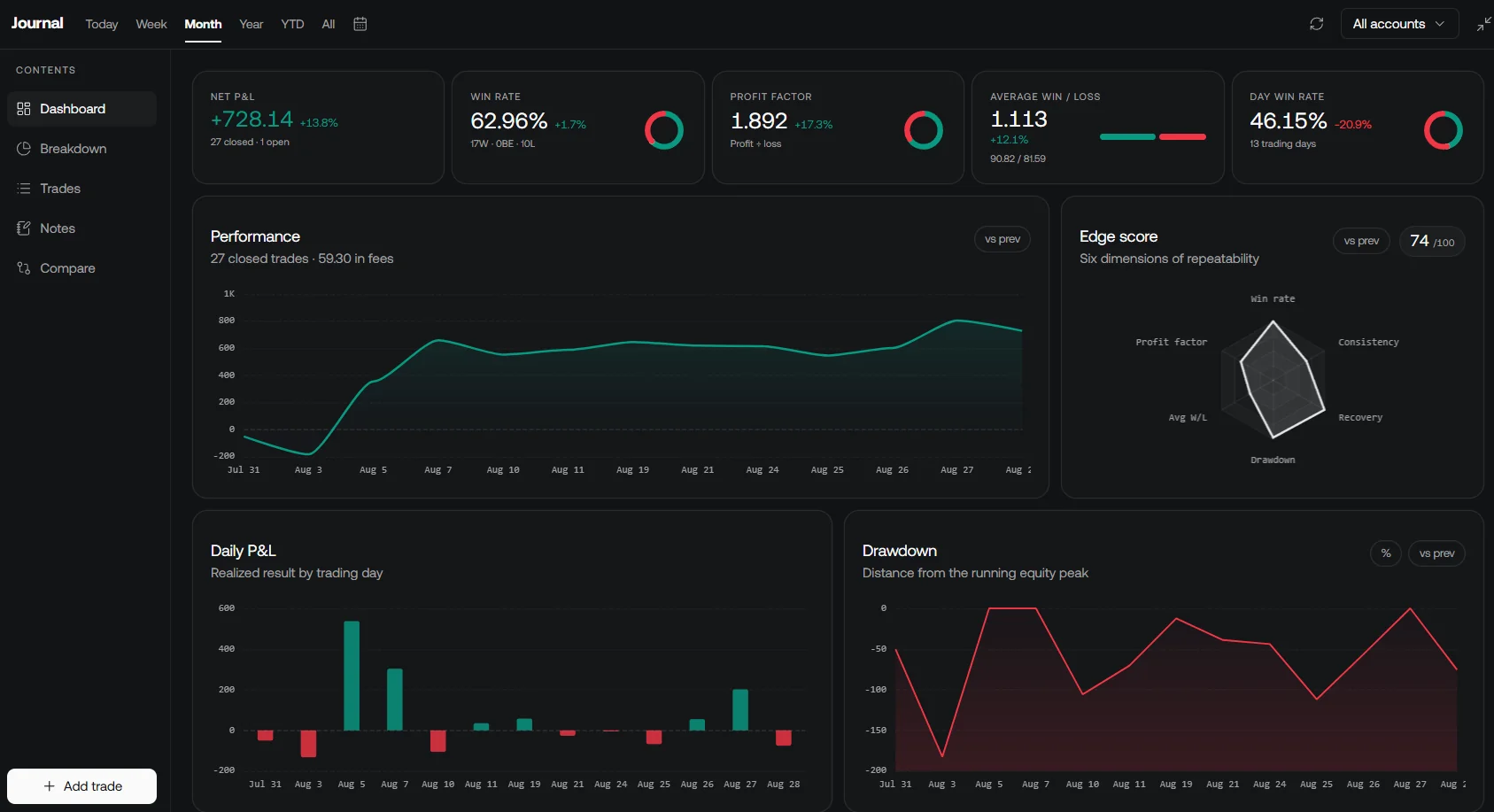
Do not assume Journal P&L equals taxable income or that LuxAlgo generates Form 8949. Use broker records, appropriate tax software and professional review to calculate tax lots, cross-account wash sales and filing adjustments. Specialist services such as TraderFyles or digital-asset tax platforms should be evaluated for current broker coverage, supported instruments, transaction limits and reconciliation features, rather than an old pricing table.
Next Steps and Resources
- Build a complete list of taxable, retirement, foreign and digital-asset accounts.
- Preserve confirmations, statements, basis history and election documentation.
- Reconcile actual executions and cash movements with tax reporting.
- Review estimated payments and next-year election deadlines before year-end.
- Give the preparer a list of unresolved transactions and supporting records.
Automation can make trade collection more consistent, but tax classification and reconciliation still require care. A traceable record and timely decisions are the foundation of managing algorithmic-trading liabilities.
Read next