Clusters Volume Profile

Feb 6, 2026

Static chart image
Support and Resistance
Volume Based
Liquidity
Works on the following platforms:
tradingviewSymbolTradingView
For free use on the TradingView platform
ninjatraderNinjaTrader
For free use on the NinjaTrader platform
metatrader4MetaTrader 4/5
For free use on the MetaTrader 4/5 platform
thinkorswimThinkorswim
For free use on the Thinkorswim platform

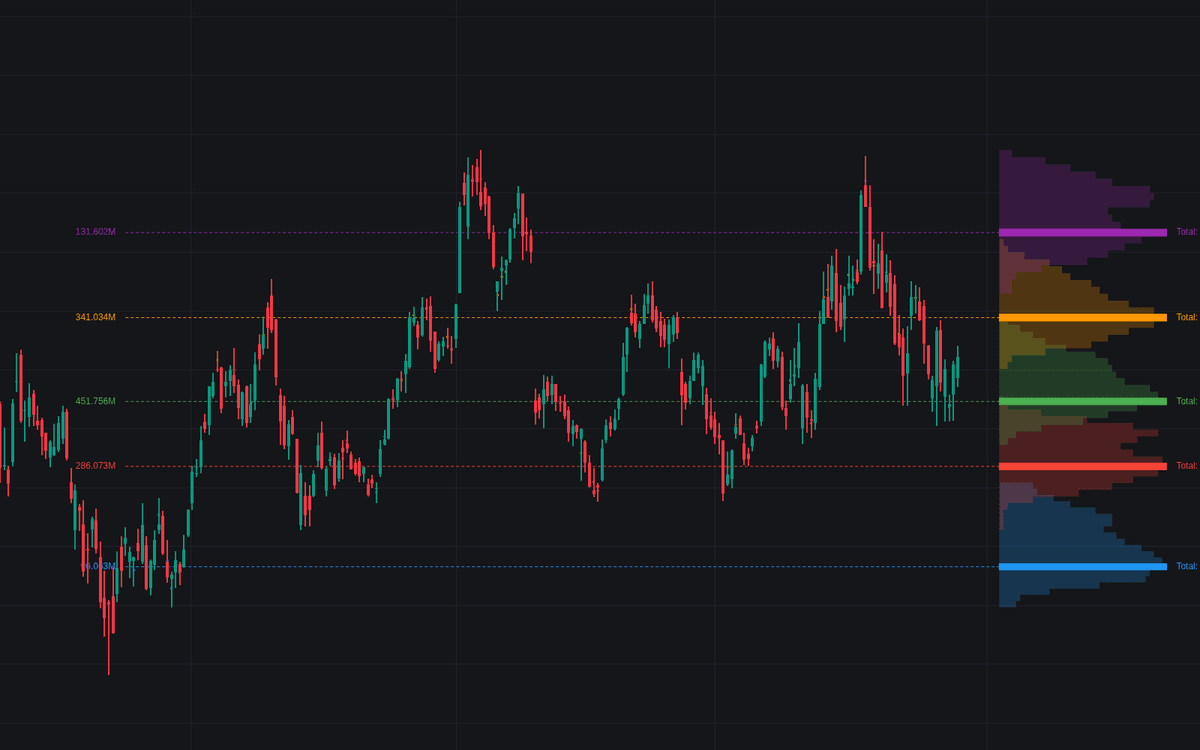
The Clusters Volume Profile [LuxAlgo] indicator is an advanced trading indicator that applies K-Means clustering to historical price action in order to segment the market into distinct price regimes and generate an individual volume profile for each one. Instead of analyzing volume strictly over time, this trading tool groups price action by proximity and density, offering traders a clearer view of where liquidity, participation, and fair value have truly formed across different market conditions.

By combining statistical clustering with detailed volume profiles, this indicator helps traders uncover institutional zones, identify market regimes, and build more precise trading strategies based on volume-backed price behavior.

How to Trade the Clusters Volume Profile Trading Indicator?

This trading indicator scans a user-defined lookback period and separates historical price action into multiple clusters. Each cluster represents a distinct price regime where trading activity shared similar characteristics. Every cluster is assigned a unique color and its own horizontal volume profile, allowing traders to visually compare liquidity distribution across different price areas.

Because clusters are formed using K-Means clustering rather than chronological segmentation, the resulting volume profiles often reveal important high-interest zones that traditional volume profiles may obscure.

Identifying Institutional Trading Zones

One of the primary uses of this trading indicator is identifying institutional price levels. Each cluster produces a Point of Control (POC), representing the price level with the highest traded volume within that regime.

Since clusters are grouped by price density rather than time, a cluster’s POC often reflects a true “fair value” level where significant market participation occurred. These POC levels frequently act as strong support or resistance when revisited, making them valuable reference points for both discretionary and systematic trading strategies.

Market Regime Detection and Structure Analysis

The spatial arrangement of clusters provides insight into broader market conditions:

  • Multiple overlapping clusters with high volume typically indicate accumulation or distribution phases, often associated with range-bound or sideways markets.
  • Clearly separated clusters with minimal overlap and visible volume gaps suggest trending environments.
  • The formation of a new, isolated cluster after a period of overlap can signal a breakout or the early stages of a new trend.

This makes the Clusters Volume Profile indicator particularly useful for traders looking to adapt their trading strategy to changing market regimes.

Precision Entries, Stops, and Targets

Cluster boundaries and POC levels offer well-defined, objective levels for trade management:

  • Entries can be considered when price revisits a high-volume cluster POC.
  • Stop-loss levels can be placed outside the full price range covered by a specific cluster’s volume profile.
  • Take-profit targets can be aligned with the POC of the next major cluster above or below current price.

This structured approach helps traders move away from arbitrary levels and toward volume-backed decision-making.

Volume Conviction and Participation Analysis

The indicator displays volume metrics for each cluster, allowing traders to compare participation across different price regimes. By analyzing the total volume of one cluster versus another, traders can assess where the strongest conviction occurred.

A breakout into a price zone associated with a high-volume cluster often signals stronger institutional involvement and a higher probability of the level holding, compared to moves into low-volume clusters with weaker participation.

DETAILS

The Clusters Volume Profile trading indicator is built around a K-Means clustering algorithm designed for financial market data. The process works as follows:

  • Initial centroids are distributed across the price range of the selected lookback period.
  • Each price bar is assigned to the nearest centroid using the HLC2 (median) price.
  • Centroids are recalculated using the volume-weighted average price of their assigned bars.
  • The process is repeated for a defined number of iterations to ensure stable and meaningful clusters.

By separating price action into statistically derived clusters, the indicator reveals high-interest trading zones that are often hidden when using a single traditional Volume Profile.

SETTINGS

Clustering Settings

  • Lookback Period: Defines how many historical bars are included in the clustering analysis.
  • Number of Clusters: Specifies how many distinct price regimes the algorithm should identify (from 2 to 10).
  • K-Means Iterations: Controls how many refinement cycles are used to stabilize cluster centers. Higher values generally produce more reliable clusters.

Volume Profile Settings

  • Rows per Cluster VP: Sets the vertical resolution of each cluster’s volume profile.
  • Max VP Width (Bars): Limits the maximum horizontal width of the volume histograms.
  • VP Offset: Adjusts the horizontal spacing between the current bar and the volume profiles.
  • Highlight Price Dots: Enables or disables colored dots on price bars to show cluster assignments.
  • Dot Size: Controls the size of the cluster assignment dots, from tiny to very large.

FAQ

What type of trading strategy works best with the Clusters Volume Profile indicator?

This trading indicator is well-suited for volume-based trading strategies, market structure analysis, and regime detection. It can be used for both discretionary trading and systematic rule-based approaches across any market or timeframe.

Is this indicator suitable for beginners?

Yes. While the underlying logic uses advanced clustering techniques, the visual output is intuitive and helps traders of all experience levels understand volume distribution and market structure more clearly.

How can I access the Clusters Volume Profile [LuxAlgo] indicator?

You can get access on the LuxAlgo Library for charting platforms like TradingView, MetaTrader (MT4/MT5), and NinjaTrader for free.

Trading & investing are risky and many will lose money in connection with trading and investing activities. All content on this site is not intended to, and should not be, construed as financial advice. Decisions to buy, sell, hold or trade in securities, commodities and other investments involve risk and are best made based on the advice of qualified financial professionals. Past performance does not guarantee future results.

Hypothetical or Simulated performance results have certain limitations. Unlike an actual performance record, simulated results do not represent actual trading. Also, since the trades have not been executed, the results may have under-or-over compensated for the impact, if any, of certain market factors, including, but not limited to, lack of liquidity. Simulated trading programs in general are designed with the benefit of hindsight, and are based on historical information. No representation is being made that any account will or is likely to achieve profit or losses similar to those shown.

Testimonials appearing on this website may not be representative of other clients or customers and is not a guarantee of future performance or success.

As a provider of technical analysis tools and strategies, we do not have access to the personal trading accounts or brokerage statements of our customers. As a result, we have no reason to believe our customers perform better or worse than traders as a whole based on any content, tool, or platform feature we provide.

Charts used on this site are by TradingView in which the majority of our technical indicators are built on. TradingView® is a registered trademark of TradingView, Inc. www.TradingView.comTradingView® has no affiliation with the owner, developer, or provider of the Services described herein.

Market data is provided by CBOE, CME Group, BarChart, CoinAPI. CBOE BZX real-time US equities data is licensed from CBOE and provided through BarChart. Real-time futures data is licensed from CME Group and provided through BarChart. Select cryptocurrency data, including major coins, is provided through CoinAPI. All data is provided “as is” and should be verified independently for trading purposes.

This does not represent our full Disclaimer. Please read our full disclaimer.

© 2026 LuxAlgo Global, LLC.