Gaussian Volume Profile

Feb 15, 2026

Static chart image
Support and Resistance
Volume Based
Liquidity
Works on the following platforms:
tradingviewSymbolTradingView
For free use on the TradingView platform
ninjatraderNinjaTrader
For free use on the NinjaTrader platform
metatrader4MetaTrader 4/5
For free use on the MetaTrader 4/5 platform
thinkorswimThinkorswim
For free use on the Thinkorswim platform

The Gaussian Volume Profile is an advanced volume analysis trading indicator that models historical volume distribution using a Sum of Gaussians approach. Instead of relying on traditional jagged histograms, this indicator applies non-linear optimization to produce a smooth, continuous volume density curve—helping traders precisely identify high-volume nodes, liquidity clusters, and institutional support and resistance levels.

By leveraging the Levenberg-Marquardt optimization algorithm, the Gaussian Volume Profile transforms raw volume data into a mathematically refined structure. The result is a noise-reduced, high-precision volume profile trading tool designed for traders who want deeper insight into fair value zones and market structure.

How to Trade the Gaussian Volume Profile?

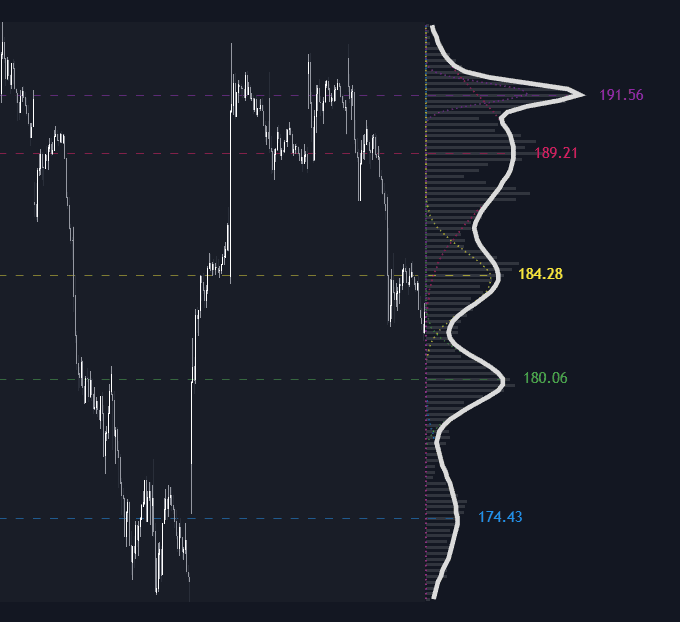
This trading indicator projects a lateral volume density map to the right of price action, allowing traders to visually identify where the highest concentration of trading activity occurred within a selected lookback window.

Unlike a standard Volume Profile that displays discrete horizontal bars, the Gaussian Volume Profile generates:

  • A smooth density curve representing volume distribution
  • Individual Gaussian components (liquidity clusters)
  • Automatically detected peak levels
  • A refined center-of-gravity for each high-volume area

This makes it especially useful for:

  • Identifying high-probability support and resistance levels
  • Locating fair value zones for mean reversion strategies
  • Defining optimal entry and exit areas
  • Filtering breakout and rejection setups

Identifying High-Volume Nodes

The script automatically detects local maxima (peaks) within the fitted Gaussian model. These peaks represent price levels where trading activity was most concentrated.

Each detected node is displayed as:

  • A horizontal dashed line at the Gaussian apex
  • Color-coded to match the dominant Gaussian component
  • Positioned at the mathematically derived liquidity center ($\mu$)

These levels often act as:

  • Institutional accumulation/distribution zones
  • Reaction points for pullbacks
  • Breakout validation areas

Because the peak is derived from a continuous model rather than a fixed bin, it often provides more precise support and resistance levels than traditional Volume Profile tools.

Understanding Zone Width and Volatility

Each Gaussian component has a standard deviation ($\sigma$), which determines its width.

  • Narrow, sharp peaks: Indicate highly concentrated agreement at a specific price level. These zones often produce strong reactions.
  • Wide, shallow curves: Suggest broader value areas where volume was distributed across a range, indicating less precise consensus.

Traders can use this information to:

  • Adjust stop-loss placement
  • Gauge conviction at price levels
  • Assess whether a zone represents compression or expansion in participation

Why This Trading Indicator Is Different

This tool represents a scientific evolution of traditional Volume Profile analysis by applying a Gaussian Density model to market data.

Noise Reduction

Standard profiles can appear fragmented due to tick-by-tick binning. The Sum of Gaussians model smooths out insignificant variations, filtering noise and revealing the underlying liquidity structure.

This allows traders to focus on meaningful volume clusters rather than random micro-imbalances.

Levenberg-Marquardt Optimization

The indicator uses the Levenberg-Marquardt (LM) algorithm—a well-known solution for non-linear least squares optimization—to refine multiple Gaussian components iteratively.

This ensures:

  • Convergence toward the most accurate mathematical representation
  • Stable peak detection
  • Reduced overfitting to minor fluctuations

Precise Liquidity Centers

Rather than relying on bin midpoints, each Gaussian apex represents a mathematically derived liquidity center ($\mu$).

This often provides:

  • More accurate support and resistance levels
  • Cleaner backtests for volume-based trading strategies
  • Better-defined value areas

Continuous Volume Distribution

Because the model treats volume as a continuous function, it can estimate density between discrete price levels.

This results in:

  • A smoother trading indicator
  • More fluid interpretation of value
  • A refined view of institutional interest

SETTINGS

Profile Settings

  • Lookback Window: Defines the number of historical bars used to compute the volume distribution. Larger windows capture broader structural value; smaller windows focus on short-term positioning.
  • Number of Bins: Controls vertical resolution. More bins increase detail but also computational load.

Gaussian Settings

  • Max Potential Peaks: Determines the maximum number of Gaussian components the model attempts to fit. Higher values allow more detailed liquidity decomposition.
  • Max Iterations: Specifies how many refinement cycles the LM optimizer performs. Increasing this improves fit precision at the cost of performance.
  • Initial Lambda: Sets the damping factor for early optimization steps, influencing convergence behavior.

Visual Customization

  • Histogram Resolution: Controls the horizontal projection length of the histogram and fitted curve.
  • Highlight Window Range: Displays a background box showing the active lookback region.
  • Highlight Detected Peaks: Automatically draws horizontal dashed lines at detected liquidity centers.
  • Fit Color: Sets the color of the main Gaussian density curve.
  • Auto Mode: Automatically adapts the fit color to your chart’s foreground for improved visibility.

Practical Trading Strategy Applications

The Gaussian Volume Profile can be integrated into multiple trading strategies:

  • Mean Reversion Strategy: Trade rejections from narrow Gaussian peaks.
  • Breakout Strategy: Confirm breakouts when price clears a dominant liquidity node.
  • Range Trading: Use wide Gaussian clusters as rotational value areas.
  • Trend Continuation: Enter on pullbacks into prior high-density zones.

Because this indicator mathematically models liquidity concentration, it is especially useful for traders who rely on:

  • Volume-based analysis
  • Market profile techniques
  • Order flow concepts
  • Institutional trading strategies

FAQ

What makes the Gaussian Volume Profile different from a regular Volume Profile?

Traditional profiles use fixed bins and display discrete bars. The Gaussian Volume Profile fits a continuous Sum of Gaussians model to the data, providing smoother, more precise liquidity centers and reduced noise.

Is this trading indicator suitable for all markets?

Yes. It can be applied to stocks, crypto, forex, futures, and indices—any market with reliable volume data.

How many peaks should I use?

It depends on market complexity. Trending markets often require fewer components, while consolidating or rotational markets may benefit from more Gaussian nodes.

How do I access the Gaussian Volume Profile?

You can get access on the LuxAlgo Library for charting platforms like TradingView, MetaTrader (MT4/MT5), and NinjaTrader for free.

Trading & investing are risky and many will lose money in connection with trading and investing activities. All content on this site is not intended to, and should not be, construed as financial advice. Decisions to buy, sell, hold or trade in securities, commodities and other investments involve risk and are best made based on the advice of qualified financial professionals. Past performance does not guarantee future results.

Hypothetical or Simulated performance results have certain limitations. Unlike an actual performance record, simulated results do not represent actual trading. Also, since the trades have not been executed, the results may have under-or-over compensated for the impact, if any, of certain market factors, including, but not limited to, lack of liquidity. Simulated trading programs in general are designed with the benefit of hindsight, and are based on historical information. No representation is being made that any account will or is likely to achieve profit or losses similar to those shown.

Testimonials appearing on this website may not be representative of other clients or customers and is not a guarantee of future performance or success.

As a provider of technical analysis tools and strategies, we do not have access to the personal trading accounts or brokerage statements of our customers. As a result, we have no reason to believe our customers perform better or worse than traders as a whole based on any content, tool, or platform feature we provide.

Charts used on this site are by TradingView in which the majority of our technical indicators are built on. TradingView® is a registered trademark of TradingView, Inc. www.TradingView.comTradingView® has no affiliation with the owner, developer, or provider of the Services described herein.

Market data is provided by CBOE, CME Group, BarChart, CoinAPI. CBOE BZX real-time US equities data is licensed from CBOE and provided through BarChart. Real-time futures data is licensed from CME Group and provided through BarChart. Select cryptocurrency data, including major coins, is provided through CoinAPI. All data is provided “as is” and should be verified independently for trading purposes.

This does not represent our full Disclaimer. Please read our full disclaimer.

© 2026 LuxAlgo Global, LLC.