ultraultimate
Backtester (OSC)
 By LuxAlgoNov 21, 2023
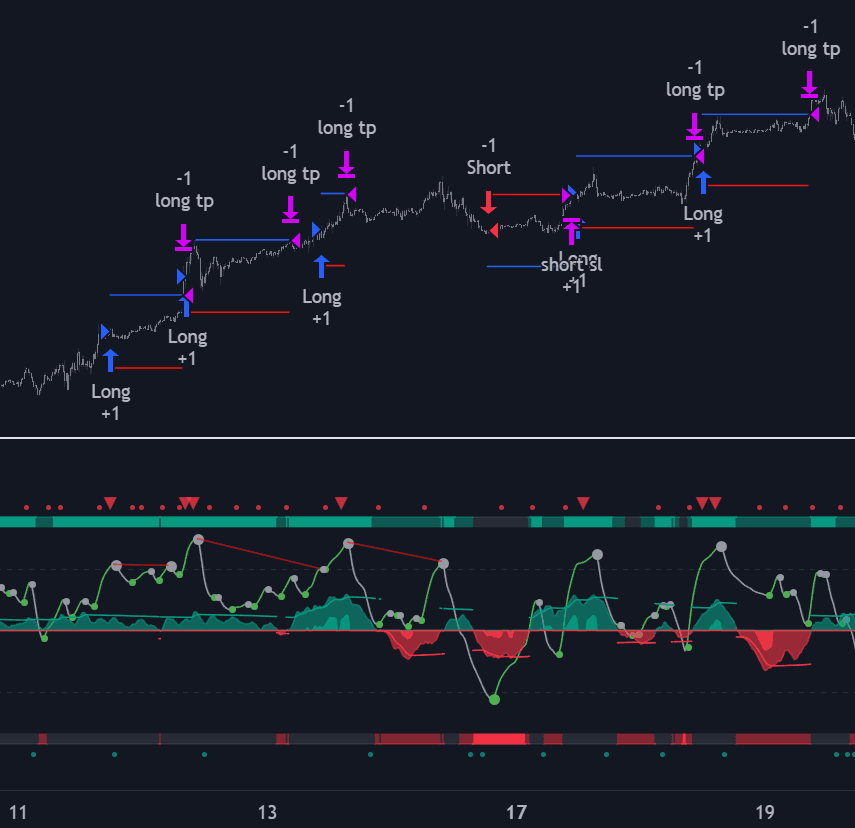
The Backtester (OSC) is the strategy-script companion to LuxAlgo's Oscillator Matrix™: it converts the toolkit's oscillators and signals into strategy entries and exits so momentum ideas can be measured instead of assumed. Trend-following and contrarian traders alike can encode their reading of the pane (a divergence into an oversold cross, a money flow filter, an overflow exhaustion) and see how the rules would have traded.
What's Inside the Backtester (OSC)?
- Step & Match algorithm: every condition carries a Step number; conditions on the same step are evaluated together as matching requirements, while different steps form an ordered sequence that opens a market order once its final step is true. Sequences and matches combine freely, so one stage can demand several simultaneous conditions.
- HyperWave conditions: the normalized adaptive oscillator that reflects price trends without excess noise provides crossings and level-based entries. The documented examples use crosses of 50 for entries and of 80/20 for exits.
- Smart Money Flow conditions: the participation oscillator whose readings above 50 suggest bullish market participants, below 50 bearish, usable as an entry condition or as a filter on other conditions.
- Overflow conditions: the derived overbought/oversold detector based on participant activity, flagging excess that often precedes reversals.
- Reversal signal and divergence conditions: proprietary reversal signals and real-time divergence detection act as direct entry triggers for contrarian strategies.
- Oscillator confluence: a condition expressing how aligned the toolkit's oscillators currently are, for strategies that only act on agreement.
- External sources: any external indicator can define entries, exits, or take-profit/stop-loss triggers, for example TP/SL levels set a multiple of ATRs away from entry, or conditions built on another LuxAlgo toolkit's features.
- Complete alert system: every strategy action can notify you, with per-action custom messages via the Alert Messages settings and defaults otherwise.
How to Trade with the Backtester (OSC)?
- Start from a documented template: the contrarian example enters long on a HyperWave bullish divergence matched with an oversold HyperWave under 20, and short on the bearish mirror, a two-condition match that captures reversal logic cleanly.
- Filter trend entries with participation: another documented strategy goes long on the HyperWave crossing over 50 while money flow is bearish (deliberately hunting early turns), with profit exits on the HyperWave crossing 80 or 20.
- Sequence multi-stage setups: steps express "this, then that" (for example a reversal signal only counting after a prior condition completes), which is how the script encodes ordered confluence rather than coincidental overlap.
- Add explicit risk boundaries: take-profit and stop-loss conditions from external sources, such as levels a fixed number of ATRs from entry, keep win rates and losses interpretable across instruments.
- Make the test honest before reading it: the published preview runs on daily data with a 10,000 balance, 10% equity orders, a commission approximating the instrument's average spread, and slippage, and the authors strongly recommend adjusting Strategy Properties to your own account and market, since defaults such as 1-contract sizing exist only for broad instrument compatibility.
Key Settings & Modes
- Step dropdown beside each condition: selects matching versus sequenced evaluation.
- Entry conditions from HyperWave, Smart Money Flow, Overflow, reversal signals, divergences, confluence, and external sources, for both long and short sides.
- Exit conditions including long/short take-profit exits (the documented "long exit tp" / "short exit tp" pattern) and external TP/SL sources.
- Alert Messages: custom message field per strategy action, defaults when unset.
- Strategy Properties: balance, order size, commission, and slippage. Align these with your account before interpreting any statistic.
Frequently Asked Questions
The Library is free. Quant makes it yours.
Pull any concept or indicator into Quant: rebuild it, retune it, or turn it into a backtested strategy of your own.