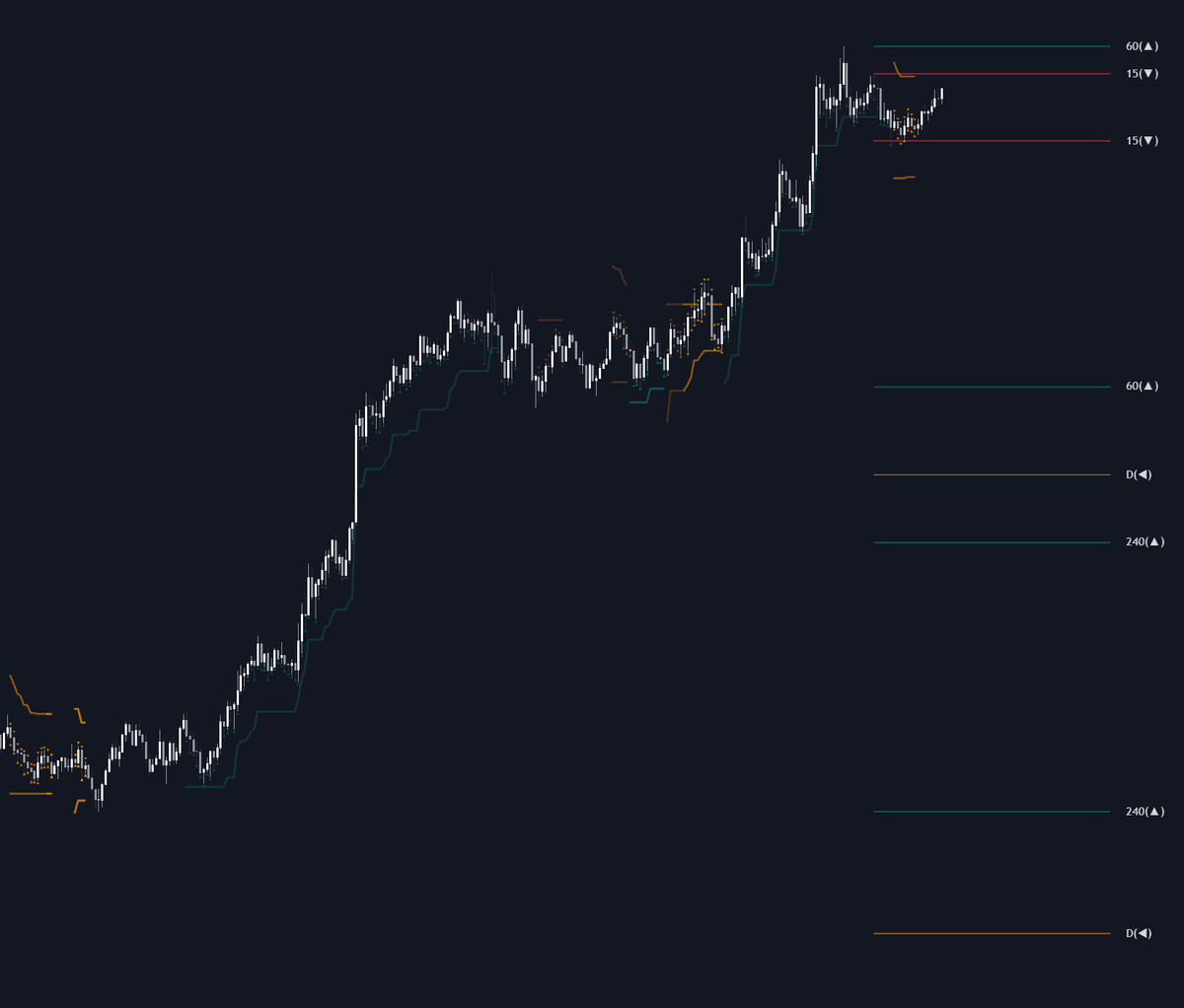
Multi Timeframe Market Formation
By LuxAlgoJan 15, 2025
The Multi Timeframe Market Formation tool is a powerful trading indicator designed to simplify multi-timeframe analysis for traders. By enabling the examination of up to six different timeframes at once, this tool equips traders with the ability to discern current market formations, support and resistance levels, and the synchronization degree with the primary chart timeframe.
How to Trade with Multi Timeframe Market Formation?
This trading tool conveniently displays the formation of the current chart's timeframe along with up to five additional formations from higher timeframes. A standout feature of this tool is its ability to highlight when the chart formation synchronizes with any enabled timeframe formation by showing labels and a visually striking trailing channel. The default gradient visibility enhances as more timeframes are synchronized, providing traders with a clearer picture of market behavior.
It's crucial to note that all timeframes enabled in the settings must be higher than the chart's timeframe, or an error message will be displayed, ensuring accurate analysis.
Understanding Formations
Formations define market structure through upper and lower boundaries, also known as support and resistance levels. The tool categorizes each formation with distinct symbols and colors for easy identification, offering traders an instant understanding of current market dynamics.
Formation Types:
- BULLISH (green ▲): Characterized by a higher high and higher low, indicating upward momentum.
- BEARISH (red ▼): Defined by a lower high and lower low, signaling downward trends.
- CONTRACTION (orange ◀): Occurs with a lower high and a higher low, suggesting market indecision.
- EXPANSION (blue ▶): Shows a higher high and lower low, pointing to increased volatility.
- SIDEWAYS (yellow ◀): Represents any pattern not fitting the other categories, indicating stagnation.
Exploring Multi Timeframe Formations
Within this tool, up to six different timeframe formations can be displayed, including the chart's timeframe and five additional configurations set via the settings panel. Each formation defines upper and lower levels, a specific timeframe, color, and icon style.
When several formations share a boundary level, the tool aligns the timeframes and symbols on a single line, marking these shared levels as particularly noteworthy for traders.
Synchronization with Chart Timeframe
The tool showcases real-time synchronization whenever the current chart timeframe's formation aligns with any of the other configured timeframes. This synchronization is visualized through increased label visibility and a highlighted trailing channel, providing traders with a consolidated view of market behaviors across multiple timeframes.
Settings Overview
The tool settings offer flexible customization to optimize trading strategies for any trader's preference or market condition.
- Formation Size: Adjusts the size of visualized market formations specific to the chart timeframe.
Timeframe Adjustments
- TF1 to TF5: These settings allow activation or deactivation of additional timeframes, size adjustments of market formations, and toggling of high and low levels.
Styling Preferences
- Show Labels: Toggle the display of synchronized timeframe labels.
- Transparency Gradient: Option to enable or disable the transparency gradient effect for visual clarity.
- Show Trailing Channel | Multiplier: Control the visibility of the trailing channel and adjust its multiplier for enhanced analysis.
- Formation Colors: Customize colors for different market formations, aiding in pattern recognition.
FAQ
How can I access the Multi Timeframe Market Formation tool?
You can get access on the LuxAlgo Library for charting platforms like TradingView, MetaTrader (MT4/MT5), and NinjaTrader for free.
What are the benefits of using multi-timeframe analysis?
Multi-timeframe analysis provides a more robust view of market dynamics by correlating high and low points across different periods, enhancing trading precision and decision-making.
Why is synchronization important in market formations?
Synchronization between timeframes indicates strengthening trends and potential movement continuations, providing traders with strategic entry and exit points.
Free indicator
Get free access to this indicator on the platforms below.
The Library is free. Quant makes it yours.
Pull any concept or indicator into Quant: rebuild it, retune it, or turn it into a backtested strategy of your own.