Concept
Break of Structure
Break of Structure is a Market Structure concept. The Library holds 19 implementations, each one a working definition you can pull into Quant.
BOS
Top Break of Structure indicators
The top custom implementations, built on the original standard Break of Structure formula.
19 total
From studying Break of Structure to trading it: take any implementation below into Quant and backtest it instantly.
.png&w=3840&q=75)
.png&w=3840&q=75)
What is a Break of Structure?
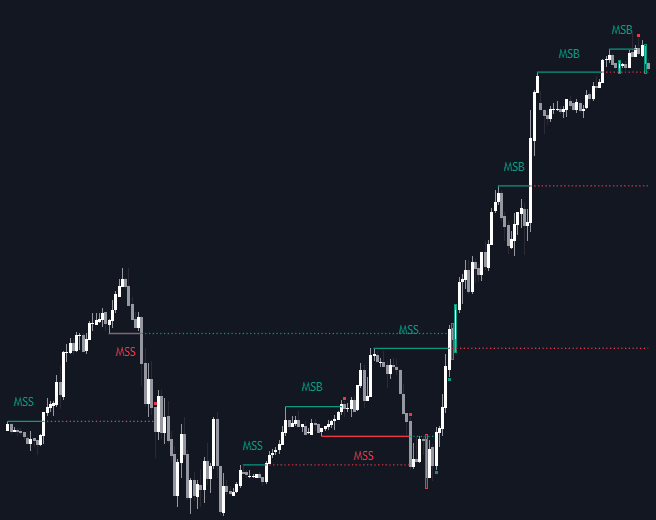
A break of structure (BOS) is a with-trend structural break. In an uptrend it is price trading through the most recent significant swing high; in a downtrend, through the most recent swing low. In Smart Money Concepts vocabulary the direction is the point: a BOS continues the prevailing trend, while the counter-trend equivalent is a change of character. Some sources use BOS loosely for any structural break; the with-trend reading is the common one.
Confirmation conventions vary and are worth pinning down before trading them. Many traders require a candle body to close beyond the swing, because a wick-only poke frequently turns out to be a liquidity sweep that reverses. Quality matters too: a break delivered with displacement, an energetic candle sequence that leaves imbalances behind, carries more weight than a grinding, overlapping push through the level.
The BOS matters because it is the structural heartbeat of a trend. Each one confirms the impulse leg, re-anchors the active range, and hands the trader fresh reference zones: the leg that produced the break leaves behind order blocks and fair value gaps that continuation traders wait to see revisited, with the broken swing itself as the natural invalidation.
How to identify a Break of Structure
A BOS only exists relative to a mapped trend, so the map comes first and the event second.
- 1Map the swings and establish the prevailing trend from the label sequence: higher highs and higher lows for an uptrend, the reverse for a downtrend.
- 2Watch the most recent confirmed swing in the trend direction: the last swing high in an uptrend, the last swing low in a downtrend.
- 3Mark the BOS when price breaks that swing under your confirmation rule. A body close beyond the level is the common filter against wick-only sweeps; stricter rules also demand displacement through it.
- 4Re-anchor afterward: the pullback that follows defines the new protected swing, and the zones left by the breaking leg become the entry map for continuation.
How traders use it
- As trend confirmation: each fresh BOS extends the trend's structural case, and an unbroken sequence of them is about the cleanest definition of one-sided delivery a chart offers.
- As an entry framework: rather than chasing the break itself, continuation traders wait for the retracement into the order block or imbalance left by the breaking leg, where risk can be defined against the structure.
- As trade management: the swing that produced the BOS becomes the invalidation, so a structure stop trails from broken swing to broken swing as the trend advances.
- As a multi-timeframe filter: a higher-timeframe BOS sets directional bias while internal structure on lower timeframes supplies entries in that direction.
Break of structure vs related concepts
Change of Character: The directional twin: a BOS breaks structure with the trend and suggests continuation; a CHoCH breaks against it and warns the trend may be turning. Same mechanics, opposite message.
Breakout: Breakout is the generic term for any decisive level break: ranges, pattern boundaries, round numbers. A BOS is the structure-specific case where the level is the latest with-trend swing and the meaning comes from trend context.
Liquidity Sweep: A sweep pokes through the swing and closes back inside, reading as stop collection; a BOS trades through and holds. The close is what separates them, and it only resolves after the fact.
False Breakout: A false breakout is what a failed BOS becomes in hindsight: the break printed, continuation never came, and price re-entered the prior range, often trapping entries taken on the break.
More Break of Structure implementations
- Market Structure Oscillator
- Structure & Trend Dashboard
- Swing Breakout Sequence
- Smart Money Concepts (SMC)
- Market Structure Targets Model
- Market Structure Trailing Stop
- Liquidity Structure & Order Flow
- Market Structure & Scatter Dashboard
- Market Structure Volume Distribution
- Multi Timeframe Market Formation
- Pure Price Action Structures
- Volumetric Order Flow Structure
- Market Structure CHoCH/BOS (Fractal)
- Market Structure with Inducements & Sweeps
- ICT Anchored Market Structures with Validation
- Market Structure Break & OB Probability Toolkit
Concept family
Market Structure
31 concepts mapped · 31 in the Library
Break of Structure FAQ
Turn Break of Structure into a trading strategy.
Take any implementation from this page into Quant, then build on it, backtest it on real data, and keep refining it in conversation.