Parabolic SAR Oscillator
 By LuxAlgoJul 11, 2022
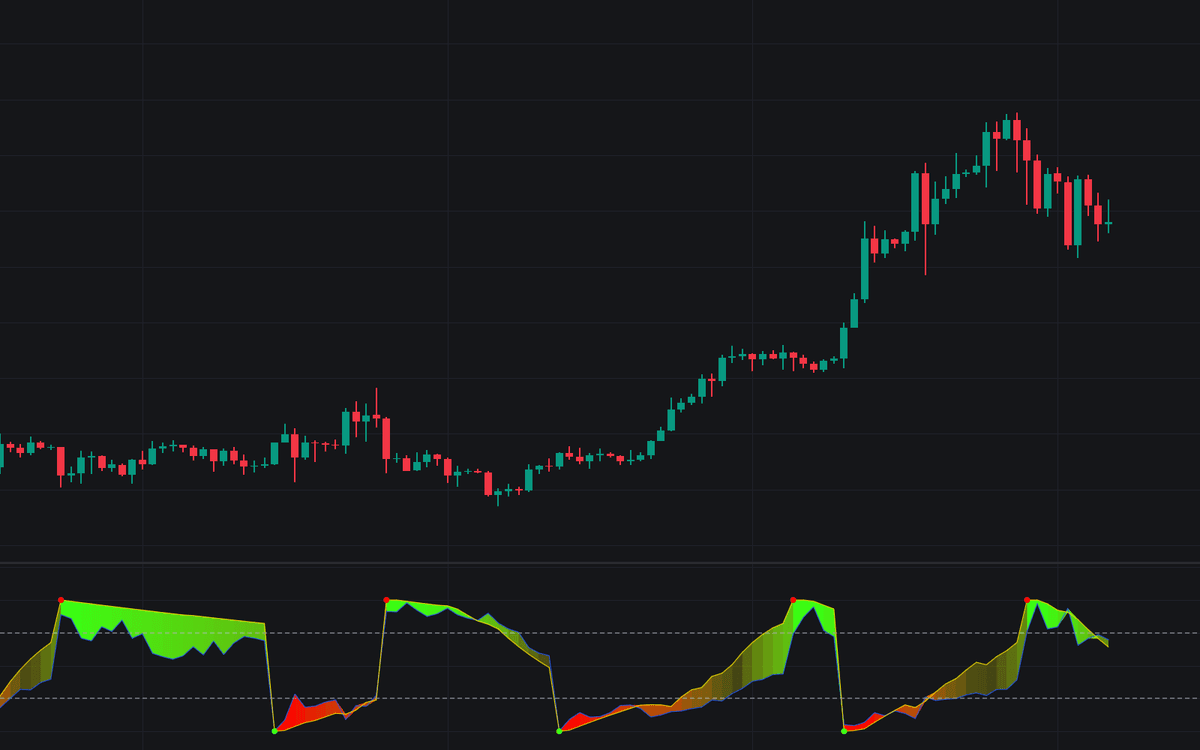

Parabolic SAR Oscillator re-expresses the Parabolic SAR trailing stop as a detrended, bounded oscillator. Price is detrended by subtracting the close from the SAR value, and the result is normalized into a fixed -100 to 100 range, a smooth, noise-free series that makes the SAR's leading, trend-anticipating character easier to read than dots on price.
Note the polarity: because the SAR trails beneath price while a market rises, the bullish extreme sits at -100, the reverse of most overbought and oversold scales.
How to Trade the Parabolic SAR Oscillator?
- Reading pinned at -100: strong confirmation of an up-trending market.
- Reading pinned at 100: the mirror case: the SAR is tracking above price in a downtrend.
- Cross of the 0 line: an early cue that the trend may be reversing, arriving before the opposite extreme is reached.
Because the output is bounded, the same -100, 0, and 100 reading rules apply on any symbol or timeframe, and the detrended series sits naturally alongside other oscillator work.
Parabolic SAR Oscillator Settings
- Start: initial value of the convergence factor when a new trend is detected: how early the SAR engages.
- Increment: growth of the convergence factor, controlling sensitivity to trend development.
- Maximum: cap on the convergence factor, preventing over-extension in fast markets.
Frequently Asked Questions
Free on Vela
Run it on Vela. Go further with a paid plan.
- Up to 500 strategy alerts, with webhook automation
- Up to 10× the chart history of Free
- Orderflow lookback up to full history
- Up to 100,000 monthly credits for Quant to customize it
- Futures data alongside crypto, stocks, forex and commodities
Also works on

Run it on Vela. Make it yours with Quant.
Open this indicator free on Vela, our next-generation charting platform. Then ask Quant, our coding agent built into Vela, to retune it or turn it into a backtested strategy of your own.