Volume-adjusted MA
 By LuxAlgoJun 7, 2026
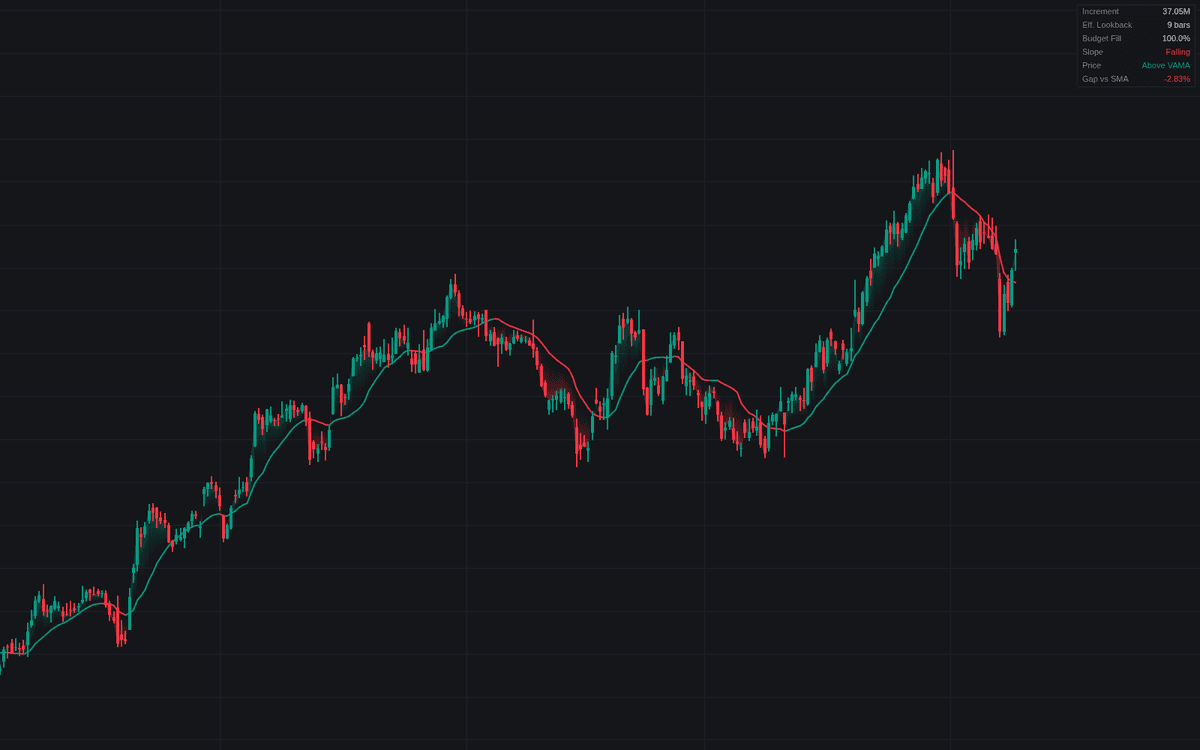

Volume-adjusted MA is the exacting rebuild of Richard Arms' elastic average: instead of averaging the last N bars, it averages the last N increments of business. One increment equals average bar volume times Arms' 0.67 factor, each bar's weight is its volume divided by that increment, and the volume-adjusted moving average stretches across as many bars as spending the budget requires: a handful when tape is busy, far more in drift. The line colors by slope, an optional SMA overlays the time-weight benchmark, and a dashboard reports the increment size, effective lookback, budget fill, and gap versus the SMA.
How to Trade the Volume-adjusted MA?
- Rising / falling slope: a participation-weighted trend read. Quiet bars barely move the line.
- Price crossing the line: the classic moving-average cross, weighted by activity; both directions carry alerts and optional markers.
- Gap versus the Comparison SMA: the lines separate where heavy trade disagrees with the calendar; pair crossings have their own alerts.
It slots into the trend toolkit anywhere a time-based average would sit.
Volume-adjusted MA Settings
- Source (default close): the price each bar contributes.
- Length (Volume Increments) (default 20): the volume budget N, measured in increments rather than bars.
- Increment Factor (default 0.67): Arms' published scaling; raise for longer reach, lower for a faster window.
- Average Volume Sample (default All Bars (Arms)): the whole-history mean, or Fixed Window via Sample Length (default 100).
- Max Lookback (Bars) (default 500): caps the elastic reach; the dashboard's budget fill shows when it binds.
- Comparison SMA (default disabled), SMA Length (default 20): the time-weight benchmark.
- Dashboard and style toggles cover slope coloring, line width, the gradient fill, and crossing markers.
Frequently Asked Questions

The Library is free. Quant makes it yours.
Pull any concept or indicator into Quant: rebuild it, retune it, or turn it into a backtested strategy of your own.