Elastic Volume-weighted MA
 By LuxAlgoMay 13, 2026
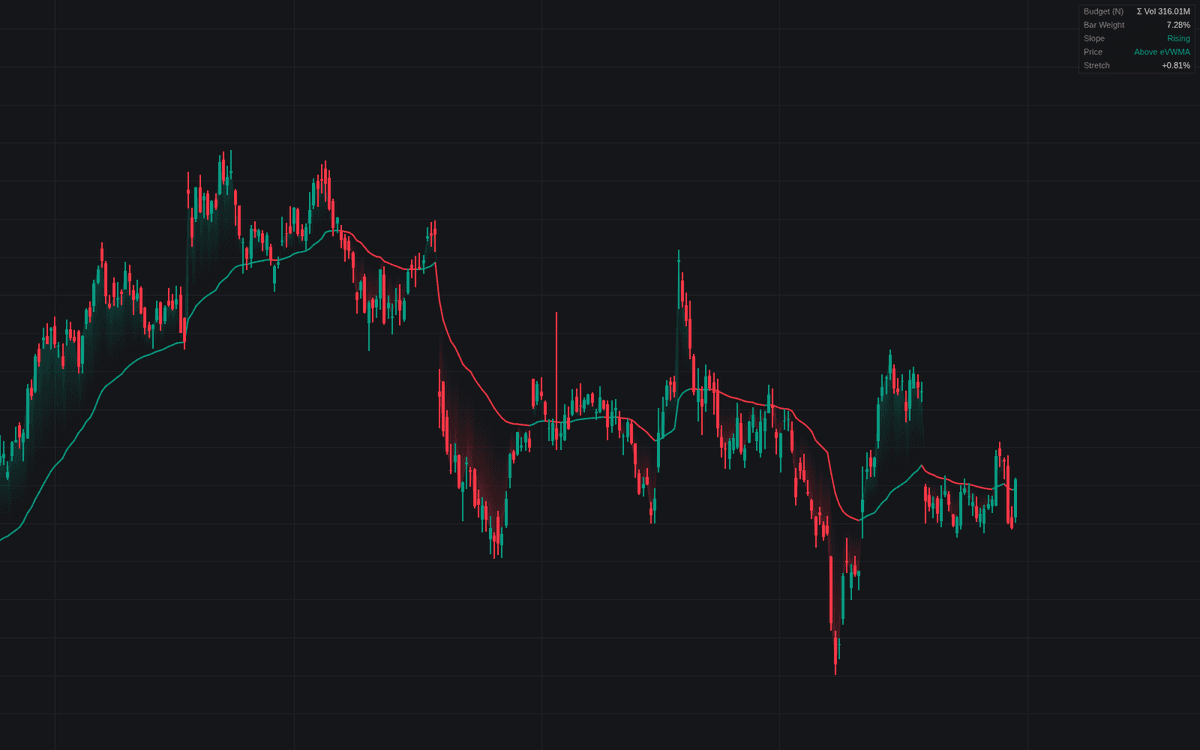

Elastic Volume-weighted MA runs Christian Fries' recursion, in which volume rather than time decides how fast the average moves: each bar rewrites a share of the line equal to its volume divided by a budget N: heavy bars relocate the line, quiet bars barely touch it, zero-volume bars leave it unchanged. It implements the elastic volume-weighted moving average with both budget conventions plus an optional slower pair line, a comparison EMA and a stretch read.
How to Trade the Elastic Volume-weighted MA?
- Slope color: the participation-weighted trend read. Only volume-backed moves turn the line quickly; slope reversals are alertable.
- Price side and crossings: the standard bias read against a volume-aware baseline, alertable with optional markers.
- Pair crossings: the optional fast/slow pair runs on one volume clock, so thin-trade drift struggles to trigger crossings.
- Stretch beyond the threshold: with a float budget the line approximates the holder base's average entry, so a stretch flags large open profits or losses: context, not timing.
Elastic Volume-weighted MA Settings
- Source (default close).
- Volume Budget (N) (default Cumulative Volume (Lookback)): Shares Outstanding (Float) uses the float instead, with an automatic fallback where share data is missing.
- Budget Lookback (default 20): bars of volume summed into the cumulative budget.
- Budget Multiplier (default 1): scales the summed volume; ignored in float mode.
- Second eVWMA (default disabled) with Second Budget Multiple (default 4): the slower half of the crossover pair.
- Comparison EMA (default disabled) with EMA Length (default 39): a matched-speed conventional average.
- Stretch Threshold % (default 10): the distance beyond which the stretch alerts fire.
- Show Dashboard (default enabled); Slope Trend Coloring and the gradient fill default on, Price Crossing Markers off, Line Width 2.
Frequently Asked Questions

Original indicatorBuilt in-house by LuxAlgo
The Library is free. Quant makes it yours.
Pull any concept or indicator into Quant: rebuild it, retune it, or turn it into a backtested strategy of your own.