Volume Anchored Price Map

Feb 16, 2026

Static chart image
Volume Based
Dashboard
Liquidation
Liquidity
Works on the following platforms:
tradingviewSymbolTradingView
For free use on the TradingView platform
ninjatraderNinjaTrader
For free use on the NinjaTrader platform
metatrader4MetaTrader 4/5
For free use on the MetaTrader 4/5 platform
thinkorswimThinkorswim
For free use on the Thinkorswim platform

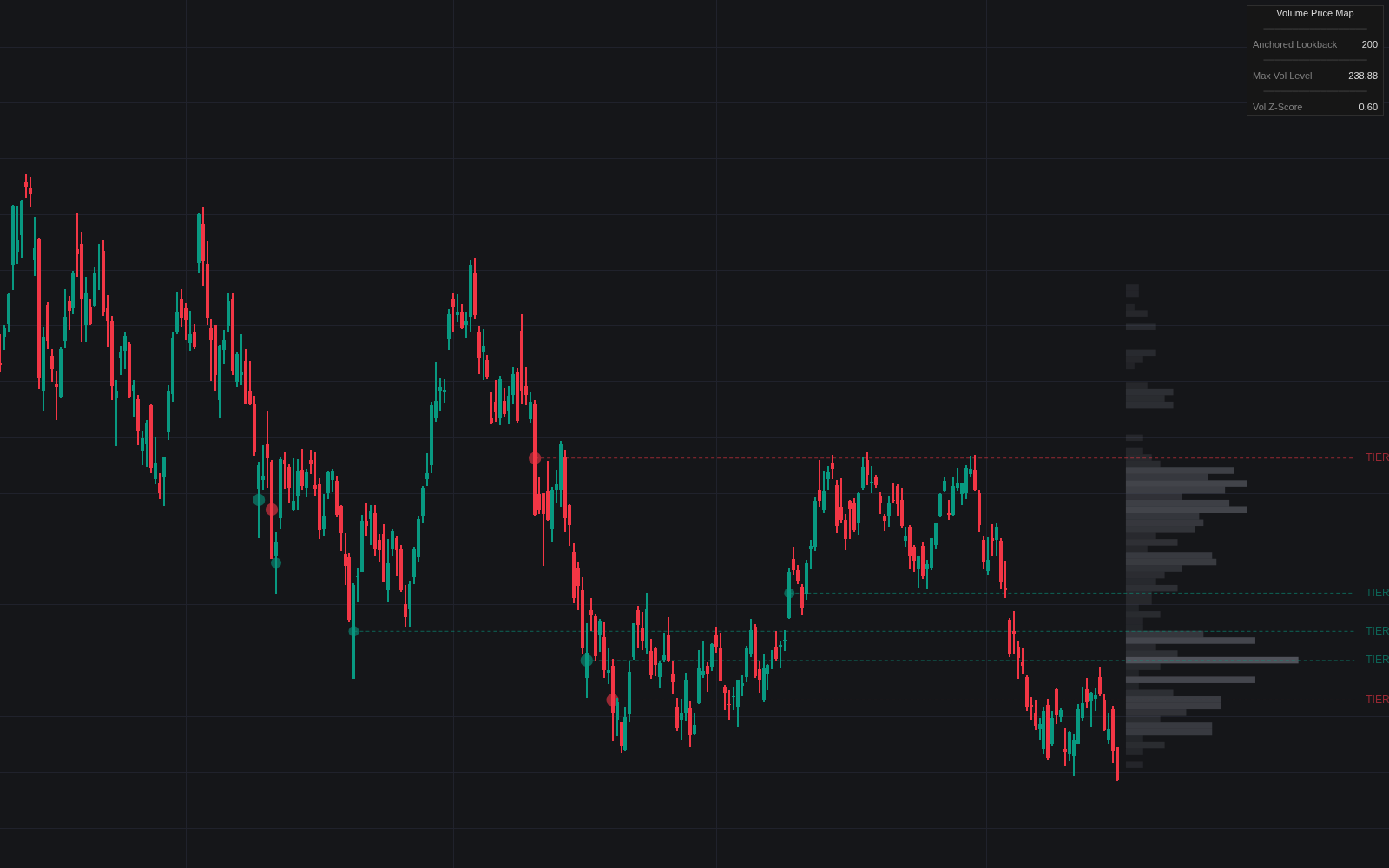
The Volume Anchored Price Map indicator is an advanced trading indicator built to reveal where institutional trading activity is most concentrated relative to current price. By combining a dynamic Volume Profile heatmap with statistically validated volume spikes (Z-Score Volume Bubbles), this tool helps traders identify high-probability support and resistance zones, liquidity clusters, and breakout areas driven by real participation—not just price movement.

Designed for serious traders seeking institutional-grade context, this indicator transforms raw volume data into a structured trading strategy framework for identifying Smart Money activity, absorption, exhaustion, and high-conviction liquidity levels.

How to Trade the Volume Anchored Price Map Indicator

This trading indicator provides a multi-layered view of market structure by combining:

  • A retrospective Volume Profile (Price Map heatmap)
  • Statistically significant Volume Bubbles
  • Projected liquidity tiers (TIER I, II, III)

Together, these components allow traders to distinguish between normal price fluctuations and meaningful institutional participation.

Identifying Institutional Support and Resistance

Projected dashed lines labeled by TIER act as a liquidity roadmap. These levels are generated from statistically significant volume events and represent areas where large market participants have previously transacted heavily.

  • TIER I (Extreme) levels often act as major structural support or resistance.
  • TIER II (High) levels reflect strong institutional positioning.
  • TIER III (Significant) levels mark notable participation zones.

When price revisits a TIER I level, traders should anticipate a strong reaction—either a sharp reversal or a high-momentum breakout. These zones frequently behave as institutional defense levels.

This makes the indicator especially powerful for:

  • Reversal trading strategies
  • Breakout confirmation systems
  • Liquidity sweep analysis
  • Institutional order flow alignment

Spotting Absorption and Exhaustion

The Volume Bubbles provide real-time statistical insight into abnormal participation using Z-Score analysis.

Large bubbles often signal critical turning points:

  • Exhaustion: Large red bubbles at the end of a downtrend may indicate capitulation or selling climax.
  • Absorption: Large green bubbles near highs can signal institutional supply absorption or potential blow-off tops.

Because the bubbles are based on standard deviations from average volume, they filter out noise and highlight only statistically meaningful spikes. This helps traders avoid false signals from minor volume increases.

Understanding Market Speed Through the Price Map

The Price Map profile visualizes volume distribution across price levels.

  • High Volume Nodes (Wide / Bright Bars)
    These are “sticky” areas where price consolidates. Markets tend to slow down here because participants agree on value.

  • Low Volume Areas (Thin Bars)
    These zones typically lead to fast price movement due to lack of historical participation. Breakouts often accelerate through these areas.

This distinction helps traders design strategies around market speed:

  • Fade moves into high-volume zones.
  • Ride momentum through low-volume corridors.

Practical Trading Strategies Using the Indicator

Filter Price Action with Confluence

Look for TIER I or TIER II levels that align with the widest High Volume Nodes in the profile. This confluence marks high-probability “Fair Value” zones where institutions have historically positioned.

These areas are ideal for:

  • Pullback entries
  • Structured stop placement
  • Scaling strategies

Mean Reversion Setup

When price deviates far into a Low Volume Area and a large Volume Bubble forms, it often signals exhaustion.

In this case:

  1. Identify the nearest High Volume Node.
  2. Wait for confirmation (rejection candle or structure shift).
  3. Target a move back toward the high-volume center.

This approach leverages liquidity imbalance and value reversion.

Breakout Confirmation Strategy

A decisive candle close above or below a projected TIER level—especially when accompanied by a new Volume Bubble—suggests institutional participation in the new direction.

This helps traders:

  • Avoid false breakouts.
  • Confirm expansion phases.
  • Filter momentum trades with volume validation.

DETAILS

Price Map (The Gradient Histogram)

The indicator looks back over a user-defined window and calculates total volume traded at each price bin. It then plots a right-anchored gradient histogram.

  • Brighter and wider bars = High Volume Nodes (HVN)
  • Thinner bars = Low Volume Areas (LVN)
  • POC (Point of Control) = Maximum traded volume level

This creates a volume-based map of fair value and liquidity concentration.

Volume Bubbles (Z-Score Statistical Analysis)

Instead of displaying raw volume, the script uses Z-Score normalization to measure how extreme a volume spike is relative to its historical average.

Bubble size scales dynamically:

  • Tiny
  • Small
  • Medium
  • Large
  • Huge

Only statistically significant deviations are displayed, helping traders focus on true institutional events rather than background noise.

Projected Anchor Levels and Liquidity Tiers

When a significant volume spike occurs, the price is “anchored” and projected forward as a structural level.

Tiers are classified by standard deviation strength:

  • TIER I (Extreme): > 6 standard deviations – Major liquidity events.
  • TIER II (High): 4 to 6 standard deviations – Strong institutional interest.
  • TIER III (Significant): 2 to 4 standard deviations – Noteworthy participation.

These levels serve as dynamic support/resistance, breakout filters, and institutional reaction zones.

SETTINGS

Price Map Profile

  • Lookback Length – Defines the historical window for profile and bubble calculation.
  • Price Bins – Controls vertical resolution. Higher values increase detail.
  • Show Price Map Profile – Toggle the heatmap visibility.
  • Profile Color – Adjusts the base gradient color.

Volume Bubbles

  • Show Volume Bubbles – Enables or disables statistical circles.
  • Bubble Sensitivity (Z-Score) – Sets the minimum deviation threshold.
  • Project Levels from Bubbles – Turns anchor projections on or off.
  • Max Projected Levels – Limits visible active liquidity levels.
  • Label Horizontal Offset – Prevents TIER label overlap.

Dashboard

  • Enable Dashboard – Displays key metrics including:
    • Lookback window
    • POC (Maximum Volume Level)
    • Current Z-Score
  • Position / Size – Adjusts dashboard placement and scaling.

Why This Trading Indicator Matters

Most traders rely purely on price action. The Volume Anchored Price Map enhances decision-making by integrating:

  • Statistical volume validation
  • Liquidity mapping
  • Institutional anchor levels
  • Volume-based breakout confirmation
  • Mean reversion detection

This makes it a complete trading strategy framework rather than just a visual overlay.

By aligning entries with statistically significant participation, traders can increase precision, improve risk management, and better understand where Smart Money is active.

FAQ

What is the Volume Anchored Price Map trading indicator?

It is a volume-based trading indicator that combines a dynamic Volume Profile heatmap with Z-Score validated volume spikes to identify institutional liquidity zones, support/resistance levels, and high-probability breakout or reversal areas.

Is this indicator suitable for all markets?

Yes. It can be used on stocks, crypto, forex, indices, and futures markets. Because it relies on volume distribution and statistical deviation, it adapts to any market with reliable volume data.

How do Volume Bubbles improve a trading strategy?

They highlight statistically abnormal volume events, helping traders detect exhaustion, absorption, and institutional participation. This reduces reliance on raw volume and improves signal quality.

How do I access the Volume Anchored Price Map indicator?

You can get access on the LuxAlgo Library for charting platforms like TradingView, MetaTrader (MT4/MT5), and NinjaTrader for free.

Trading & investing are risky and many will lose money in connection with trading and investing activities. All content on this site is not intended to, and should not be, construed as financial advice. Decisions to buy, sell, hold or trade in securities, commodities and other investments involve risk and are best made based on the advice of qualified financial professionals. Past performance does not guarantee future results.

Hypothetical or Simulated performance results have certain limitations. Unlike an actual performance record, simulated results do not represent actual trading. Also, since the trades have not been executed, the results may have under-or-over compensated for the impact, if any, of certain market factors, including, but not limited to, lack of liquidity. Simulated trading programs in general are designed with the benefit of hindsight, and are based on historical information. No representation is being made that any account will or is likely to achieve profit or losses similar to those shown.

Testimonials appearing on this website may not be representative of other clients or customers and is not a guarantee of future performance or success.

As a provider of technical analysis tools and strategies, we do not have access to the personal trading accounts or brokerage statements of our customers. As a result, we have no reason to believe our customers perform better or worse than traders as a whole based on any content, tool, or platform feature we provide.

Charts used on this site are by TradingView in which the majority of our technical indicators are built on. TradingView® is a registered trademark of TradingView, Inc. www.TradingView.comTradingView® has no affiliation with the owner, developer, or provider of the Services described herein.

Market data is provided by CBOE, CME Group, BarChart, CoinAPI. CBOE BZX real-time US equities data is licensed from CBOE and provided through BarChart. Real-time futures data is licensed from CME Group and provided through BarChart. Select cryptocurrency data, including major coins, is provided through CoinAPI. All data is provided “as is” and should be verified independently for trading purposes.

This does not represent our full Disclaimer. Please read our full disclaimer.

© 2026 LuxAlgo Global, LLC.