Wavelet Decomposition
 By LuxAlgoJun 18, 2026
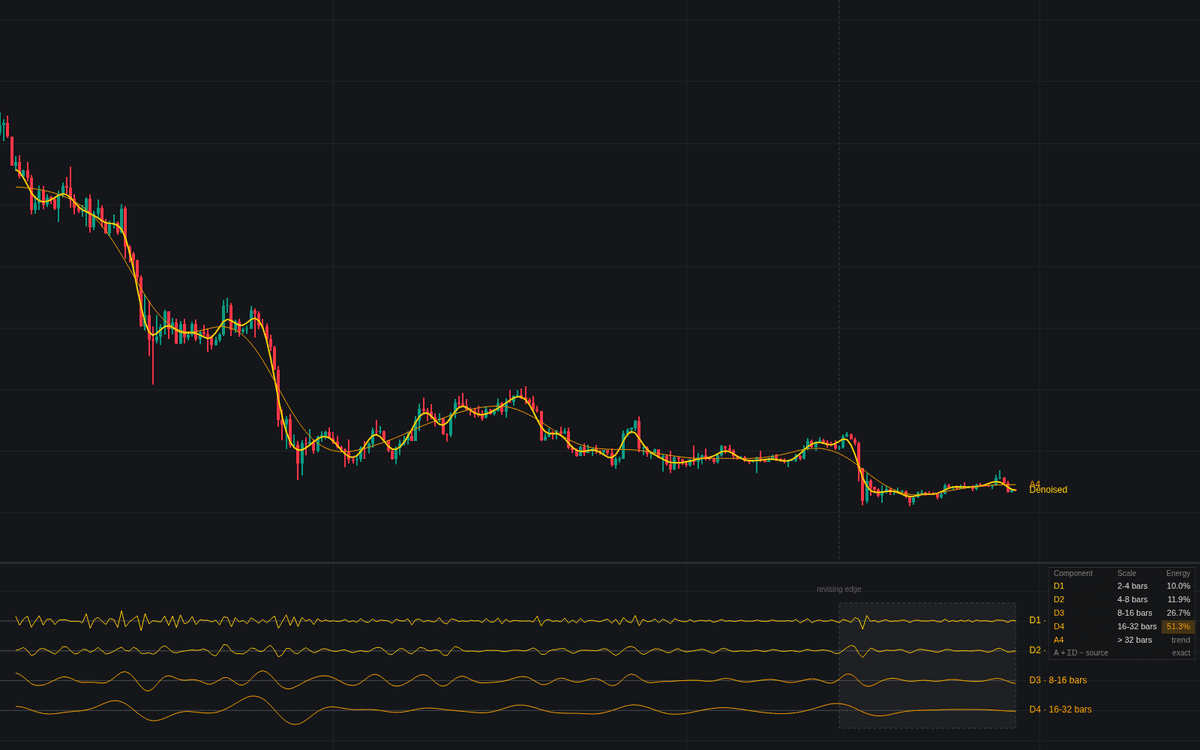

Wavelet Decomposition takes a series apart by timescale and proves the parts add back up, the library's first faithful implementation of wavelet decomposition. A shift-invariant transform splits a rolling window into detail levels, each an octave of fluctuation (D1 spans 2-4 bars, D2 4-8, and so on), plus an approximation of everything slower. Details stack in the pane on a shared amplitude scale, denoised and trend reconstructions draw over price, and an energy table ranks the scales, its last row verifying the additive identity.
How to Trade the Wavelet Decomposition?
- Denoised crosses: price crossing the denoised reconstruction (approximation plus surviving details) is alerted both ways.
- Trend turns: the approximation's slope flipping sign is alerted, the trend-extraction use.
- Dominant scale: the strongest table shading marks the level with the most detail energy; a shift there is alerted.
- Boundary zone: the shaded right edge comes from padded data and revises, provisional by construction.
Wavelet Decomposition Settings
- Source (default close): the series decomposed.
- Analysis Window (default 256): rolling bars the pyramid recomputes over.
- Levels (J) (default 4): depth, auto-reduced when the deepest filter no longer fits the window.
- Wavelet Family (default Daubechies-4): Haar is simplest and most edge-friendly; Daubechies filters smooth more with wider boundary effects.
- Boundary Handling (default Reflection): mirror the sample edges, or wrap with Periodic.
- Suppress Finest Levels (K) (default 2) and Denoise Mode (default Suppress): zero the K fastest levels, or shrink their coefficients with Soft Threshold's median-based universal threshold.
- Display (all on): Denoised Reconstruction, Trend (Approximation), Detail Stack, Energy Table and Boundary Zone; Line Width (default 2).
Frequently Asked Questions

Original indicatorBuilt in-house by LuxAlgo
The Library is free. Quant makes it yours.
Pull any concept or indicator into Quant: rebuild it, retune it, or turn it into a backtested strategy of your own.