AI Tools like ChatGPT in Algorithmic Trading
AI tools such as ChatGPT can help with algorithmic-trading research, strategy specifications, code drafting and analysis. Their value depends on the data and tools available, the quality of the instructions and the checks applied to the result. A persuasive explanation or generated script is not evidence of a profitable strategy.
Start with a concrete question: what information is available, what rule should be tested, and what result would count as useful evidence? Keep research, code execution, backtesting and broker orders distinct. An assistant can support several stages without making them interchangeable.
- Research: summarize dated sources and separate facts from interpretation.
- Specify: turn a broad idea into explicit entry, exit, size and timing rules.
- Implement: draft code for the actual platform and inspect its behavior.
- Evaluate: check calculations, data coverage, costs and independent test periods.
- Operate: use a separately configured execution system with documented controls and monitoring.
What ChatGPT Can Contribute
ChatGPT is an AI assistant built around language models and available tools. Its official feature documentation includes browsing, files, images and plugins. It is therefore inaccurate to describe every workflow as limited to historical training knowledge. Access to current information depends on the enabled tools and the sources actually retrieved.
A current web page is still different from a licensed streaming market feed. Check publication time, retrieval time, venue, price timestamp and whether the information was available at the historical decision point. A model’s training knowledge is not a current quote, and browsing does not establish low-latency execution.
Similarly, an assistant with suitable data and computation tools may perform calculations or run an analysis. OpenAI’s data-analysis workflow example describes checking source data and showing supporting calculations. That capability does not establish that a particular trading backtest was run correctly. Ask for the actual code, inputs, assumptions and outputs.
| Task | Useful AI contribution | Evidence still required |
|---|---|---|
| Market research | Summarize filings, news and supplied records | Original source, dates, units and complete context |
| Strategy development | Identify ambiguous rules and propose testable alternatives | A clear hypothesis and a comparison that was not selected after repeated hindsight |
| Coding | Draft or explain platform-specific logic | Compilation, meaningful behavior checks and supported APIs |
| Backtest review | Inspect assumptions and calculate metrics from supplied results | Reproducible data, execution model and separate evaluation periods |
| Execution | Assist with a deliberately configured integration | Account authorization, broker state, risk controls and operational checks |
Traditional algorithms can also process text, operate on historical data or adapt parameters. Language models are not exclusively qualitative, and conventional algorithms are not exclusively live order routers. Compare the implementation and task rather than treating “AI” and “standard algorithm” as two fixed capability sets.
Start with a Strategy Specification
A broad instruction such as “build a profitable bot” leaves the model to invent important details. Specify the instrument, timeframe, data source, signal calculation, order timing, exits, sizing and evaluation period. Ask it to identify missing information before writing code.
A prompt for turning an idea into rules
“Turn this hypothesis into a testable specification: a fast moving average crossing above a slow moving average on completed daily candles. List the entry and exit conditions, earliest executable order time, warm-up requirement, position limits and missing-data behavior. Mark every unresolved parameter as a question. Do not claim profitability or invent test results.”
This produces a specification to review, not a recommendation to trade a crossover. Decide whether the rule uses a completed bar, how an existing position affects the next signal and what happens if data is stale. A chart that looks attractive after the fact does not resolve these questions.
For a mean-reversion idea using Bollinger Bands, define the averaging period, deviation calculation and thresholds. If a platform reports %B, establish whether it uses a 0–1 scale or percentages. A setting copied from a favorable historical example may fail on another feed, timeframe or cost structure.
A prompt for reviewing an implementation
“Review this code against the attached specification. Identify look-ahead information, repainting or incomplete-bar assumptions, repeated entries, incorrect units and unhandled order states. Show specific discrepancies and small test cases. Preserve the rules unless I explicitly approve a strategy change.”
Distinguish fixing a coding error from changing the strategy. Keep the previous working version and record what changed. A model may produce syntactically plausible calls that are unavailable in the target runtime, so check the actual documentation and compiler output.
Use LuxAlgo for Native Chart Research
Begin with LuxAlgo’s native charts and data coverage to inspect the instrument, session and timeframe. Keep that context with the strategy notes so tests can be compared on consistent assumptions.
Ask Quant, our coding agent to implement the specification. Inspect the generated code and run it yourself. Check the plotted entries and exits against the intended behavior before interpreting performance.
Use native strategy testing with standard candles, realistic costs and separate development and evaluation periods. Request focused revisions and retain the prior version. A successful run demonstrates what happened under that test configuration, not how future live orders will perform.
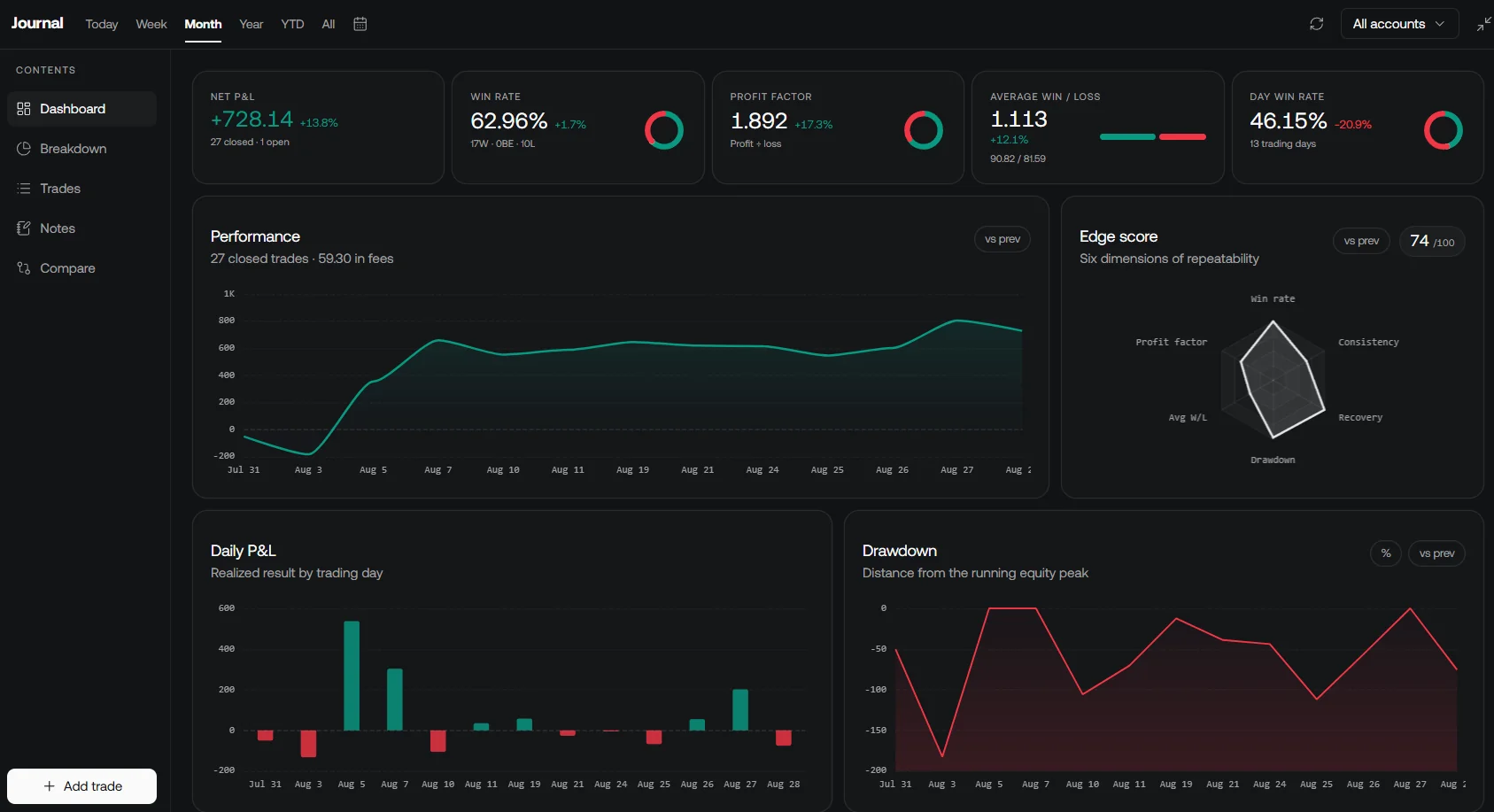
Review compatible trade records in the native LuxAlgo journal alongside the specification and change log. Use broker records to reconcile actual orders, fills and positions.
Evaluate News and Financial Documents Carefully
AI can help extract dates, company names, reported figures and themes from supplied documents. Ask it to link each material statement to the source and distinguish an author’s opinion from a reported event. Check that the article or filing concerns the intended company and reporting period.
A source-focused research prompt
“Using only these dated sources, summarize the reported event, the publication time and the evidence for each statement. Separate facts, interpretations and unresolved questions. Identify stale or conflicting information. Do not infer a trading signal or invent missing figures.”
For sentiment analysis, define the labels before scoring a sample. Review negation, quotations, sarcasm, duplicated stories and whether a headline refers to past or expected events. A positive label is not a forecast of a positive return. Evaluate whether the label adds information beyond what was already reflected in price.
Historical news testing requires the version and timestamp available at the time, not a later corrected article. Deduplicate syndicated reports and avoid using future explanations of an event as if they were known beforehand. If a source cannot be obtained or verified, mark that gap instead of supplying a plausible substitute.
What FinanceBench Actually Shows
The FinanceBench paper, submitted in November 2023, studied financial question answering. Its authors evaluated 16 model configurations on 150 cases and reported that a GPT-4-Turbo retrieval configuration answered incorrectly or refused to answer 81% of questions. That is a result for a specified historical setup, not a current ChatGPT error rate or a measure of trading profitability.
The practical lesson is to evaluate the complete workflow: document retrieval, evidence selection, arithmetic and the final explanation. Supplying a source does not guarantee the model uses it correctly. A confident answer should be checked against the relevant passage and calculation.
For example, if a hypothetical company reports revenue rising from $80 million to $100 million, growth is ($100 million − $80 million) ÷ $80 million = 25%. Dividing by the ending value instead produces 20%, a different measure. Check the denominator, currency, period and whether the figures use comparable accounting definitions.
Validate Strategies Beyond the Generated Answer
Develop on earlier data, choose settings using a defined validation process and reserve a final chronological evaluation period. Fit scaling, imputation and feature selection inside the training process. A walk-forward design can help respect timing, but repeated experimentation can still overfit the selection process.
Require a record of the data coverage, code version, indicator warm-up, order timing, position accounting and costs. A result stated in prose is not a completed test. If the assistant could not run the code or access the data, the response should say so explicitly.
A backtest-review prompt
“Review this test report and code. State the dataset, dates, timeframe, entry timing and cost assumptions. Recalculate trade count, gross and net results, average gain and loss and drawdown from the supplied records where possible. Identify what cannot be verified. Compare with the stated baseline without selecting a new rule using the final test period.”
Payoff example: a hypothetical strategy with 60 wins of $20 and 40 losses of $25 makes $200 before costs across 100 trades. If round-trip costs average $3, the $300 cost turns that into a $100 loss. A 60% win rate alone does not establish an edge.
Inspect weak periods, turnover and sensitivity to assumptions as well as favorable returns. A strategy that beats a benchmark in one selected backtest is not evidence that AI-generated strategies generally outperform. Paper trading adds order and timing checks, but simulated fills can differ from real liquidity and execution.
Check Platform Compatibility and Permissions
Name the target environment in coding requests. An MT5 Expert Advisor uses a different environment from a TradingView script or an external broker API. A platform having an API does not mean your ChatGPT session already has a supported connection, credentials or permission to trade.
Confirm the actual runtime, supported language, available data and deployment method before describing an integration as compatible. Indicators, alerts, strategy simulations and live orders can have different capabilities even inside the same product. Ask for documented interfaces rather than accepting an invented function or endpoint.
| Boundary | What to verify |
|---|---|
| Source access | Which files, sites and market feeds were actually accessed, with their timestamps |
| Code execution | Whether the code ran in the intended runtime and what the observed output was |
| Account integration | Supported broker, environment, permissions and paper/live configuration |
| Risk control | Position sizing, combined exposure, order state and incident response |
| Data handling | Who may access the inputs, what may be shared and applicable retention settings |
Keep secrets and unnecessary personal or confidential information out of prompts and shared logs. Use approved data sources and access settings appropriate to the work. A plugin, connector or external application introduces its own permissions and handling rules; review the actual setup rather than assuming every tool behaves alike.
Regulatory obligations depend on jurisdiction, activity and role. Trading one’s own account, operating a brokerage and providing investment advice are different activities. AI output does not certify compliance with broker terms, market-data licenses or applicable rules. Check requirements relevant to the actual workflow rather than treating a general AI guideline as universal permission.
Keep Human Review Focused and Repeatable
Set clear limits for size, exposure and operational failures before deployment. A stop trigger is not a guaranteed fill, and pausing new entries does not necessarily cancel pending orders or close existing positions. Verify the broker’s actual state after an incident or reconnect.
Log the model or tool configuration where available, the prompt, source data, generated code, test result and reviewer decision. When a model, data feed or platform changes, rerun representative checks. Changes in output can come from the tooling as well as the market.
Choose improvements by observed need: faster evidence extraction, fewer coding errors or clearer test review. Adding models, increasing trading frequency or automatically retuning after losses does not guarantee better performance. Forecasts about industry adoption do not substitute for evidence from your own controlled evaluation.
Original MT5 Coding Demonstration
This BKTraders video, published January 12, 2025, demonstrates using ChatGPT while building MT5 trading bots. Treat its interface and examples as a dated walkthrough. Review generated code, consult the current platform documentation and test the exact rules yourself; a tutorial demonstration is not proof of future returns.
Frequently Asked Questions
Can ChatGPT access current market information?
It can retrieve current information when suitable tools and sources are available. Verify the actual source and timestamp. Browsing is not the same as a licensed streaming market feed.
Can an AI assistant run a backtest?
With suitable computation tools, code and data, an assistant may run an analysis. Verify the actual execution, assumptions and outputs; a described result is not evidence that a test occurred.
Does generated trading code prove a strategy works?
No. Compilation and logic checks are only part of evaluation. Data timing, costs, separate test periods, execution assumptions and risk controls also matter.
Is FinanceBench’s 81% figure a current ChatGPT error rate?
No. It refers to a particular GPT-4-Turbo retrieval configuration evaluated in the 2023 FinanceBench study. It is not a general rate for current models or trading decisions.
How should LuxAlgo Quant fit into the workflow?
Use native charts to establish context, ask Quant to implement explicit rules, inspect the generated code and run it yourself. Keep strategy research, alert workflows and live broker execution distinct.
Read next