Brokerage Accounts for a Secure Retirement

A taxable brokerage account is the account most retirement plans leave out. It has no contribution limit, no age rule on withdrawals and no required distributions, which makes it the natural place for savings that exceed what a 401(k) or IRA will accept, and for money that may be needed before age 59½. It also has no tax shelter, so every dividend and realized gain is reported in the year it happens. This guide sets the brokerage account beside the tax-advantaged accounts using SEC, IRS and FINRA sources, explains the 2026 contribution limits and the withdrawal rules that make the accounts different, and shows how Quant Charts can help with the allocation, monitoring and review work that all of them share.
What a Brokerage Account Is
The SEC defines a brokerage account as an investment account at a registered brokerage firm that lets you buy and sell stocks, bonds, mutual funds and exchange-traded funds. It comes in two forms: a cash account, in which every purchase is paid in full, and a margin account, in which the firm lends against the securities in the account. Either can be held individually or jointly, and the same firm typically offers IRA accounts alongside them, so "brokerage account" in this article means the ordinary taxable account unless stated otherwise.
Tax-advantaged accounts, in the SEC's description, offer special tax benefits to encourage saving for specific purposes: tax deductions for pre-tax contributions, tax-deferred growth, or tax-free withdrawals. For retirement, the main types are employer plans such as 401(k), 403(b) and 457(b) plans, and individual retirement accounts you open yourself. The SEC notes that it does not regulate or oversee IRAs; the rules come from the Treasury and the IRS, and employer plans that receive employer contributions fall under ERISA and the Department of Labor.
Brokerage Account vs Traditional IRA vs Roth IRA vs 401(k)
| Feature | Taxable brokerage | Traditional IRA | Roth IRA | 401(k) |
|---|---|---|---|---|
| 2026 contribution limit | None | $7,500 ($8,600 at 50+) | $7,500 ($8,600 at 50+), income limits apply | $24,500 employee deferral ($32,500 at 50+; $35,750 at 60 to 63) |
| Contributions | After-tax | Often deductible; phased out for higher earners covered by a workplace plan | After-tax | Pre-tax (or Roth if the plan offers it) |
| Growth | Dividends and realized gains taxed yearly | Tax-deferred | Generally tax-free | Tax-deferred |
| Withdrawals before 59½ | No age rule | Taxed plus 10% additional tax unless an exception applies | Contributions may be withdrawn; earnings may be taxed and penalized | Taxed plus 10% additional tax unless an exception applies |
| Required minimum distributions | None | From age 73 | None during the owner's lifetime | From age 73 |
| Investment menu | Anything the broker offers | Anything the IRA custodian offers | Anything the IRA custodian offers | The plan's fund line-up |
The IRS figures above are from its November 2025 cost-of-living announcement for tax year 2026. The IRA catch-up for savers aged 50 and over is now indexed and stands at $1,100; the plan catch-up is $8,000, and a higher $11,250 catch-up applies at ages 60 through 63 under the SECURE 2.0 Act. The same combined IRA limit covers all of your traditional and Roth IRAs together.
Where the Brokerage Account Fits
The brokerage account earns its place through what the other accounts cannot do rather than through any tax advantage.
- Saving above the limits. Once the 401(k) deferral and the IRA contribution are used, additional savings have nowhere else to go. The brokerage account takes any amount.
- Money needed before 59½. IRS rules impose a 10% additional tax on early distributions from IRAs and employer plans unless an exception applies. A brokerage account has no such rule, which makes it the source for early retirement spending or large purchases without touching sheltered money.
- No forced withdrawals. Traditional IRAs and 401(k)s require minimum distributions from age 73, calculated as the prior year-end balance divided by an IRS life-expectancy factor. Brokerage assets can stay invested indefinitely, and Roth IRAs are also exempt while the owner is alive.
- Investment freedom. A 401(k) offers its plan menu; a brokerage account offers whatever the firm trades, including individual stocks and ETFs.
The cost is tax drag. Interest and non-qualified dividends are taxed as ordinary income, and every sale at a profit is a taxable event. Managing that drag is the main skill a taxable account demands.
Capital Gains, Losses and the Holding Period
The IRS taxes net capital gains at 0%, 15% or 20% depending on taxable income, with the rate applying to assets held more than one year. For 2025 the 0% rate applied to taxable income up to $48,350 for single filers and $96,700 for joint filers, and the 20% rate applied above $533,400 and $600,050 respectively. Gains on assets held one year or less are short-term and taxed at ordinary income rates, so holding period alone can change the tax on the same gain.
| Item | Treatment in a taxable account |
|---|---|
| Gain on a holding of more than one year | Long-term rate of 0%, 15% or 20% by taxable income |
| Gain on a holding of one year or less | Ordinary income rates |
| Realized losses | Offset realized gains; up to $3,000 of excess loss ($1,500 married filing separately) deducted against other income each year, remainder carried forward |
| Dividends | Qualified dividends at long-term rates; others as ordinary income |
Two practical consequences follow. A position that would be sold at a short-term gain is often worth holding past its one-year anniversary if the investment case still stands. And realized losses have value: they offset gains in the same year, up to $3,000 of them reduce other income, and any excess carries forward. Both decisions require knowing the purchase date and cost basis of each lot, which the broker's statements record.
Asset Location: Which Account Holds What
Because the accounts are taxed differently, the same portfolio produces different after-tax results depending on where each holding sits. The general logic:
- Tax-deferred accounts shelter holdings that throw off ordinary income or frequent gains: bonds, funds with high turnover, and strategies that trade often.
- Roth accounts suit assets expected to grow most, since qualified withdrawals are tax-free.
- Taxable accounts suit holdings that are already tax-efficient: broad index ETFs held for years, and stocks whose returns come mostly as long-term gains.
This is a placement decision, not a change to the overall allocation, and it depends on your bracket now and in retirement. The SEC's guidance on these accounts ends with the same advice: consult a tax professional about the rules and consequences that apply to you.
What FINRA Says About Employer Plans
FINRA's retirement account guidance highlights features that make an employer plan the first stop for most savers. Many plans match contributions up to a preset limit, and some now match repayments of qualified student loans. Plans established after December 29, 2022 must automatically enroll eligible employees at a preset rate, usually into a target-date or balanced fund, with the right to opt out. Fees and the plan's investment menu vary and affect long-run results. Once the match is captured and the deferral limit reached, the IRA and then the brokerage account absorb the rest.
Where Quant Charts Fits
LuxAlgo does not hold accounts, give tax advice or place orders. The account decisions above are yours and your tax adviser's. What Quant Charts adds is the portfolio-monitoring layer that every account type shares: seeing what you own, how it is spread, how its parts move together, and how a rule would have behaved before you commit to it.
See the allocation. The Watchlist Advanced view's Allocation panel draws an asset-allocation donut by asset class and a sector-exposure breakdown for the stocks and ETFs on the list. Load the holdings from each account as separate sections, and the concentration by sector is visible without a spreadsheet. The Financials tab lists dividend per share and yield for stocks, which is where the ordinary-income drag of a taxable account starts.
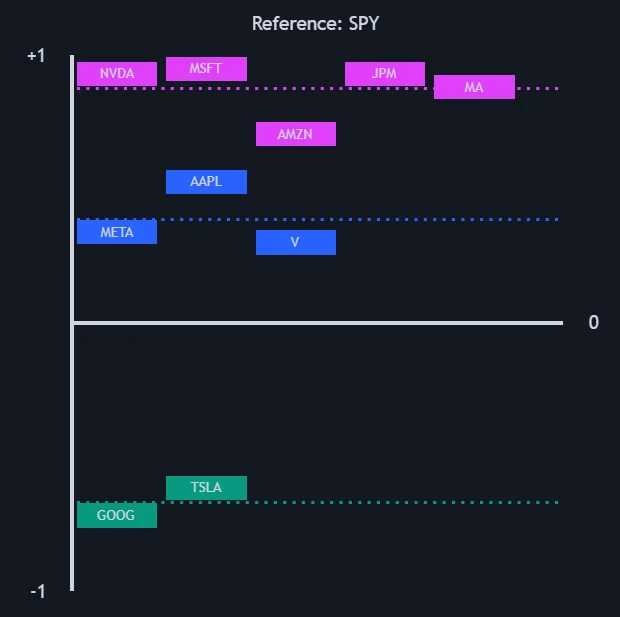
Check that diversification is real. Holding many funds is not the same as holding uncorrelated ones. The Library's correlation entry explains the measure, and the Correlation Clusters indicator takes up to ten tickers, measures each against a reference symbol and groups them into clusters that move alike. Funds that land in one cluster are one bet; a retirement portfolio spread across accounts can still be concentrated in a single cluster.
Test the rebalancing rule with Quant. Describe a rule to Quant, our coding agent, in plain language, for example holding a broad-market ETF and moving to a bond ETF when price closes below its 200-day average, returning when it closes above. Quant writes the Pine Script; open Code to inspect it, then click Run. The Backtest Summary reports net profit, trade count, win rate, max drawdown and profit factor, with commission and slippage set in the strategy's Properties. For a taxable account the trade count matters twice: each exit is a taxable event, and exits inside a year convert long-term gains into short-term ones, so compare the rule's turnover with buy-and-hold on the same symbol and timeframe before adopting it. The Library's drawdown statistics and Sharpe ratio entries explain the risk measures the summary is built on.
The video below shows how an indicator such as Correlation Clusters is added to a chart in Quant Charts.
Keep the accounts separate in the Journal. The Quant Charts Journal supports several accounts, including manual accounts with a starting balance, so taxable and retirement holdings can be logged and reviewed apart. Recording the purchase date with each fill makes the one-year holding-period check part of the review rather than a surprise at tax time.
Where Each Tool Stops
- The broker and plan administrator hold the accounts, report cost basis, dividends and gains, apply contribution limits and calculate required distributions.
- The IRS and your tax adviser determine deductibility, rates, penalties and exceptions for your situation.
- Quant Charts charts exchange-listed US equities and ETFs, shows allocation and sector exposure, measures correlation, backtests rules through Quant and keeps a journal. It does not connect to retirement accounts, track tax lots or place orders.
- The Library explains correlation, drawdown statistics and the Sharpe ratio, and provides indicators such as Correlation Clusters.
Conclusion
A brokerage account is not a substitute for a 401(k) or an IRA; it is the account that starts where they stop. It accepts unlimited contributions, imposes no age rule and no required distributions, and offers the widest investment menu, in exchange for paying tax on income and realized gains each year. Used deliberately, it holds the tax-efficient part of the portfolio, funds the years before 59½ and absorbs savings above the 2026 limits of $24,500 for a 401(k) and $7,500 for an IRA. Quant Charts covers the shared work of seeing the allocation, checking that holdings actually diversify, testing rules before they trade and keeping each account's record straight.
Key Takeaways
- A taxable brokerage account has no contribution limit, no early-withdrawal penalty and no required minimum distributions, but no tax shelter.
- 2026 limits: $24,500 for 401(k)-type deferrals and $7,500 for IRAs, with catch-ups of $8,000 and $1,100 at 50+, and $11,250 in plans at ages 60 to 63.
- Early distributions from IRAs and plans before 59½ generally carry a 10% additional tax; required distributions from traditional accounts start at 73; Roth IRAs have neither during the owner's life.
- Long-term gains are taxed at 0%, 15% or 20% by income; short-term gains at ordinary rates; excess losses offset up to $3,000 of other income with carryforward.
- Place tax-inefficient holdings in sheltered accounts and tax-efficient ones in the brokerage account, with professional advice on your own brackets.
- Quant Charts shows allocation and sector exposure, clusters holdings by correlation, backtests rules through Quant and journals each account separately; it does not hold accounts or give tax advice.
FAQs
Why use a brokerage account for retirement if it has no tax benefits?
Because it has no limits. It accepts savings above the 401(k) and IRA caps, can be drawn on before age 59½ without the 10% additional tax that applies to early retirement-account distributions, and has no required minimum distributions.
What are the 2026 contribution limits?
Per the IRS, $24,500 for employee deferrals to 401(k), 403(b), governmental 457 and TSP plans, with an $8,000 catch-up at 50 and over and $11,250 at ages 60 to 63; $7,500 for IRAs with a $1,100 catch-up. A taxable brokerage account has no limit.
Do brokerage accounts have required minimum distributions?
No. RMDs apply to traditional IRAs, SEP and SIMPLE IRAs and employer plans from age 73, calculated from the prior year-end balance and an IRS distribution period. Roth IRAs are also exempt while the owner is alive.
How are gains taxed in a brokerage account?
Assets held more than one year are taxed at long-term rates of 0%, 15% or 20% depending on taxable income; assets held one year or less are taxed as ordinary income. Losses offset gains, and up to $3,000 of excess loss reduces other income each year, with the rest carried forward.
Which investments belong in the taxable account?
Generally the tax-efficient ones: broad index ETFs and stocks held for years whose returns arrive as long-term gains. Bonds, high-turnover funds and frequently traded strategies usually fit better in tax-deferred accounts. Your own brackets decide, so confirm with a tax professional.
Can Quant Charts manage my retirement accounts?
No. It does not connect to retirement or brokerage accounts, track tax lots or place orders. It charts the listed securities you hold, shows allocation and sector exposure in Watchlist Advanced, clusters holdings by correlation, backtests rules through Quant and keeps a journal per account.
References
LuxAlgo Resources
- Correlation, Drawdown Statistics and Sharpe Ratio (LuxAlgo Library)
- Correlation Clusters indicator (LuxAlgo Library)
- Watchlist Advanced: Allocation and Financials (LuxAlgo Docs)
- Making strategies with Quant and Reading a strategy backtest (LuxAlgo Docs)
- Quant Charts Journal (LuxAlgo Docs)
External Resources
- SEC Investor.gov: Brokerage Accounts
- SEC Investor.gov: Tax-Advantaged Accounts
- SEC Investor.gov: Individual Retirement Accounts (IRAs)
- IRS: 401(k) limit increases to $24,500 for 2026, IRA limit increases to $7,500
- IRS: Retirement Topics, Tax on Early Distributions
- IRS: Retirement Topics, Required Minimum Distributions
- IRS Topic 409: Capital Gains and Losses
- FINRA: Retirement Accounts
Read next