Confirmation Bias in Trading: Examples and Impact

Confirmation bias in trading means favoring evidence that supports a view you already hold while discounting evidence that challenges it. It can affect which news you read, which indicators you trust and which backtest results you keep. The problem is the uneven treatment of evidence—not simply having a bullish or bearish opinion.
The APA definition emphasizes seeking supporting evidence while neglecting contradictory information. A practical trading response is to write down your hypothesis, its invalidation conditions and your evaluation method before seeing the outcome.
Use LuxAlgo’s native charts and Quant, our coding agent, to make rules and tests easier to inspect. Technology does not eliminate bias: prompts, data selection and repeated parameter changes can all reflect the conclusion you want to reach.
How Confirmation Bias Appears in Trading
The following examples are hypothetical. They illustrate decision processes, not a diagnosis of particular traders or an explanation for a historical market crash.
| Situation | Biased response | More useful check |
|---|---|---|
| You expect a breakout. | Count bullish indicators while dismissing a failed entry condition. | Apply the same written eligibility rules to every setup. |
| A backtest loses money. | Remove losing dates without a pre-existing reason. | Keep the full baseline and document any exclusion. |
| A position moves against you. | Search only for commentary predicting recovery. | Review the original invalidation and exposure limits. |
| An AI response supports your idea. | Accept it without checking the data or generated code. | Ask what would disprove the idea and verify the evidence. |
A trader might require a completed daily close above a prior high, then enter early because an intraday rally looks convincing. Adding RSI or a moving average afterward does not make the original condition true. Record the deviation even if the trade eventually wins.
Separate Related Biases from the Trading Result
Anchoring means placing too much weight on a reference point, such as an entry price. Recency bias involves overweighting recent experience. Confirmation bias concerns how evidence is selected or interpreted. These can overlap, but they are not interchangeable explanations for every loss.
A planned trade can lose despite correct execution. A rule-breaking trade can profit. Evaluate whether the decision used the information and rules available at the time, then evaluate the strategy’s outcomes across an appropriate sample. Judging the decision only after seeing the price move introduces hindsight.
How Selective Reasoning Can Change Risk
Moving a stop farther away or increasing a position can increase exposure, but there is no universal “two to three times” multiplier. Calculate the actual change.
For illustration, 100 shares with a $2 entry-to-stop distance represent $200 of planned price risk. Widening that distance to $5 while keeping 100 shares raises it to $500, or 2.5 times the original amount, before costs. A gap or poor fill can create a larger realized loss. This is arithmetic, not a recommended position size or risk budget.
Changing a rule is not automatically evidence of bias. The concern is changing it selectively to defend a position without assessing the new risk or recording the reason. Predefined adjustments and unplanned rationalizations should be distinguishable in your records.
Write a Test That Could Reject Your Idea
- State the hypothesis: Describe the market, timeframe and conditions precisely enough to identify qualifying trades.
- Define failure: Decide which evidence would cause you to reject or revise the idea. Use criteria appropriate to the strategy rather than a universal win-rate target.
- Keep the baseline: Record costs, sizing, exits and the original date range before trying variations.
- Preserve failed attempts: A winning variant selected from many attempts is different evidence from a single planned test.
- Reserve evaluation data: Do not repeatedly tune the strategy against the same supposedly independent period.
Seeking opposing evidence does not mean treating every rumor as equally credible. Apply the same standards of relevance, timeliness and source quality to claims that support and challenge your view. Sometimes the appropriate conclusion is that the evidence is insufficient.
Use Quant to Inspect Rules, Not Endorse a Prediction
Give Quant explicit entry, exit and risk conditions. Review the script in Code before Run, then inspect individual simulated trades. Inputs control exposed parameters; Properties control simulation assumptions such as capital, sizing, commission and slippage.
A useful request is: “Explain whether these rules use information unavailable at entry, identify ambiguous conditions, and show which assumptions affect the result.” Check the response against the code and data. A successful run does not prove the logic is correct, the sample is representative or the strategy will remain profitable.
Keep the strategy version and test settings with each result. Changing the timeframe until the chart looks favorable, omitting transaction costs or retaining only the best run can preserve confirmation bias inside an apparently systematic workflow.
Keep a Decision Record in Journal
Use the LuxAlgo Journal to review recorded trades, notes and tags. It belongs to your account rather than a particular workspace, and supports manual accounts, supported imports and available broker connections. Record the strategy version and your reason for acting alongside the outcome.
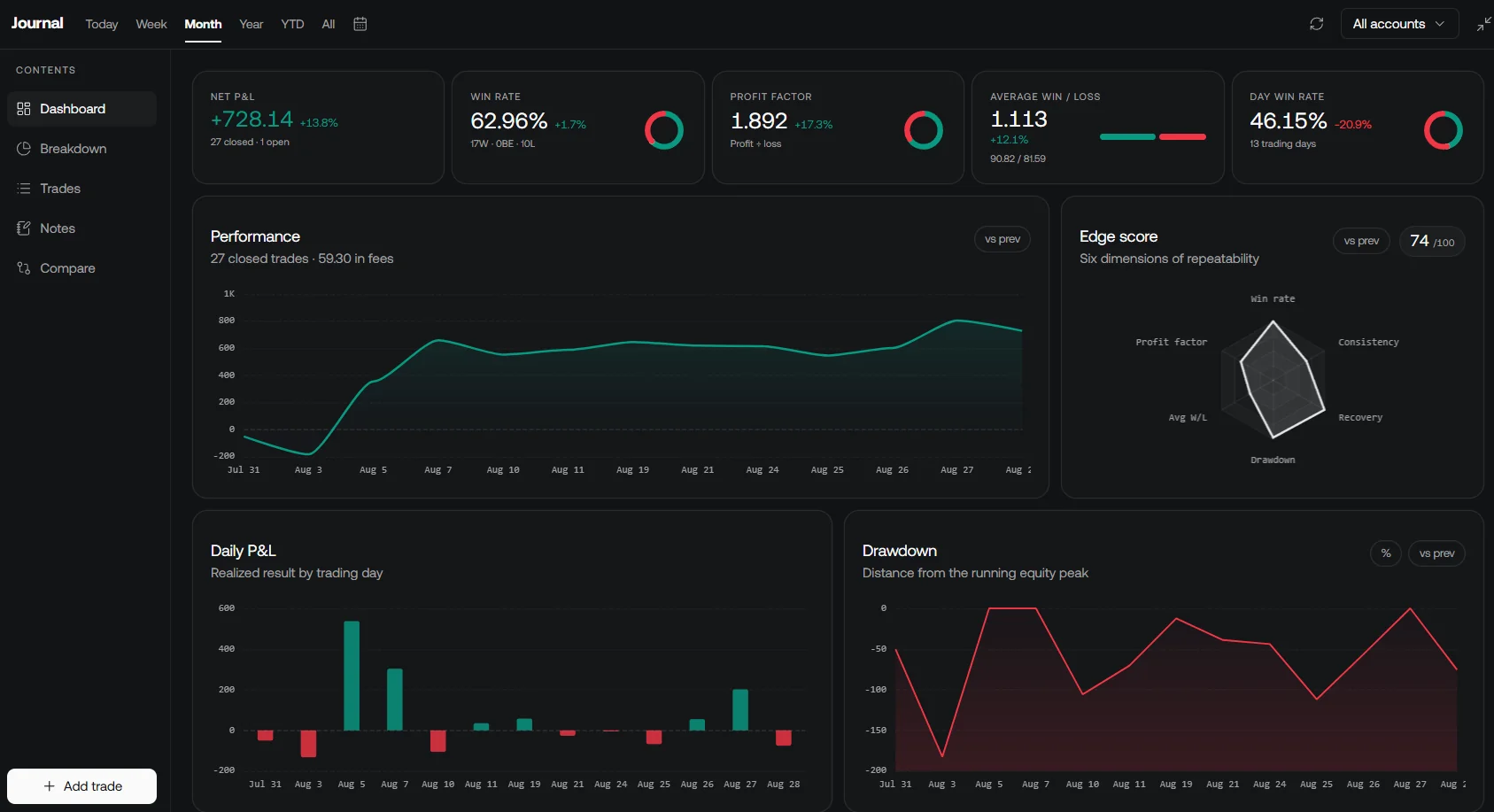
For each decision, note the supporting evidence, the strongest relevant counterevidence, the planned invalidation and any rule change. Record skipped setups separately when they do not create fills. Otherwise your review may include only the opportunities you chose to act on.
At a scheduled review, ask whether you applied the same standards to winners and losers. For example, did you dismiss a losing trade as “unusual” while keeping an equally unusual winner? Investigate the pattern before changing the strategy.
Make Peer Review Useful
Ask another trader to assess the rules and evidence before revealing the outcome where practical. Invite specific objections, such as a missing cost or a signal that uses an unfinished higher-timeframe bar. Agreement from a group is not independent validation if everyone relies on the same sources or shares the same position.
The aim is not certainty or emotion-free trading. It is a record that makes selective reasoning easier to notice. Combine clear rules, realistic tests and honest review so you can change your mind when the evidence warrants it.
FAQs
What is confirmation bias in trading?
Confirmation bias is favoring information that supports an existing trading view while discounting relevant contradictory evidence. It can appear in news selection, indicator interpretation and backtest selection. Written rules, documented counterevidence and consistent review can help expose it, but no tool guarantees its elimination.
Read next