Emotional Trading vs. Data-Driven Trading
The useful distinction between emotional trading and data-driven trading is how a decision is made and checked. An impulsive trade changes the plan because of urgency, fear, or excitement. An evidence-based process records the hypothesis, risk, and conditions for acting before evaluating the outcome.
Data does not eliminate bias, and having emotions does not make every decision wrong. A manually executed strategy can follow clear rules, while an automated strategy can embody poor assumptions. Use LuxAlgo’s native charts, Quant, our coding agent, and the Journal to make decisions easier to inspect rather than assume software makes them profitable.
Compare the Decision Process
| Situation | Unplanned reaction | Documented response |
|---|---|---|
| A trade loses | Increase the next position to recover quickly | Keep the established risk limit and review whether the trade followed the rules |
| Price moves without you | Chase because the move feels urgent | Check whether the entry is still valid at the current price |
| A headline appears | Act on an unverified interpretation | Verify the source and apply a defined event or risk rule |
| A backtest looks attractive | Select the best result and stop investigating | Inspect assumptions, costs, rejected trials, and another test period |
| A position moves against you | Move the stop because you hope it recovers | Follow the planned exit or a previously defined adjustment rule |
News, company fundamentals, and sentiment measures can all be inputs to a disciplined process. Technical indicators are not automatically superior data. What matters is whether the information is reliable, available at the decision time, and used through a rule you can evaluate.
Where Bias Can Enter
After a winning streak, confidence may encourage an unplanned increase in size. After a loss, the desire to avoid another loss may lead to hesitation—or to holding a position beyond its invalidation point. Record the behavior that changed rather than treating the emotion itself as a complete explanation.
Data-heavy workflows have their own traps. You can choose only favorable examples, keep adding filters until history looks good, or dismiss new evidence because it conflicts with a preferred strategy. A precise-looking number does not make the underlying sample representative.
Distinguish a process error from a strategy limitation. An entry before the planned trigger is a rule deviation. A losing trade that followed the specification may be an expected loss, an execution issue, or evidence that the strategy needs review. See when trading psychology is not the problem.
Before the Session: Make the Plan Observable
- Define the setup. Specify the symbol, interval, session, and observable entry condition.
- Define invalidation and exits. State what ends the idea and how orders should behave.
- Set the risk budget. Include position size, concurrent exposure, and any session loss limit.
- Define a pause rule. Decide what happens after a rule violation or operational problem.
- Schedule review. Record when you will assess changes instead of rewriting the plan after each trade.
Prepare a consistent native chart workspace. Check the data source and price interval before comparing examples. A clean layout can help you inspect the same conditions repeatedly, but it does not enforce risk limits.
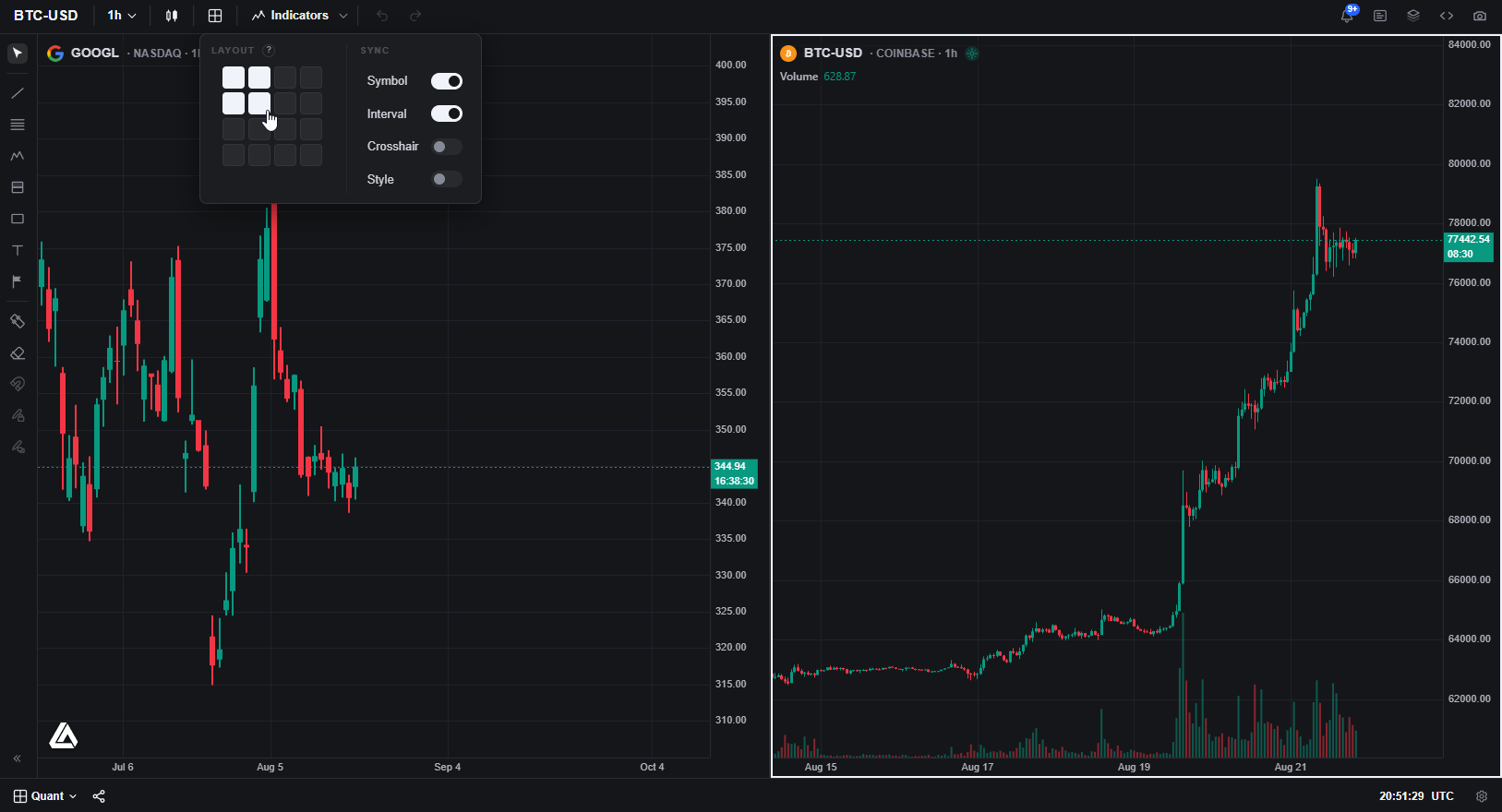
The short demonstration below shows switching workspaces. Use layouts to organize the research you actually need for the session.
Test the Rules with Quant
Describe explicit entry, exit, and risk conditions to Quant. Review the generated Code, then Run it on the intended chart. Inspect individual simulated trades to confirm that the implementation matches the specification.
Use Inputs for exposed parameters and Properties for simulation assumptions such as capital, order size, commission, and slippage. Read drawdown, trade count, profit factor, and the trade log alongside net profit and win rate. A syntax fix is not validation of the trading idea.
Compare a proposed change with the original baseline under consistent assumptions. Evaluate a separate period, and keep track of how many variations you tried. Otherwise, repeated tuning can turn random historical detail into an apparently convincing strategy. See in-sample and out-of-sample testing.
Historical simulation does not place protective orders in a brokerage account. Confirm the broker’s supported order types and execution behavior separately. Likewise, saving a Quant script does not automatically activate notifications or make every script portable without compatibility checks.
During the Session: Check the Trigger and Risk
When a decision feels urgent, pause new order entry long enough to answer: Has the trigger occurred? Is the idea still valid? Does the current price fit the risk budget? If not, a skipped trade may be the correct application of the plan.
A pause in new entries does not mean abandoning an open position. Continue its existing risk-management process. Stop orders can fill worse than expected during gaps or fast markets, so the planned stop distance is not a guarantee of the maximum loss. Review slippage when setting expectations.
Discretion can still be documented. If the plan permits a decision around an earnings event or a data outage, record the evidence and reason. A predefined exception is easier to assess than a justification written only after the result is known.
After the Session: Separate Process from Outcome
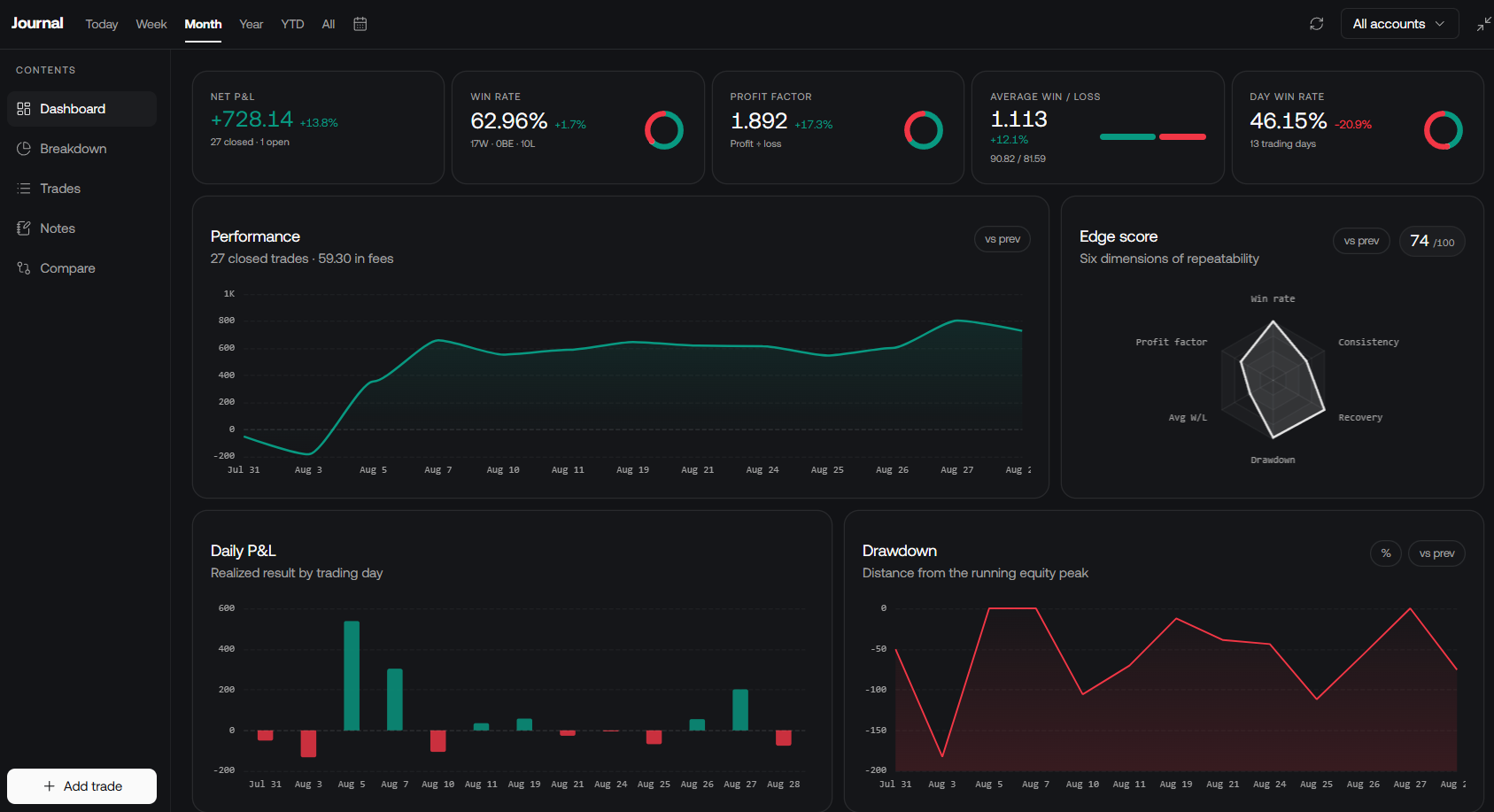
Use the LuxAlgo Journal to record fills and add decision notes. It supports manual records, statement imports, and supported broker connections. Your journal belongs to your account, and sharing a workspace does not include its private data.
| Process | Outcome | Review question |
|---|---|---|
| Followed the plan | Win | Was the implementation correct, and is the broader evidence still sound? |
| Followed the plan | Loss | Was this an expected loss, execution issue, or reason to investigate the strategy? |
| Departed from the plan | Win | Did a favorable result reward a behavior you did not intend to repeat? |
| Departed from the plan | Loss | What changed, and what practical control would address that deviation? |
Record relevant skipped setups separately: a fill-based log cannot infer trades you never took. Compare planned and unplanned entries over a meaningful sample, including fees and losses, rather than selecting a few memorable examples. Make changes at a scheduled review and preserve the prior version for comparison.
The aim is a process you can explain, test, and improve. Native charts, reviewed Quant strategies, and a journal can support that process, while evidence and risk controls remain essential.
FAQs
How can I avoid impulsive emotional trading?
Write entry, exit, and risk rules before trading, pause new entries when urgency changes the decision, and record deviations in a journal. Review behavior separately from profit or loss. Data and automation can support consistency, but they do not eliminate bias or guarantee profitable results.
Read next